🔄 Updated 21 Jun 2026
Ang Thong's well-known temples are spread across different districts. Wat Pa Mok sits to the south, right off the Ayutthaya road; Wat Khun Inthapramun is to the north in Pho Thong district; and Wat Muang is to the west in Wiset Chai Chan district. Order them well and you can drive a clean loop without backtracking past yourself. This plan starts with the temple closest to the entry point from Bangkok, then works through the rest, finishing at Wat Muang — the big photo highlight.
The one-day 3-temple plan
Ang Thong's 3 famous temples
Order it to save driving
If you come in via Ayutthaya, hit Wat Pa Mok first since it's right at the entry point, then work north to Khun Inthapramun and finish at Wat Muang in the west. That way you drive a loop without backtracking. On weekends Wat Muang gets busy through the late morning — going in the afternoon is quieter.
Book the activities in your Ang Thong trip ahead
Booking online ahead on Klook or GetYourGuide is usually cheaper than the gate and skips the queue. Pick only the experiences you actually want — prices and availability are shown live on each site.
Wat Muang — the giant Buddha you see from afar
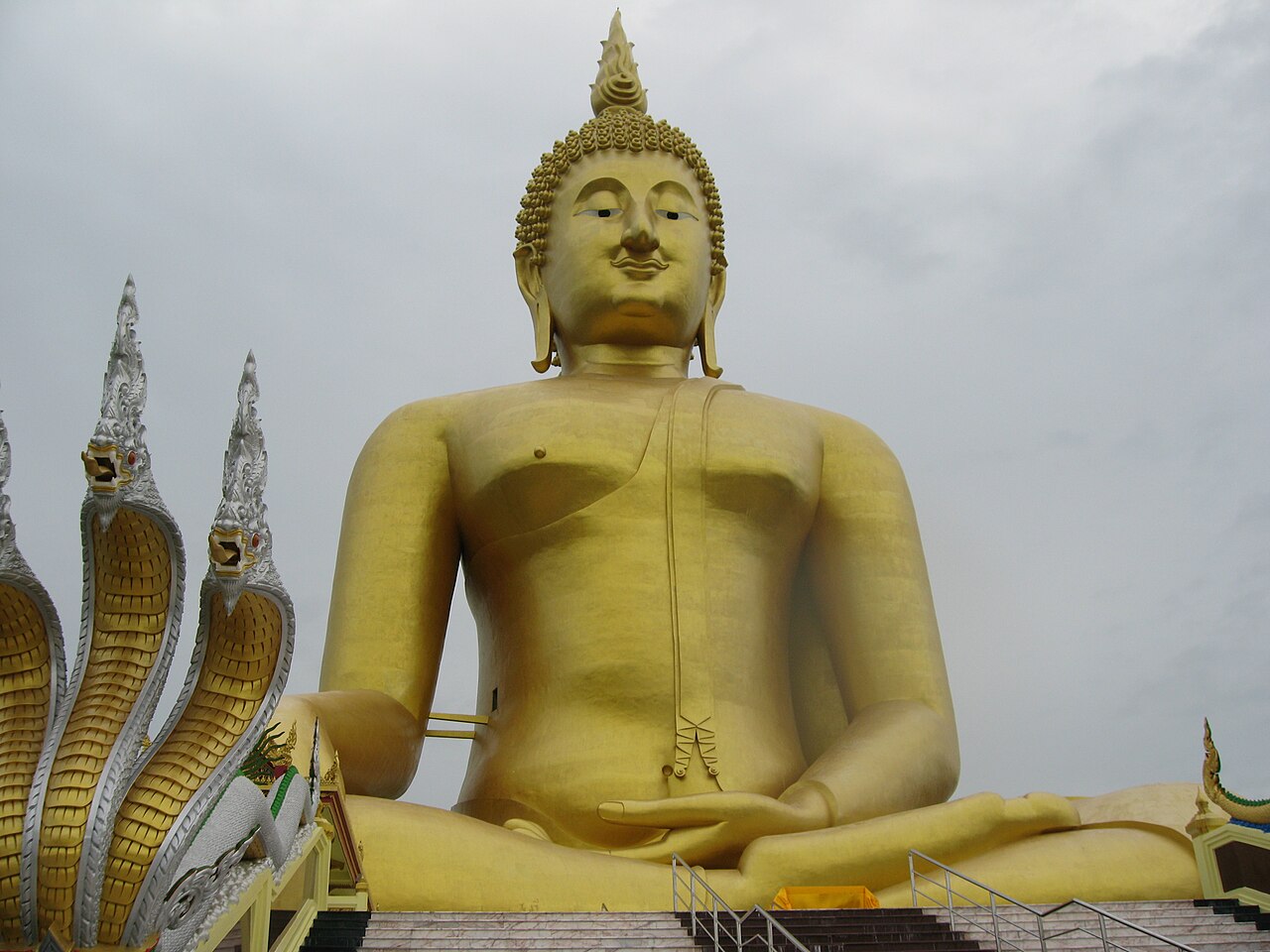
Wat Muang is in Hua Taphan sub-district, Wiset Chai Chan district. The highlight is Phra Phuttha Maha Nawamin Sakayamuni Si Wiset Chai Chan, known to everyone simply as "Luang Pho Yai." It's a gleaming gold seated Buddha in the subduing-Mara posture, with a lap width of 63 metres and a height of around 95 metres — the largest seated Buddha image in Thailand. Drive close and you'll see it rising above the rice fields from a long way off. Beyond the statue itself there's a model of heaven and hell to walk through, and an ordination hall set in the middle of a lotus pond.
- Opening times — open daily; the statue and photo spots are open during the day, while some service areas mainly run on weekends.
- Entry fee — no entry fee; donate as you wish.
- Popular photo spot — the angle where you reach up to touch the tip of Luang Pho Yai's hand, and the shot of the hall in the middle of the water.
- Come prepared — the midday sun is strong, so bring a hat or umbrella. Walking around takes roughly 1–1.5 hours.
Wat Khun Inthapramun — a reclining Buddha and a tax collector's legend
Wat Khun Inthapramun is in Inthapramun sub-district, Pho Thong district, and is thought to date back to the Sukhothai era. The highlight is the Phra Phuttha Saiyat, a large open-air reclining Buddha around 50 metres long — one of the longest reclining Buddhas in the country, with a calm, smiling face. People come to ask for blessings of health and good fortune. Legend says Khun Inthapramun, a tax collector, built it and chose to accept punishment rather than reveal where the money for the statue came from. In the reign of King Rama V, the king made the journey to pay respects to the statue twice.
An honest note
The reclining Buddha at Wat Khun Inthapramun is out in the open, without the roof you'd get inside a hall. Around midday the sun is harsh, so if you want easy, good-light photos, swing by in the gentler afternoon or in the morning rather than at high noon.
Wat Pa Mok Worawihan — the riverside reclining Buddha
Wat Pa Mok is a royal temple on the bank of the Chao Phraya River in Pa Mok district, about 18 kilometres from Ang Thong town along the Ang Thong–Ayutthaya road. Inside the hall sits a Phra Phuttha Saiyat, a stucco reclining Buddha lacquered and gilded, measuring about 22 metres from the flame finial to the feet, and thought to date to the Sukhothai era. What makes this temple special is the tale of moving the statue: in 1728, during the reign of King Thai Sa, he ordered the reclining Buddha pulled back from the riverbank that the water was eroding, and a hall was built over it that still stands today.
- Location — right at the entry point from the Ayutthaya side, ideal as the first temple of the trip if you're driving from Bangkok.
- Atmosphere — shady and riverside; the reclining Buddha is indoors so it stays cool and is comfortable to walk through.
- Time to spend — roughly 45 minutes to an hour, including paying respects and a stroll along the river.
What to eat along the way
Ang Thong is a riverside town, and its best-known dishes are boat noodles, river prawns, and freshwater fish. In town there are riverside spots where you can sit and eat with a view of the water, and along the route to Wat Muang and Wat Khun Inthapramun you'll find plenty of small boat-noodle shops tucked in. Doing lunch in town before splitting off to the remaining temples is the most convenient way to go.
Ang Thong boat noodles
Rich, dark broth in small bowls you can order several of — a local staple you'll find both in town and along the temple route.
Special mealRiverside fish & river-prawn restaurants on the Chao Phraya
Grilled river prawns and river fish, eaten with a water view in town — a good way to close out the trip before heading back.
Who this trip suits
- Temple and merit-making travellers — you can tick off the province's biggest Buddha images all in one day.
- People with a car — the temples are in different districts, so driving yourself is by far the easiest; allow roughly 20–40 minutes of travel between each temple.
- Families bringing older relatives — not much walking, parking close to the statues, and plenty of spots to rest along the way.
Want to stay overnight? See Ang Thong hotels with real reviews
See the Top 10 Ang Thong hotels →