🔄 Updated 21 Jun 2026
If you had to sum up Ang Thong for temple lovers in one phrase, it would be "big Buddha images." This province has one of the longest reclining Buddhas in the country, an old reclining figure that was once dragged inland to escape an eroding riverbank, and a Luang Pho To in a viharn first commissioned by Somdej Phra Phutthachan (To Phrommarangsi). Most of the temples cluster along the Chao Phraya and its tributaries, so you can drive from one to the next comfortably in a single day — the gaps between them are usually no more than 20–30 minutes.
The Buddha images people come to pay respects to
These four are the main reason people travel to Ang Thong. Each has its own story and scale. We've ordered them by historical significance and how popular they are with visitors.
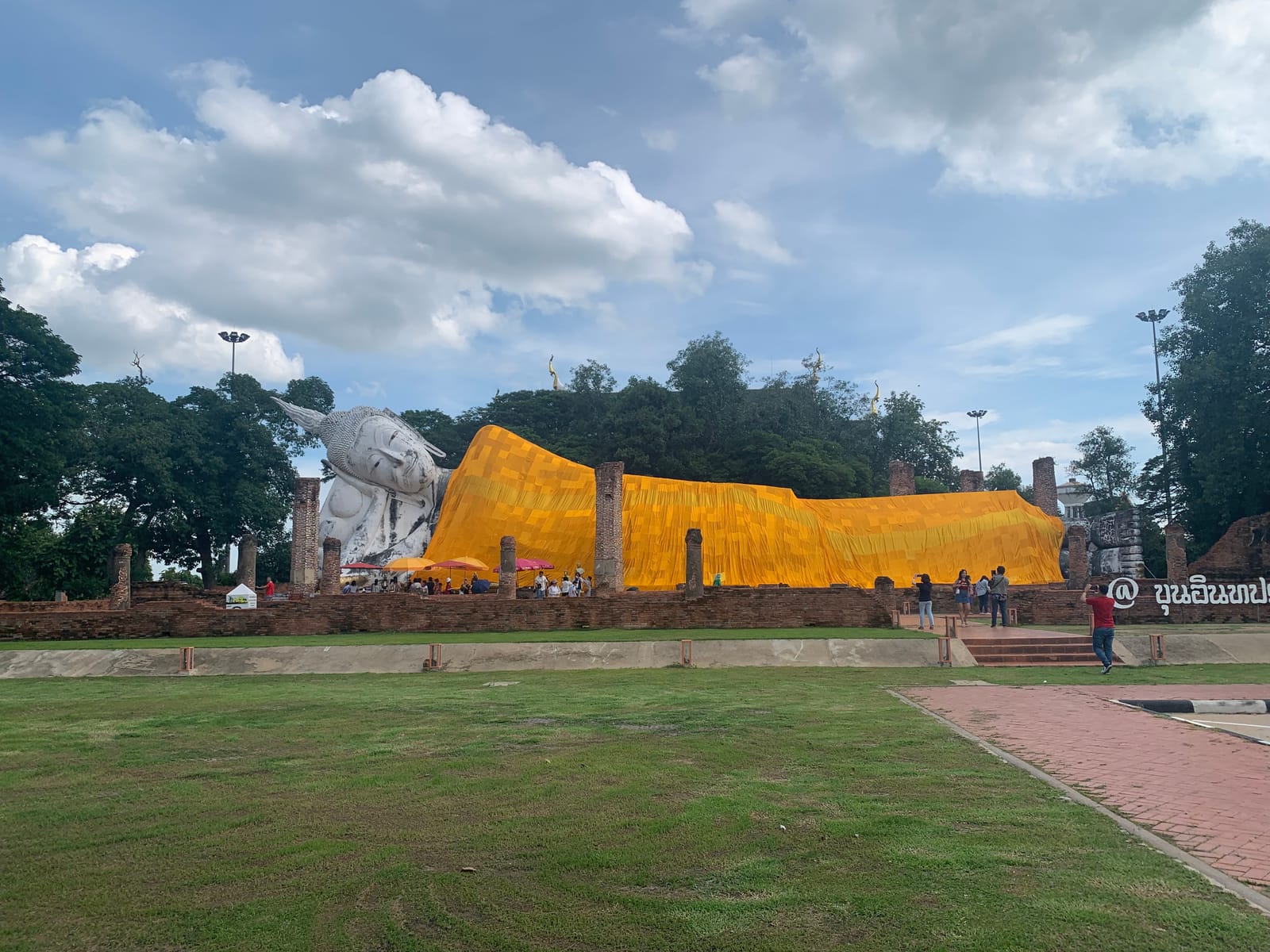
Reclining Buddha, Wat Khun Inthapramun (Pho Thong district)
An open-air reclining Buddha around 50 metres long — one of the longest in Thailand. It's thought to date to the Sukhothai period. The figure originally sat inside a viharn, but the hall burned down and collapsed, leaving the Buddha exposed to sun and rain out in the Pho Thong fields for over a century. Today it has been restored and beautifully gilded, with a wide plaza and a new viharn to walk around.
Reclining Buddha, Wat Pa Mok Worawihan (Pa Mok district)
A brick-and-stucco reclining Buddha, gilded all over, around 22 metres long, lying on its right side in the lion-rest pose. The head rests on a pillow finely decorated with gold-on-lacquer work. This is a royal temple, and there's a story that during the Ayutthaya period the figure was dragged about 168 metres back from the river to save it from the eroding bank.
Luang Pho To (Phra Maha Phutthaphim), Wat Chaiyo Worawihan (Chaiyo district)
A large seated Buddha in the meditation pose inside a tall viharn, with a lap width of about 16 metres and a height of around 22 metres. It was first commissioned by Somdej Phra Phutthachan (To Phrommarangsi), later rebuilt during the reign of King Rama V and granted a royal name. The tall hall lets light fall on the image beautifully in the mid-morning.
Somdej Phra Si Mueang Thong, Wat Ton Son (Mueang district)
A large cast-metal Buddha in the subduing-Mara pose at Ang Thong's town temple, sitting on the Chao Phraya right in the centre of town. It was built in stages from around 1945 onward. Locals come to pay respects here as the provincial temple, and it's easy to reach since it's right in the town centre.
Worth knowing before you go
The reclining Buddha at Wat Khun Inthapramun is out in the open, and the midday sun is harsh. Go in the morning or late afternoon for better photos and less heat. At the royal temples like Pa Mok and Chaiyo, dress modestly — no sleeveless tops or shorts inside the viharn.
Want more out of Ang Thong? Book tours & activities
Booking online ahead on Klook or GetYourGuide is usually cheaper than the gate and skips the queue. Pick only the experiences you actually want — prices and availability are shown live on each site.
Riverside temples and Chao Phraya valley culture
The charm of Ang Thong's temples is their relationship with the river. Many old temples face the Chao Phraya, because in the past travel and trade ran mainly along the water, so the temples were both places of worship and the centre of riverbank communities. Some still keep traces of Ayutthaya-era art in their ordination halls and mural paintings.
- Ayutthaya-style halls and viharns — look at the roof shapes, doorway arches and old stucco work that several temples still preserve.
- Murals and gold-on-lacquer work — like the gold-on-lacquer pillow at Wat Pa Mok, fine craftsmanship that's hard to find these days.
- Markets and communities by the temple gate — many temples have food and souvenir stalls out front, so after paying respects you can sit down to local snacks.
- Seasonal merit festivals — during the Buddhist Lent period and each temple's annual fair things get especially lively, and if your timing lines up you get the full atmosphere.
Other temples and cultural stops worth adding
Wat Muang (Wiset Chai Chan district)
Home to an enormous subduing-Mara Buddha you can see from far away. Around the temple are stucco scenes depicting heaven and hell — good for photos and making merit.
Ekkarat drum-making village (Pa Mok district)
An old drum-making community in Ang Thong. Watch the hides being stretched and the wood being turned — a craft that's still made and sold for real.
Bang Sadet court-doll village (Pa Mok district)
A court-doll workshop set up under a royal-initiative project. Watch the dolls being made and support the handiwork. It's near Wat Pa Mok, so it's easy to combine.
A one-day temple route, linked together
Ang Thong is a great pick for a one-day temple trip from Bangkok, because the main temples aren't far apart. Here's a sample route that flows smoothly from stop to stop — feel free to swap the order around depending on where you're starting from.
The Chao Phraya temple loop
Travel tips
Driving yourself is by far the easiest, since the temples are spread across several districts and public transport between them is scarce. Coming from Bangkok, take the Asia Highway (Route 32) then branch off into Ang Thong town — the whole trip is about 1.5–2 hours.
Want a full-day Ang Thong plan, all laid out for you?
See the Ang Thong travel guide →