🔄 Updated 21 Jun 2026
Plenty of people know Chiang Rai for Chalermchai's white Wat Rong Khun, but not far away sits another work of art with a completely different mood: Baan Dam, the life's work of Thawan Duchanee, a National Artist in visual art. This isn't a temple and it isn't an ordinary home — it's a museum the artist designed and built himself, one structure at a time, on his own land.
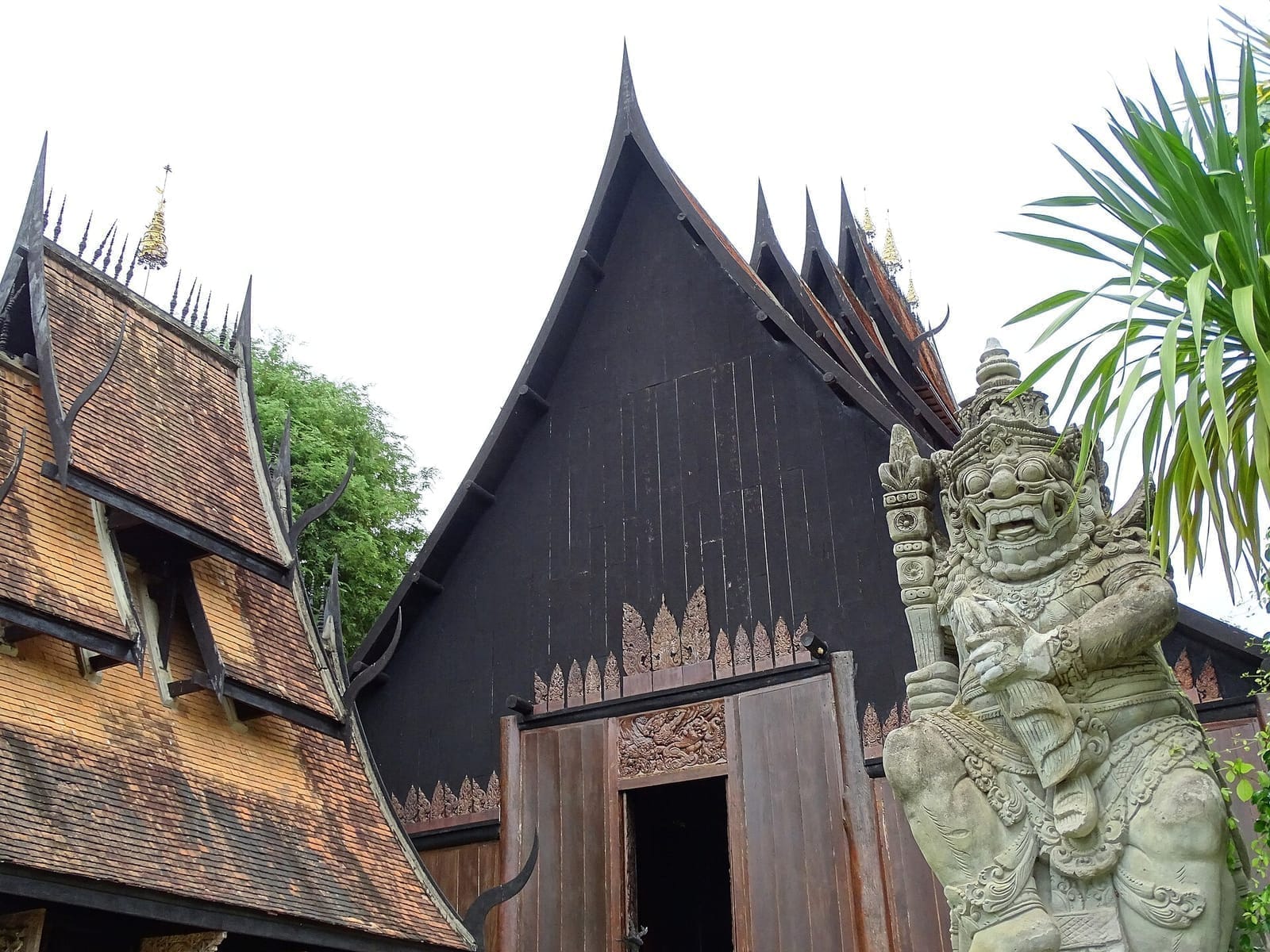
Walking through Baan Dam feels very different from the usual Chiang Rai attractions. Sombre black tones, carved teak, buffalo and deer horns, animal hides, and bones are arranged inside buildings done in an adapted Lanna style. Some people find it eerie, others find it calm and powerful — it's a place you really should experience for yourself rather than take someone else's word for it.
What is Baan Dam?
Baan Dam, or the Baan Dam Museum, is a private museum that Thawan Duchanee built up gradually over several decades on more than 100 rai of land in Nang Lae subdistrict, Mueang district, Chiang Rai province. It's made up of dozens of black wooden buildings and houses spread across the grounds, each one decorated with carved woodwork along with animal horns, hides, and bones that the artist collected and arranged as art.
Thawan was a National Artist in visual art (painting), best known for his bold black-and-white works inspired by Buddhist philosophy and imaginary creatures. Baan Dam is in a sense his largest piece, expanding his ideas about life, death, and nature into real architecture you can walk through.
Want more out of Chiang Rai? Book tours & activities
Booking online ahead on Klook or GetYourGuide is usually cheaper than the gate and skips the queue. Pick only the experiences you actually want — prices and availability are shown live on each site.
What to see inside Baan Dam
- The main hall (the principal building) — the standout black wooden structure, with a long wooden table, buffalo horns, and animal hides arranged inside. It's where most people take their photos.
- Chapel-shaped houses and black stupas — scattered across the grounds, each with a different form. Some are so small only one person can step inside.
- The horn and bone collection — buffalo and deer horns, skulls, crocodiles, and animal hides arranged as art. This is the source of Baan Dam's brooding atmosphere.
- Carved woodwork and furniture — tables, chairs, and teak pillars with detailed carving, made by craftsmen the artist hand-picked.
- Gardens and walking paths — a wide, shady area you can stroll through at your own pace, great for photos of the big trees set against the black houses.
Tip
Some buildings let you go inside, while others can only be viewed from the outside. Check the sign in front of each one, and don't touch the pieces or climb up to sit on them — many are genuine objects the artist collected over the years.
Tickets and opening hours
Admission runs around 80 THB per person for general visitors (the price can change, so it's worth checking on site or on the official page again). It's open roughly 9:00 AM–5:00 PM, and an unhurried walk-through takes about 1–1.5 hours. If you love photography and want to study the woodwork in detail, you may stay longer.
Closing days are a bit inconsistent across sources — some say it's closed on Mondays and public holidays, while at other times it's listed as open every day. To be safe, check Baan Dam's official page or call ahead before you set out, especially if you're planning to go on a Monday or during a long holiday weekend.
- Location — Nang Lae subdistrict, Mueang district, Chiang Rai (the northern side of town, on the way to Mae Chan)
- Entry — around 80 THB/person (confirm on site)
- Hours — roughly 9:00 AM–5:00 PM · allow at least 1 hour to walk through
- Dress code — no strict rules like at a temple, but you'll be out in the sun a lot, so comfortable shoes are a good idea
Getting to Baan Dam
Baan Dam is in Nang Lae subdistrict on the northern side of Chiang Rai town, about 12–15 km from the city center along the Chiang Rai–Mae Chan road. It's roughly a 20–25 minute drive, and the turn-off is fairly clear with signs all the way.
Rental car / self-drive
The easiest option, with plenty of parking. You can combine Baan Dam with Wat Rong Suea Ten or the tea plantations north of town in a single day.
Rented motorbike
Good for backpackers — rent one in town and cruise along the main road. Watch out for the sun and bring a helmet.
Taxi / private car
If you're traveling as a group, hiring a car for half a day works out better — have the driver wait and take you on to the next stop.
Pair it up for value
Plenty of people do the "three colors" trip in a single day: Wat Rong Khun (white) in the morning, Baan Dam (black) late morning, and Wat Rong Suea Ten (blue) in the afternoon — a route that covers all of Chiang Rai's signature art in one trip.
Is Baan Dam worth it? The honest take
If you're into art, architecture, or you want to see a side of Chiang Rai that's different from the bright, colorful temples, Baan Dam is well worth the visit. Entry is cheap, the grounds are spacious, and the atmosphere is like nowhere else. But if you're coming with small children who might be scared of the horns and bones, or you're expecting a bright, sweet photo-op kind of spot, Baan Dam may not be your thing — better to know that going in so you're not disappointed.
Plan a Chiang Rai trip that covers every angle
See the Chiang Rai guide →