🔄 Updated 21 Jun 2026
When people think of Udon Thani, the Red Lotus Sea and the city cafes usually come to mind first. But the thing that put Udon on the map for archaeologists worldwide is Ban Chiang, a small village in Nong Han district about 55 kilometres from the city centre. Beneath the ground here lie the traces of prehistoric people who lived in the area continuously for thousands of years.
What makes Ban Chiang special is that it isn't just objects behind glass. There are real excavation pits you can walk up to and look down into the soil layers, where skeletons and clay jars still sit exactly where they were dug up. It's a very different experience from a standard museum, and it's the reason UNESCO granted it World Heritage status.
What is Ban Chiang, and why is it a World Heritage site?
Ban Chiang is a prehistoric archaeological site that archaeologists began excavating seriously around 1967–1974. They found evidence that this area was home to a settled community that farmed, raised animals, knew how to cast bronze, and made pottery, continuously over thousands of years. Its importance is that it changed how scholars understand the Metal Age in Southeast Asia entirely.
Because of this scholarly value, UNESCO inscribed the Ban Chiang Archaeological Site as a Cultural World Heritage site in December 1992. It was the 359th World Heritage site in the world and one of the first in Thailand, putting the name of this small Udon Thani village into archaeology textbooks everywhere.
Want more out of Udon Thani? Book tours & activities
Booking online ahead on Klook or GetYourGuide is usually cheaper than the gate and skips the queue. Pick only the experiences you actually want — prices and availability are shown live on each site.
What is there to see at Ban Chiang?
Ban Chiang is split into two main parts that are both worth seeing: the Ban Chiang National Museum building and the excavation pits at Wat Pho Si Nai. The two spots are only a few hundred metres apart, so you can walk or drive between them in a single visit.
- Ban Chiang National Museum building — displays the real finds from the digs, including pottery, bronze tools, beads, and the story of the excavations, with models of daily life from that era to help you picture it.
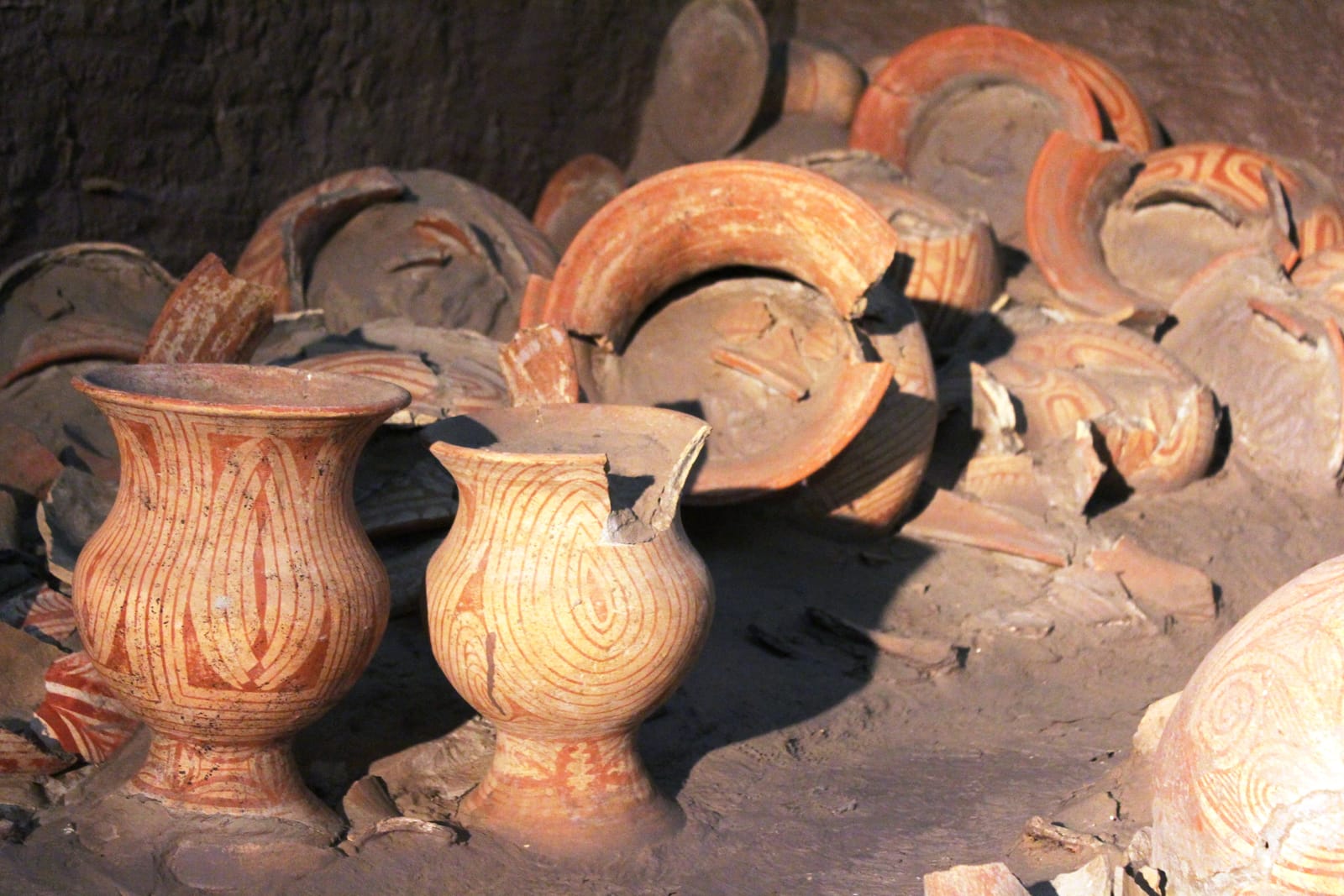
- Red-painted pottery — the highlight here. Jars and pots painted with spiral and curved patterns in red on a cream background. This design became the symbol of Ban Chiang and of Isan as a whole.
- Wat Pho Si Nai excavation pits — an open-air museum where a real pit is left exposed down to the soil layers, with skeletons and jars sitting right where they were found. As many as 52 burial pits were uncovered here, complete with grave goods left for the dead.
- Tools and metalwork — spearheads, bracelets, and bronze tools, proof that the people of Ban Chiang worked with metal a very long time ago.
- Souvenir shops in the village — around the site you'll find shops selling Ban Chiang-style pottery replicas and woven textiles, souvenirs you won't find anywhere else.
Tip
Don't just visit the museum building and head back. The excavation pits at Wat Pho Si Nai are where you see the real finds in their original positions. A lot of people miss it because they think the visit ends at the museum, when this is actually the highlight.
Entry fees and opening hours
Entry to Ban Chiang is charged separately for the museum building and the Wat Pho Si Nai excavation pits. The prices are very low for what you get to see, especially for Thai visitors. Students in uniform, monks, novices, and clergy enter both spots for free.
- Museum building — entry Thai visitors 10 THB, foreign visitors 30 THB
- Museum building — hours open Tuesday–Sunday, roughly 9:00 AM–4:00 PM, closed Mondays
- Wat Pho Si Nai excavation pits — entry Thai visitors 30 THB, foreign visitors 150 THB (Thai seniors and students in uniform exempt)
- Wat Pho Si Nai excavation pits — hours open daily, roughly 8:30 AM–4:00 PM
- Time needed allow about 1.5–2 hours for both spots combined
Check before you go
The museum building is closed on Mondays, but the Wat Pho Si Nai excavation pits are open every day. If your trip lands on a Monday, you can at least still visit the pits. Official fees and hours can change, so it's worth checking the Fine Arts Department page or the museum's page again before you set out.
How to get to Ban Chiang
Ban Chiang is in Ban Chiang subdistrict, Nong Han district, about 55 kilometres east of Udon Thani city, around a 1-hour drive. Most of the route is on smooth roads with clear signage, which makes self-driving the easiest option.
Rental car / self-drive
The most convenient option. Take the Udon–Sakon Nakhon road, then turn off toward Nong Han. There's a car park, and you can pair it with the Red Lotus Sea on the eastern route.
Private car / taxi
If you're not driving yourself, hiring a car from the city for a half day is more convenient. Have the driver wait so you can stop at other spots afterward.
Songthaew / public bus
There are vehicles from the city to Nong Han, then another ride into the village. The budget option, but allow extra time and check the schedules.
Pair it up to make the trip worthwhile
Ban Chiang is in the eastern zone of Udon, the same direction as the Red Lotus Sea at Nong Han Kumphawapi. If you go in the cool season (December–February), you can do the lotus trip at dawn and continue to Ban Chiang in the late morning, all in one day.
Is Ban Chiang worth it? An honest take
If you're into history or archaeology, or you want your kids to see the real thing outside a textbook, Ban Chiang is great value. Entry is cheap, real excavation pits are hard to find elsewhere, and you come away having actually learned something. But if you're coming for pretty photos, you're a cafe person, or you're with young kids who aren't into old things, it might feel a bit quiet — better to know that up front so you're not disappointed. The best approach is to read up on the Ban Chiang story a little beforehand, which makes walking through it a lot more rewarding.
Plan a full Udon Thani trip from every angle
See the Udon Thani guide →