🔄 Updated 21 Jun 2026
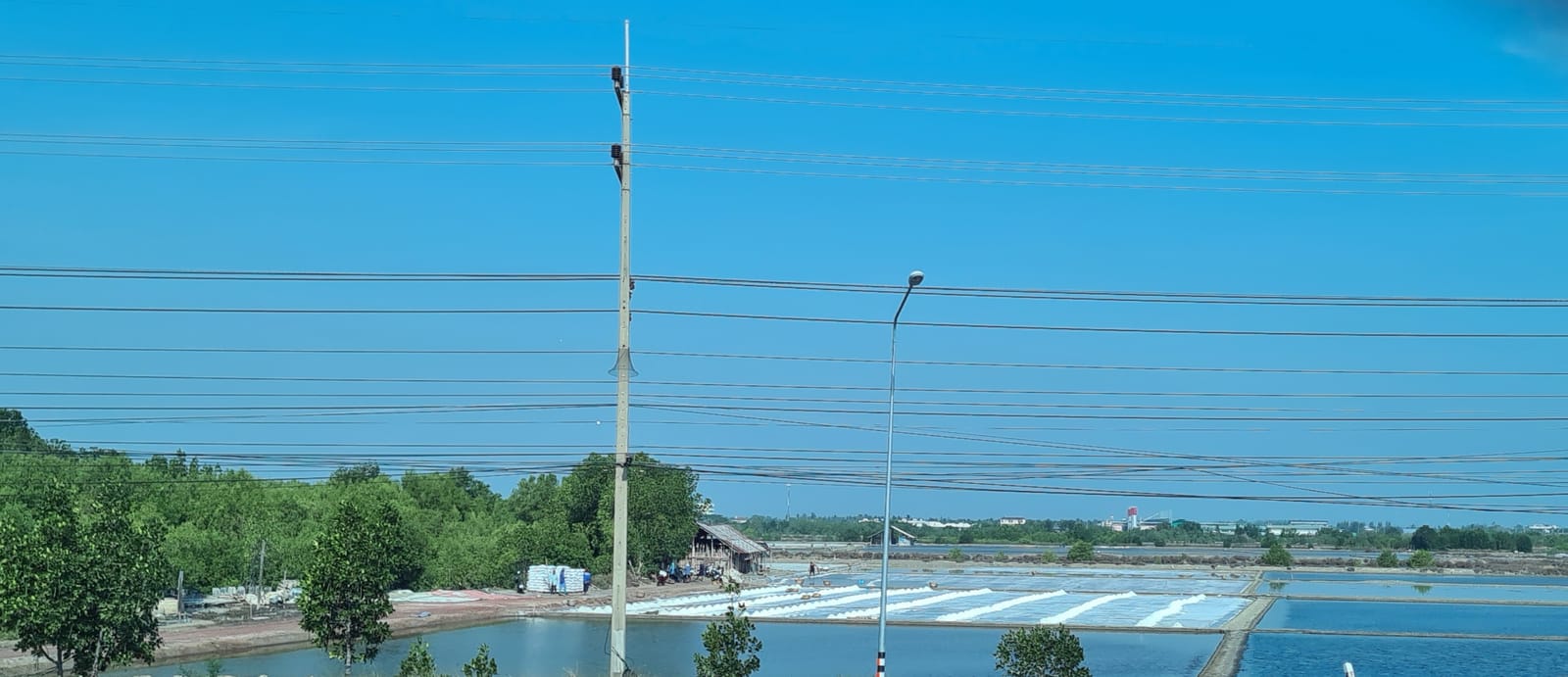
Samut Sakhon produces more sea salt than any other province in Thailand. The salt trail runs from Khok Kham through Na Khok, Ban Bo, Bang Thorat and on to Kalong, then carries on to Ban Laem on the Phetchaburi–Samut Songkhram side. It's the kind of wide-open scenery you rarely see in central Thailand. Plenty of people who use the Rama II highway regularly have spotted the white salt mounds by the road but never pulled over — even though you can absolutely stop and walk in for a closer look.
How a salt farm works
Making sea salt relies on nothing but nature: earth, water, wind and sun. Salt farmers pump seawater into a series of shallow pans, stepping up the salinity pan by pan until it reaches the crystallizing beds where the brine is at its saltiest. Sun and wind evaporate the water and the salt crystallizes into white grains, taking around 15 days per cycle before the farmers rake it up into small mounds along the edge of the fields.
- Fleur de sel (dok kluea) — the thin crystals that form on the surface of the first layer, gathered gently by hand. It has a rounder, less harsh taste and costs more than regular salt, popular in the kitchen and at spas.
- Coarse sea salt — the salt that crystallizes beneath the fleur de sel, raked into the big mounds you see along the fields, used in homes and industry.
- Salt-pan mud (khi daet) — the sediment from the bottom of the pans that locals turn into fertilizer and body scrubs, a piece of local know-how now sold as a souvenir.
Why the dry season matters
The salt-making season starts once the rains end, roughly November through May. This is when the sun is strong, the wind is good, and the fields are full of salt mounds. Come in the rainy season and the pans just turn into pools of water — a few minutes of rain can dissolve everything the farmers prepared, so there's usually not much to see.
Want more out of Samut Sakhon? Book tours & activities
Booking online ahead on Klook or GetYourGuide is usually cheaper than the gate and skips the queue. Pick only the experiences you actually want — prices and availability are shown live on each site.
When the view is at its best
The real charm of the salt fields is the still, mirror-like water in the pans. As the afternoon sun sinks low, around 4–6 pm, the light stretches across the surface in gold and orange, set against the dark silhouettes of the water wheels and workers raking salt. It's the moment photographers wait all year for. If you love symmetrical reflections, look for a pan that's full and dead-still and you'll get a clean mirror shot.
- Arrive about an hour before sunset so you have time to find a pan with a good angle and the light at its best.
- Early morning before 8 am is lovely in a different way — soft sky, cool breeze, farmers heading out to the pans, and fewer people than the evening crowd.
- Watch your step on the narrow dikes: the ground is slippery and these are people's working fields, so ask before walking into any pan.
Khok Kham salt-farm tourism village
If you want more than a roadside photo, the Khok Kham salt-farm tourism village (Ban Sahakorn community, Moo 3, Khok Kham subdistrict, Mueang district) is set up as a learning site where you can get hands-on. There's a "salt-farm school" that walks you through every step, from adjusting the brine to raking the salt, open roughly 8 am–5 pm. It's great for families who want their kids to see where the salt on the dinner table actually comes from.
Rake salt with the farmers
Grab a salt rake and work a real pan — you'll quickly see how much sun and wind it takes before those white mounds exist.
Herbal salt foot spa
Soak your feet in herbal salt straight from the fields to ease the ache after walking around in the sun — a local signature.
Salt-farm souvenirs
Fleur de sel, spa salt and salt soap at community prices — easy on the wallet to take home as gifts.
Ban Laem salt fields and the salt barn
Past Khok Kham, heading south toward Na Khok–Bang Taboon, you cross into Ban Laem, another long-established salt-making area. Around here you'll find the Ban Laem Salt Barn, an old salt-storage barn turned into a café beside the fields, where you can sip coffee looking out over the salt pans while learning the traditional process. It makes a good rest stop with both a view and some shade before you loop back to catch the sunset over the fields.
Rare migratory birds that stop at the salt fields
What a lot of people don't realize is that the Samut Sakhon salt fields are a key stopover for migratory shorebirds from Siberia — including the critically endangered spoon-billed sandpiper. Roughly November to April, flocks come down to feed across the pans and mudflats before flying on to Australia. That's why locals and conservation groups work together to protect the salt fields, both as a livelihood and as a home for the birds. If you're into birdwatching, bring a zoom lens or binoculars and keep your distance so you don't disturb the flocks.
A few small courtesies
The salt fields are people's actual workplace, not a public park. Walk on the dikes only, don't step on the salt mounds or wade into the crystallizing pans. If you want to get close or photograph someone working, say hello and ask first — most are friendly and happy to tell you about it.
Getting there and planning your time
- By car — from Bangkok take the Rama II highway toward Mahachai; after about 30–45 minutes the salt fields start appearing on both sides, with pull-offs to stop and shoot here and there.
- Mahachai railway line — take the train from Wongwian Yai station to Mahachai, then continue by local transport — good if you'd rather travel without driving.
- Plan a half day — seafood in Mahachai in the morning, a market in the afternoon, then close out at the salt fields for golden hour. Best value on a single-day trip.
Plan a full day of food and sights in Samut Sakhon
See the Samut Sakhon travel guide →