🔄 Updated 21 Jun 2026
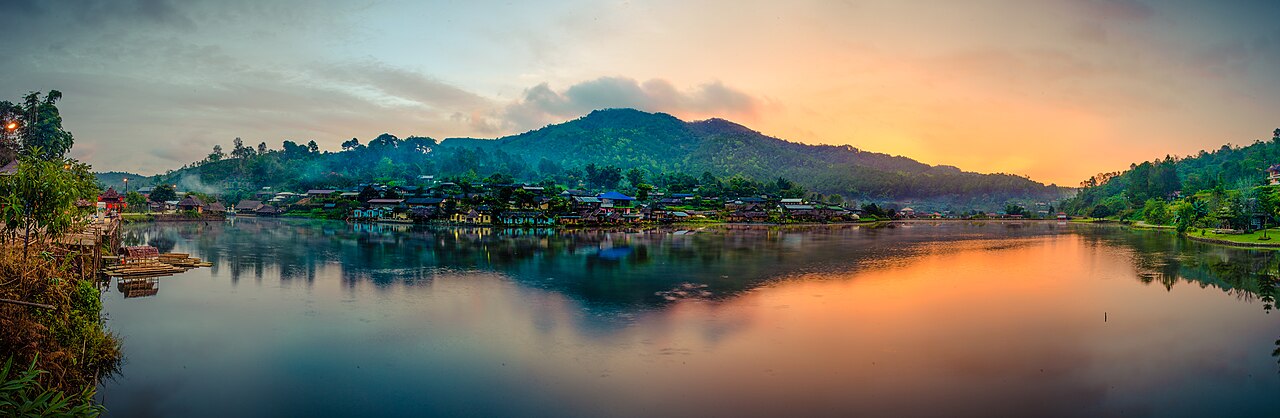
If you've ever dreamed of visiting Yunnan but haven't made it there, Ban Rak Thai is the closest thing in Thailand. The village was founded by former Chinese Nationalist (Kuomintang) soldiers who fled south from Yunnan after the change of government in China, then settled on these high hills and started growing tea. The people here still speak Yunnanese Chinese, eat Yunnanese food, and build the same thick-walled clay houses as back home. All of it together adds up to an atmosphere that's hard to find anywhere else in Thailand.
The village sits in Mok Cham Pae subdistrict, Mueang Mae Hong Son district, around 1,700 metres above sea level, so the air stays cool even in the hot season. The cold season (November–February) is peak time, when the mist is thick, the cool-climate flowers bloom, and the tea fields turn a fresh green. If you're coming then, book your stay well ahead, because it really does get busy.
What to do in Ban Rak Thai
The village isn't big — you can stroll the loop around the central lake in about an hour. But the charm here is in "slowing down" rather than rushing to tick off check-in spots. Here's what people usually do.
- Walk the tea fields — the tea fields climb the slopes around Lee Wine Rak Thai resort. You can walk in to take photos even if you're not staying there; the tea-field walk costs around 50 THB per person.
- Sip tea, taste wine — oolong and green tea grown and roasted right in the village. You can sit and sip all day in the wooden teahouses by the water, and some spots have local fruit wine to try.
- Boat ride on the lake — dragon boats and decorated boats loop the lake in about 30 minutes for around 160 THB per person. Go early and you'll catch mist drifting over the water.
- Wake up for the morning mist — the real highlight is before sunrise, when mist rises off the lake and reflects the clay houses and tea fields. It's the shot people happily set a 5 a.m. alarm for.
- Wander and shoot the clay houses — brown earthen-walled Chinese-style houses, red lanterns, Chinese-character signs. Every corner looks like a scene from a period Chinese film.
Tip
If you want pretty mist photos without the crowds, head out and walk along the lake between 5 and 6 a.m. Once the sun is up and the morning warms, the mist burns off and people start to fill in.
Want more out of Mae Hong Son? Book tours & activities
Booking online ahead on Klook or GetYourGuide is usually cheaper than the gate and skips the queue. Pick only the experiences you actually want — prices and availability are shown live on each site.
Yunnanese food you have to try
You can't come all the way to Ban Rak Thai and not eat Yunnanese food. Most of the restaurants cluster along the lake and open from morning to evening. There are only a handful of dishes nearly every table orders — but they're all good.
Pork knuckle with mantou
Pork knuckle braised in Chinese herbs until it falls apart, in a deep, rich sauce, eaten with steamed or fried mantou buns. It's the village's signature dish and every restaurant has it — skip it and people would say you never really made it here.
Rak Thai oolong / green tea
Tea grown and roasted in the village itself — fragrant and smooth. Order a pot and sit sipping by the water for a while, then buy some loose leaf to take home as a gift.
Fried mantou with condensed milk
Mantou fried crisp outside and soft inside, dipped in sweet condensed milk. A popular snack to grab while you wander, and easy on the wallet.
Herbal chicken soup
Chicken stewed in Chinese herbs in a hot broth that warms you up nicely on a cool day. Good to order and share with the group.
Stir-fried cool-climate greens
Fresh vegetables grown up on the hills, stir-fried Chinese-style with sesame oil or garlic — sweet and crisp, a good way to cut the richness of the pork knuckle.
Straight talk
Lakeside restaurants are noticeably pricier than in town because it's a tourist spot, but the setting and the view earn their keep. Order a few dishes to share with a group and it works out better value.
Where to stay in Ban Rak Thai — sleeping in a clay house by the tea fields
The charm of an overnight here is getting to sleep in a Chinese-style clay house among the tea fields, then opening your door in the morning straight onto mist and the lake. Most stays are small resorts run by people in the village, with prices and styles that vary. Here are the places that are genuinely open and come up often in reviews.
Lee Wine Rak Thai Resort
The village's icon — clay houses set among the tea fields by the lake, with its own teahouse and restaurant, and the tea-field walk right there. Starts around ฿1,100/night.
Chenfong Tea Resort Rak Thai
A stay right in the middle of the tea fields, with Chinese-styled villa rooms and balconies looking out over the rows. Slow-living atmosphere. Starts around ฿1,500/night.
Chasa Rak Thai Resort
Up on a rise looking down at the lake, with clean rooms at an easy-to-reach price. Good for couples or pairs. Starts around ฿1,100/night.
Pu Num / Baan Daeng Rak Thai
Small local resorts with a warm, friendly feel; some rooms catch a lake view. Starts around ฿1,500–1,700/night.
Booking tip
In the cold season (Dec–Jan), lakeside rooms fill up fast — book several weeks ahead. If you're on a budget, look at rooms set back from the water; they're cheaper and still a 2–3 minute walk to the lake.
The borderland drive to Ban Rak Thai
Ban Rak Thai is about 1–1.5 hours from Mae Hong Son town (around 45 km), heading northwest until you're almost at the Myanmar border. The road is a winding mountain climb with great views the whole way, but you'll want to drive carefully.
- Drive yourself — from Mae Hong Son town, take Route 1095, then turn off toward Pha Suea Waterfall / the Pang Tong Royal Project and follow the Ban Rak Thai signs. The road is narrow with lots of curves, so it helps to be used to mountain driving.
- Yellow songthaew — there are songthaews from the town market for around 120 THB per person, but they don't run often, so check the return times carefully.
- Rent a motorbike — about 300 THB/day in town, fine if you're comfortable riding in the hills. But the cold season gets very cold up on the mountain, so pack a windproof jacket.
- Private car / guide — easiest if there are several of you. It's often arranged as a single trip bundling Pang Ung, Pha Suea Waterfall, and Phu Klon mud spa in one day.
Road safety
Route 1095 is famous for its thousands of curves, so if you get carsick easily, bring something for it. Avoid driving at night or when the mist sets in heavily — visibility gets very bad.
Suggested 2-day, 1-night trip — Ban Rak Thai + nearby
You can do Ban Rak Thai as a single day trip, but it's a bit rushed. Stay a night and you get both the morning mist and the village's evening atmosphere. Here's a plan people put together often that doesn't wear you out.
From town up to the hills and tea fields
Morning mist, then loop back
When is the best time to go
The air here is cool all year because it sits high on the hills, but each season has a different feel. Pick whichever you like.
- Nov–Feb (cold season) — peak time: thick mist, cool-climate flowers in bloom, fresh-green tea fields. But it's crowded and rooms fill fast, so book ahead.
- Mar–May (hot season) — up on the hills it's still much cooler than the lowlands, with fewer people and easier-to-find rooms. But some stretches can have haze from crop burning.
- Jun–Oct (rainy season) — the tea fields are deep green and Pha Suea Waterfall is full, but rain makes the roads slick, so take extra care driving the mountain.
Plan a full Mae Hong Son trip — where to stay, where to eat, what to see
See the Mae Hong Son travel guide →