🔄 Updated 11 Jun 2026
Before you set off, keep the story in your head — it makes the trip a lot more rewarding, because each stop on this route isn't just a pretty spot, it's the actual setting where things happened. Walk them in order and the story pieces itself together as you go.
The story before you go
Going back to around the third lunar month of the Year of the Rooster, 1765, in the late Ayutthaya period under King Ekkathat, the Burmese army pushed in through the northern frontier towns. About 400 villagers from Bang Rachan and nearby hamlets decided not to flee. They banded together and built a camp ringing the village of Bang Rachan to hold off the army, with Phra Ajarn Thammachot as their morale and spirit, blessing amulets so the villagers felt protected going into battle.
This small camp held out against the Burmese army for a long stretch — winning seven battles despite being far outnumbered in men and weapons — until the Burmese had to send in army after army to crush it. The camp finally fell in the eighth lunar month of the Year of the Dog, 1766, after the villagers had fought for roughly five months. Even though the camp fell, the courage of this small group became a symbol of bravery and unity that Thais still remember today. Names like Nai Chan Nuat Khiao, Nai Thong Men who rode a buffalo into battle, Khun San and Phan Rueang, and several others were among the eleven leaders who headed the camp.
Straight talk
The Bang Rachan story we remember mixes parts drawn from the chronicles with parts that have been retold so often they became legend in novels and films. Some details — like the exact number of leaders or the dramatic scenes — vary by source. But the core, that a small group of villagers rose up and won several battles, is backed by real records. Travel with a sense of where the story comes from and you'll feel it more.
Want more out of Sing Buri? Book tours & activities
Booking online ahead on Klook or GetYourGuide is usually cheaper than the gate and skips the queue. Pick only the experiences you actually want — prices and availability are shown live on each site.
Stop 1 — Bang Rachan Heroes Park
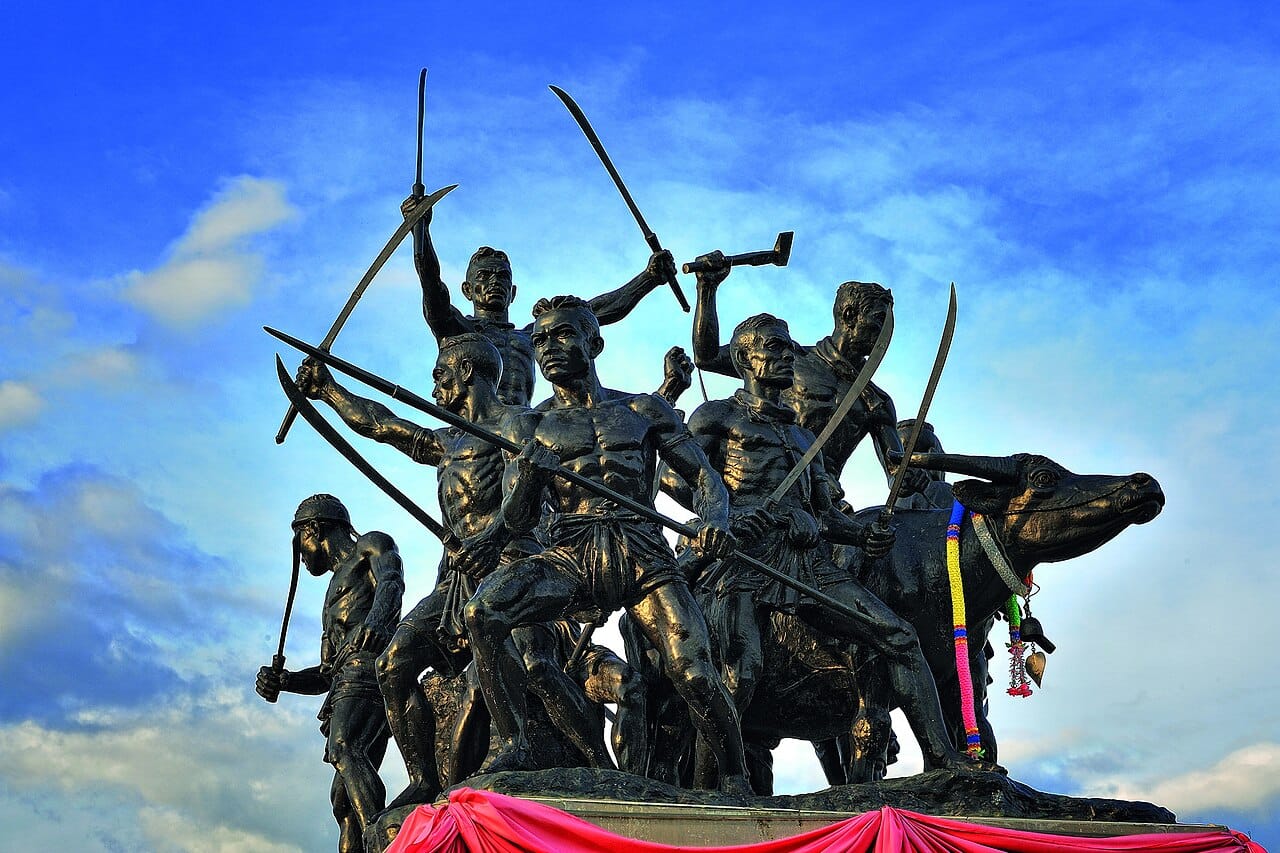
Start the trail at the Bang Rachan Heroes Park, because it lays out the big picture best before you go see the real thing. Here there's a monument plaza with cast statues of the camp's leaders standing in a battle-ready line — a Fine Arts Department work, officially opened on 29 July 1976 by King Rama IX himself. The park covers around 115 rai and doubles as a public garden.
Inside the park there's a museum building with an exhibition that tells the story from the background of Sing Buri town, to building the camp, through each battle against the Burmese one by one. There are models, a scale recreation of the camp, and maps of the army's marching routes. Walk through this room first, then go see the real ground at Wat Pho Kao Ton, and the picture in your head gets a lot clearer. Free to enter the whole grounds, open daily 08:00–17:00.
- Monument plaza — cast statues of all eleven camp leaders; the main spot to lay garlands and take photos
- Museum building — models, a scale recreation of the camp, and marching-route maps that tell each battle one by one
- Garden grounds — a wide open area with some shade, easy to stroll in the morning or evening
Stop 2 — Wat Pho Kao Ton, the real old camp
Cross over from the park to the other side and you reach Wat Pho Kao Ton, which locals also call Wat Mai Daeng. This old Ayutthaya-era temple is the ground that actually served as the stronghold of the Bang Rachan camp back then. Stand here and picture villagers gathering to build their camp on this very spot 260 years ago — it hits quite differently than looking at models in the museum. It sits right across from the park, just a few minutes to walk or drive.
Inside the temple there's a viharn and Buddha images the villagers hold dear, with a shady atmosphere from the big old trees. Almost everyone who comes to the park stops at this temple in the same go, because you get both the modern memorial side and the real historic ground in a single trip.
Stop 3 — Phra Ajarn Thammachot Shrine
Within the grounds of Wat Pho Kao Ton stands the Phra Ajarn Thammachot Shrine, the revered monk who was the morale and spirit of the camp during the fighting. He blessed sacred amulets so the villagers felt protected going into battle, which became an important source of strength that helped a tiny camp fight off the Burmese time after time. Many people from Sing Buri and beyond travel here regularly to pay their respects.
One thing a lot of people mention is the custom of carrying water to fulfil a vow at the temple pond. People whose wishes have come true return to carry water as a way of repaying the vow — a scene you'll often catch on weekends. Whether you come to make a wish or just take in the atmosphere of faith, you're welcome to stop by. No entry fee.
Three stops in one go
The Heroes Park, Wat Pho Kao Ton and the Phra Ajarn Thammachot Shrine are all in the same neighbourhood — you can move between them without driving far. Plan for roughly 1.5–2 hours total for these three stops and you'll have time for the museum, standing on the real camp ground, and paying respects.
Stop 4 — Ban Rachan Retro Thai Market
If you arrive on a Saturday, Sunday or public holiday, don't miss the Ban Rachan Retro Thai Market, held right within the grounds of Wat Pho Kao Ton. The market sits under the big shade trees in the temple, with vendors dressed in old-style Thai costume, speaking in the old polite register. The stalls are decorated with natural, folk-style materials, and walking through feels like slipping into an older world.
- Opening times — Saturday–Sunday and public holidays that fall next to the weekend, roughly 09:00–16:30
- Food — folk dishes, hard-to-find old-fashioned Thai sweets, and fresh fruit and veg from local farms, starting from a few tens of baht
- Performances — folk games, choi singing, and re-enactments of the Bang Rachan villagers' heroics by kids from the community at intervals
- Entry — no entry fee, with a large car park that holds several hundred cars
Time your visit to the market
The retro Thai market only opens on weekends and long holidays. If you want both the history trail and the old-time market atmosphere in one trip, coming on a weekend is the best value. Come on a weekday and you'll only get the park and the temple — the market won't be open.
1-day Bang Rachan trail plan
Sing Buri is close enough to Bangkok to do as an easy day trip. The Bang Rachan trail's main stops are nearly all in the same neighbourhood. Here's a plan that follows the story in order and leaves room for meals too — best on a Saturday or Sunday when the market is open.
Bang Rachan history trail + food in town
Want two provinces
If you leave earlier or stay a night, you can easily pair Bang Rachan with Lopburi or Ang Thong in one trip. Both provinces are close by and an easy drive on, ideal for anyone who wants a longer central-Thailand history run.
Getting there and what to prepare
- Private car from Bangkok — drive the Asia Highway (Route 32) to Sing Buri in about 1.5–2 hours, then take Route 3032 to Bang Rachan, another 15 km or so. Signs are clear and this is the easiest way to do the route.
- Coach/van + local transport — take a coach or van to Sing Buri town first, then continue by songthaew or a chartered car/motorbike taxi into Bang Rachan, since the sights are outside town and no public bus reaches them directly.
- Renting a car/motorbike to explore yourself — if you plan to hit every stop on the route and then carry on into town, renting and driving yourself is the most flexible.
- What to prepare — the monument plaza is open ground with strong midday sun, so bring a hat, sunglasses and water; dress modestly enough to enter the temple.
What else to do nearby
Wat Phra Non Chakkrasi
A huge reclining Buddha that's another of Sing Buri's main sights, right on the way into town — stop to pay your respects and make a wish.
Sing Buri boat noodles
The town's signature dish, with famous shops lining the road — close out the trip with a tasty bowl before you head home.
Riverside river-fish dining
Mae La snakehead and river fish are what people come to Sing Buri for — find a riverside spot and settle in.
Want to see Sing Buri's temples, the Bang Rachan camp and the local food all in one trip
See the Sing Buri travel guide →