🔄 Updated 21 Jun 2026
Most people fly or bus into Udon Thani–Nong Khai and then push north to Bueng Kan. But if you're already starting in Bueng Kan, the return leg down to Nong Khai is a genuinely worthwhile trip, because Route 212 runs right beside the Mekong for nearly the whole way. You get the wide river bends around Pak Khat, riverbank villages, and finally Nong Khai town with its old temples, riverside market, and the one-of-a-kind Sala Kaew Ku. We've planned this so the driving stays relaxed rather than packed, with regular stops to eat by the water.
Honest heads-up: this route works best if you have your own car or a rental. There are vans and buses running between Bueng Kan and Nong Khai, but Bueng Kan's natural sights like Hin Sam Wan (Three Whale Rock) and Phu Thok lie outside town with no public transport reaching them. Nong Khai town itself is easy to explore on foot or by tuk-tuk, so if you have no car, focus on Nong Khai town and only hire a vehicle for the days you want to reach the nature spots.
Route overview and when to go
The main road is Highway 212, running west from Bueng Kan town along the Mekong through Pak Khat and Rattanawapi districts, crossing into Nong Khai at Phon Phisai, and finally into Nong Khai town. The total distance is around 130–140 km, roughly 2.5–3 hours of actual driving if you don't stop. But this trip is built around stopping, so it'll take most of a day.
- Hin Sam Wan (Three Whale Rock) and Phu Thok — the headline sights on the Bueng Kan side, doable year-round, but Three Whale Rock is best in the cool season (Nov–Feb) when you have a chance of a sea of mist and clear skies.
- Pak Khat — the wide Mekong bend and riverside fish restaurants are good all year; late afternoon light is the prettiest for photos.
- Sala Kaew Ku — open year-round, with a lot of walking outdoors, so go in the morning or late afternoon to avoid the heat.
- Bang Fai Phaya Nak (Naga fireballs) — if you hit the end of Buddhist Lent (October), Phon Phisai on this route is the main viewing spot in Isan. It gets very crowded, so book Nong Khai accommodation far in advance.
About the car
Fill the tank before leaving Bueng Kan town or at Pak Khat. Around the nature spots like Three Whale Rock and the Phu Wua forest, fuel stations are fairly far apart, and some of the roads up to the viewpoints are steep and narrow. If you're in a rental, check the tyres and fuel before setting off.
Book the activities in your Bueng Kan trip ahead
Booking online ahead on Klook or GetYourGuide is usually cheaper than the gate and skips the queue. Pick only the experiences you actually want — prices and availability are shown live on each site.
Day 1 — Bueng Kan nature before you set off
The first day stays on the Bueng Kan side, picking up natural highlights that are hard to see elsewhere: Three Whale Rock, a cluster of huge sandstone formations on Phu Singh, and the town riverfront in the evening. If you have time to spare you can swap in Phu Thok or Tham Naga (Naga Cave), but if you'd rather not rush, just do Three Whale Rock at dawn and rest in town in the afternoon, which works nicely.
Three Whale Rock (Phu Singh) → Bueng Kan town → riverfront at dusk
If you want to add Phu Thok or Tham Naga
If you have 4 days or more, you can add Phu Thok (a wooden walkway along the cliff face) or Tham Naga at Phu Langka National Park on the first day. Tham Naga requires booking a slot in advance through the QueQ app and a long hike up the mountain, so set aside a full separate day for it. Don't cram it into the same day as Three Whale Rock — it's too much.
Day 2 — Following the Mekong from Bueng Kan to Nong Khai via Pak Khat
Today is the real Mekong drive. Leave Bueng Kan town and drift west along Route 212, through Pak Khat with its pretty river bend and riverside fish restaurants as the main draw, then on to Phon Phisai as you enter Nong Khai. The focus today is eating and stopping as the mood takes you — see a nice viewpoint by the road and you can just pull over, no rush.
Bueng Kan town → Pak Khat → Phon Phisai → Nong Khai town
Today's distances are about 40 km from Bueng Kan to Pak Khat, then another 90–100 km from Pak Khat to Nong Khai town. Across the whole day it's relaxed driving with plenty of room to stop for food and photos.
Mekong fish restaurants worth stopping at
The standout food along this route is Mekong river fish — pla khang (river catfish), pla nuea on (sheatfish), and pla krai (clown knifefish). The riverside restaurants around Pak Khat and Nong Khai town serve them fresh. We've picked places that are still open with steady reviews. Prices are rough ranges, so check again before you go, since some places have closing days and the fish on the menu depends on the season.
Kin Lom Chom Khong (Pak Khat)
The real deal for Mekong fish on the river in Pak Khat, set on a wide bend with a sweeping view. Known for tom yum pla khang, larb pla khang, garlic-fried sheatfish, fried clown knifefish cakes, and prawns in fish sauce — bold Isan flavours. Easy parking and a lovely view in the evening.
Khrua Sawoei (Pak Khat)
A riverside restaurant that Pak Khat locals recommend, focused on river fish dishes, with a comfortable evening atmosphere. Open evening to late night, so it's a good dinner option if you reach Pak Khat in the late afternoon.
Boeng Khong Café (Pak Khat)
A café and restaurant on the Mekong in the Ban Tai area of Na Kang subdistrict, with fresh coffee, drinks, and snacks. A good stop to refuel and shoot river views from late morning into the afternoon along the way.
Riverside snacks at Phon Phisai
As you enter Nong Khai at Phon Phisai there are restaurants and riverside snack stalls to stop at — a good place to stretch your legs and grab a bite before driving on into town, especially lively around the end of Buddhist Lent.
Riverside restaurants, Tha Sadet Market (Nong Khai)
In Nong Khai town, several riverside restaurants line the riverfront road around Tha Sadet Market — a good choice for the second night's dinner with a sunset over the Laos side. Mekong fish dishes and general Isan food.
Vietnamese food in Nong Khai town
Nong Khai has a community of Vietnamese descent, so it's easy to find naem nuang, fresh spring rolls, mu yo (Vietnamese sausage), and khao piak around town. A nice lighter change from Mekong fish before you carry on sightseeing.
Ordering Mekong fish well
Pla khang and sheatfish are the stars on this route. If there are several of you, ordering a tom yum set or blanched fish with dipping sauce works out better value than frying a whole fish. And ask the price per kilo before you order, since river fish is charged by weight and prices rise and fall with the season and the size of the fish.
Day 3 — Sala Kaew Ku and Nong Khai town
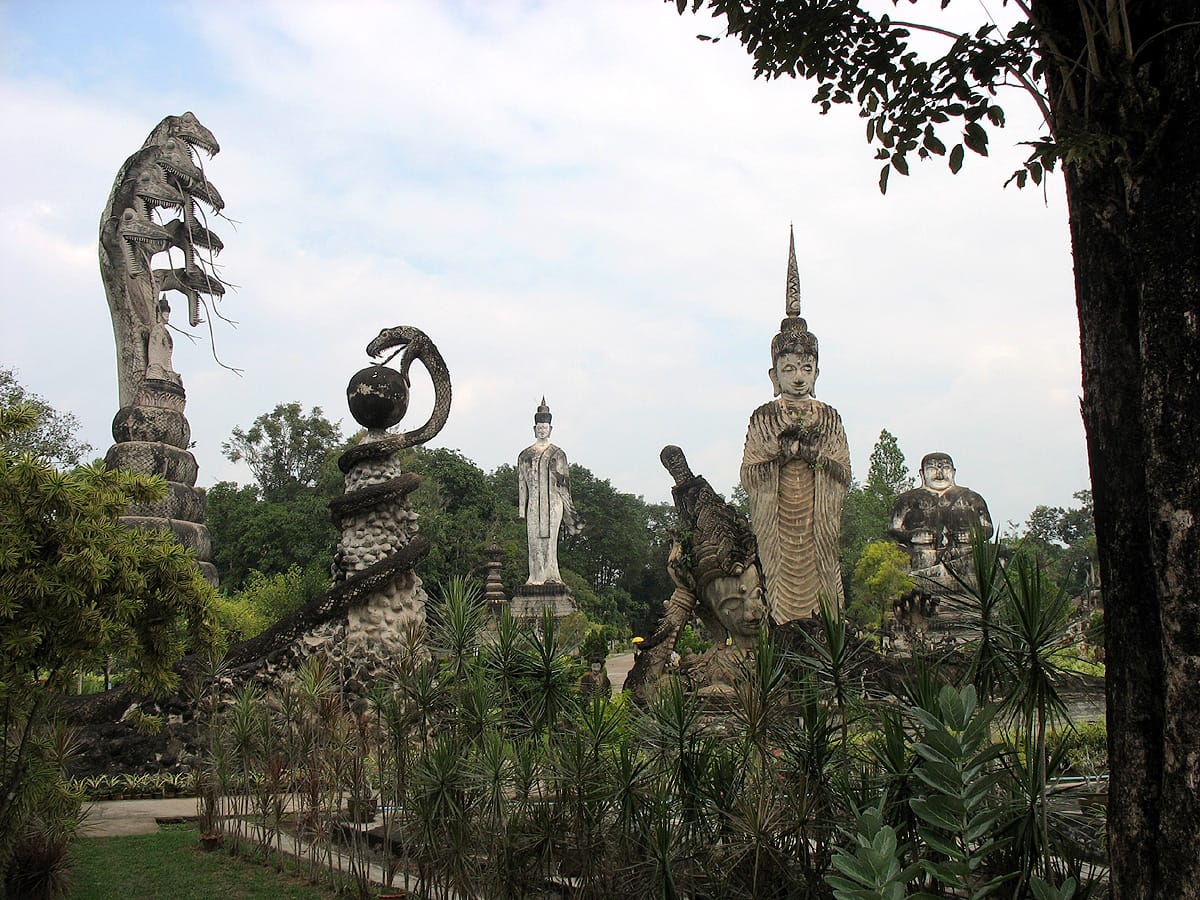
The closing highlight is Sala Kaew Ku, a large sculpture park of more than 200 concrete figures blending Buddhist and Hindu beliefs, built by Pu Bunleua Sulilat. There are seven-headed Naga figures, Buddha images, various deities, and the Wheel of Life that visitors walk through as a favourite photo spot. Allow about 1–2 hours to walk through it. It's open daily, roughly 08:00–18:00, with admission around THB 20 for Thais and THB 40 for foreigners — check on site.
Sala Kaew Ku → Wat Pho Chai → Tha Sadet Market → head home
Making the most of Sala Kaew Ku
Sala Kaew Ku is mostly outdoor walking, so wear comfortable shoes and bring water. Midday is hot with strong sun, so if you come then, pack a hat or umbrella. The most popular photo spots are the big seven-headed Naga and the Wheel of Life you can walk through. Inside there's also a hall preserving Pu Bunleua's body for visitors to pay respects.
Adjust for your time: if you only have 2 days, drop the Bueng Kan nature on the first day and drive straight down to Nong Khai, then cover Sala Kaew Ku and Nong Khai town on the second day. If you have time to spare, you can add Wat Pha Tak Suea — a riverside glass skywalk viewpoint over toward Sangkhom district — or the Thai–Lao Friendship Bridge.
Extra stops if you have time
Wat Pha Tak Suea (Sangkhom)
A hilltop viewpoint over the Mekong with a glass skywalk that juts out for views of the river bend and the Laos side. Worth a stop if you loop via Sangkhom district before heading into town.
Wat Pho Chai (Luang Pho Phra Sai)
Nong Khai's signature temple, home to Luang Pho Phra Sai, a sacred Buddha image revered by locals. It's in town and easy to drop by for a visit.
Thai–Lao Friendship Bridge
The bridge across the Mekong linking Nong Khai with Vientiane — a photo spot and the border crossing. If you want to continue into Laos, this is where you start.
Budget and what to prepare
- Car — fuel for the Bueng Kan–Nong Khai route including stops runs around THB 700–1,100 per car for a sedan.
- Accommodation — one night at a hotel in Bueng Kan town and one in Nong Khai town, starting around THB 500–1,200 per night.
- Food — main meals at Mekong fish restaurants run about THB 150–300 per person, plus a little more for cafés and snacks.
- Admission — Sala Kaew Ku is around THB 20 for Thais and THB 40 for foreigners; Three Whale Rock has a local vehicle fee to reach the viewpoint; temples accept donations as you wish.
- What to pack — shoes with good grip, a warm layer if you're doing Three Whale Rock before dawn in the cool season, a hat or umbrella for the sun at Sala Kaew Ku, and drinking water.
Where to stay
On this trip, the first night is in Bueng Kan town (near Three Whale Rock and the riverfront), then you move to Nong Khai town for the second night (near Sala Kaew Ku, Tha Sadet Market, and the transport links home). That's the smoothest way to travel, with no doubling back.
Check out places to stay in Bueng Kan before you set off
See 10 Bueng Kan hotels →