🔄 Updated 21 Jun 2026
What makes downtown Buriram easy is that everything clusters within walking distance. The old quarter around the train station and the main town road are the heart of it — a temple over a century old, the City Pillar Shrine that locals believe marks the town's origin, a fresh market where residents buy their groceries every morning, and the famous stand-and-eat meatballs that have basically become the province's calling card. We've laid it out as stops along the route, starting at the train station and working slowly into town. Pick from it for a half-day or a full day.
Start at Buriram train station and the meatball square
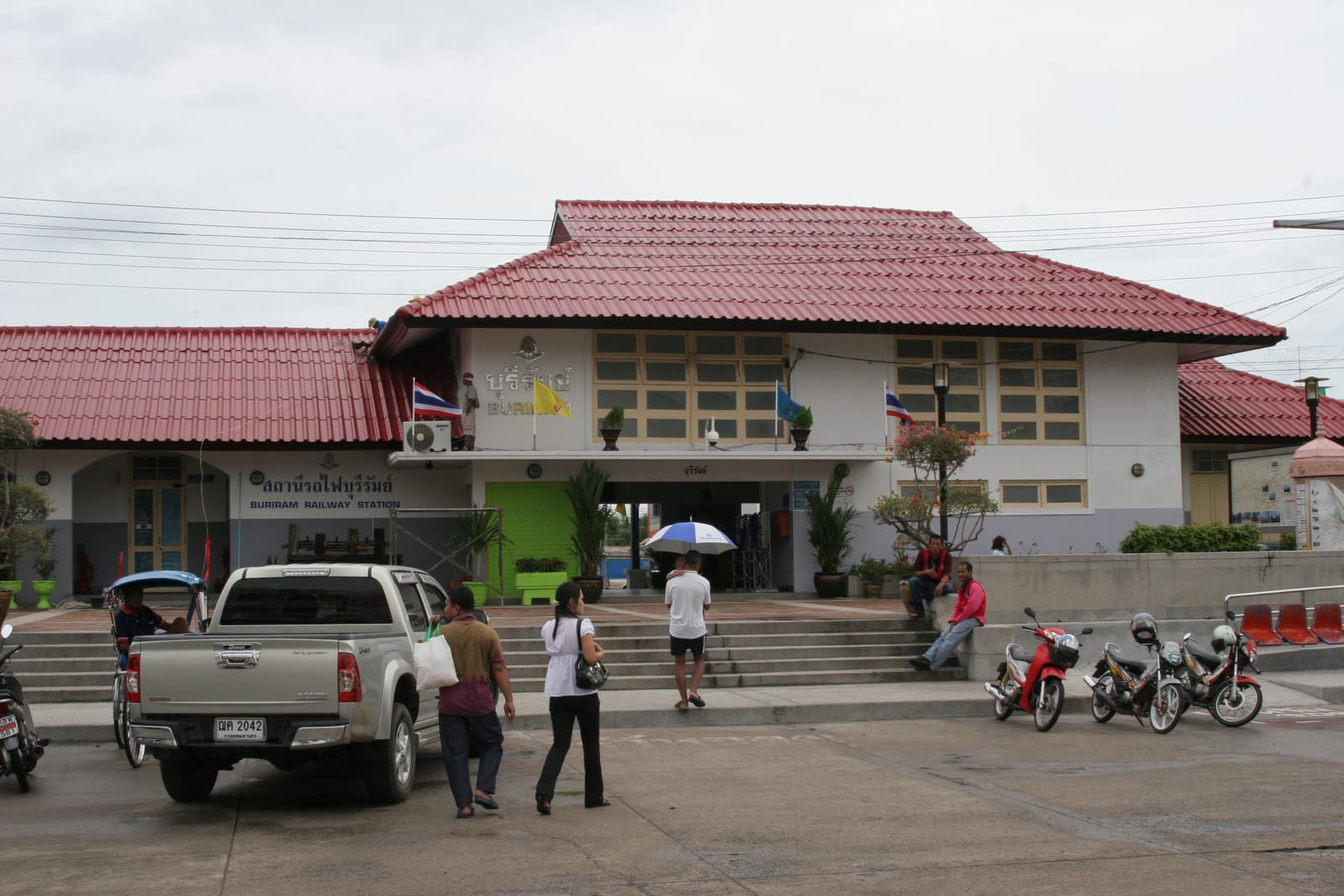
If you arrive by train, the first thing you'll see is the square in front of Buriram station, packed with stand-and-eat meatball stalls. It's the image most people picture when they think of Buriram before anything else. The station building itself is old and photogenic, with a town-name sign for a check-in shot. If you drive in, you can still park and eat here too — the station has its own lot.
The way it works: you pick your own meatballs off the tray, hand them over to be reheated in hot water or grilled, then stand at the stall dipping them in sauce as you eat. There's fresh and pickled veg to grab. Prices run around 6 skewers for 20 THB depending on the stall, with some starting at 3 THB a skewer. Most stalls open from morning until evening.
A bit of backstory before you eat
There are several stand-and-eat meatball stalls out front of the station. The one people call the original is Pa Nok, around so long that it's become the name everyone mentions most. Each stall has its own dipping-sauce recipe, so try a few — it's only a few baht a skewer. Eat it as a snack or have it bagged up to take away. Some stalls pack it by the kilo and ship nationwide.
Want more out of Buriram? Book tours & activities
Booking online ahead on Klook or GetYourGuide is usually cheaper than the gate and skips the queue. Pick only the experiences you actually want — prices and availability are shown live on each site.
The old temple and City Pillar Shrine, heart of the old quarter
Walk from the station into town along the main town road and it's not far before you hit a cluster of the town's sacred sites lined up in one area, easy to do on foot. This is where Buriram locals come to pay their respects and travellers stop to photograph the old architecture.
Wat Klang Royal Temple
Buriram's oldest temple, originally called Wat Pae Yai, and the province's first royal temple. There's an old ordination hall and stupa to see, with a shady, calm feel right in town. It sits on the main town road, open roughly 06:00–20:00, no entry fee.
Buriram City Pillar Shrine
The city pillar shrine in the centre of town. Locals believe this spot was once a campsite of King Rama I and the origin point of the town. It's deeply respected by residents — stop in to pay respects as you walk into town. It's not far from Wat Klang.
Wat Thung Pho
A Dhammayut-tradition temple near town, quiet in feel and used for meditation practice. Good for a low-key merit-making stop away from the crowds. Add it to the route if you have time and want to fit in another temple in town.
Dressing for the temples
Both Wat Klang and the City Pillar Shrine are sacred sites for the town, so dressing modestly suits the setting better — skip tank tops and very short shorts. Mornings are quieter with gentler sun, the most comfortable time to walk.
The fresh market and food in town
If you want to see real Buriram life, walk the fresh market in the morning — home-style dishes, garden produce, Thai sweets, and breakfast spots where locals eat before work. As you walk the old quarter you'll keep passing noodle shops, pork-blood congee stalls, and little cafés tucked in along the way, so you can graze the whole route without getting bored.
Stand-and-eat meatballs in front of the train station
The town's signature snack — stand and dip at the station, picking your own pork, chicken, sausage, and red hot dogs, then dunk in sauce and eat with fresh and pickled veg. The Pa Nok stall is the one locals call the original.
Kwangchao (morning congee & rice porridge)
A long-running breakfast spot in town with congee, pork-blood soup, red pork over rice, crispy pork, and wonton noodles. A good way to start the day before heading out on foot. Open morning to afternoon.
Boat noodles & noodle shops in town
Downtown Buriram has several go-to boat-noodle and noodle shops tucked into the lanes of the old quarter. Rich broth, top up the condiments however you like — a light meal between stops.
Buriram municipal fresh market
The fresh market in the town centre — walk through and you'll find home-style dishes, garden-fresh veg, fermented fish, chilli dips, and Isan-style snacks. Busiest in the early morning, and a good place to grab something to take with you before walking on.
Som tam & grilled chicken, local shops
It's Isan, so you have to have som tam, grilled chicken, and sticky rice. There are several go-to shops in town, bold-flavoured the way locals like it. Pair it with laap or koi for a full meal.
Thai sweets & khanom jeen in the market
The fresh market and morning stalls have home-style Thai sweets — khanom jeen with curry sauce, grilled sticky rice, coconut desserts — all cheap. Grab some to snack on as you walk, or bag it up for the room.
Coffee cafés in the old town
The town quarter has several small cafés tucked away, some with outlets for working. Standouts include house-roasted coffee and salted-egg burnt cheesecake. Good for a midday break out of the sun.
Food at the Sao Kraw walking street
Weekend evenings only — the walking street fills with street food: grills, fried snacks, sweets, and drinks. Plenty to graze across in a single evening.
Sao Kraw walking street, if you come on a weekend
The evening highlight for anyone walking the town is the Sao Kraw walking street, open Saturday and Sunday only, in the evening from around 17:00–22:00 (sometimes starting at 16:00). "Sao Kraw" is a local dialect word for townsfolk. The market sets up around Phithak Road in front of the governor's residence, with food, souvenirs, crafts, and clothes — a genuine local hangout. Check before you go whether the site has been temporarily moved, since it does relocate at times.
- Go early evening — around 18:00–19:00 the stalls are all open and the air is cooling down, the most comfortable time to walk.
- Bring cash — most market stalls take cash, and some have PromptPay but not all.
- Make it your dinner — there's enough food that you won't need to find a restaurant afterwards.
- Weekends only — come on a weekday and this market isn't on, so plan your day to line up.
How to plan your Buriram town walk
The spots in town are all close together, walkable for almost the whole route. If you tire out, you can grab a motorcycle taxi or a tuk-tuk for short hops. We've put together two versions — a half-day for people stopping over while waiting on a train, and a full day for those who want to soak up the town without rushing.
Half-day morning, walking the old quarter
Full day, the whole town + walking street
Straight advice before you walk Buriram town
- The town is walkable, no rental needed — the main spots are within a few kilometres, and if you tire out you can grab a motorcycle taxi or tuk-tuk for short hops.
- Starting early is best — the fresh market and meatball stalls are liveliest in the morning, with gentler sun and easy walking.
- The walking street is weekends only — if you want the evening market, plan your day to match; it's not on during the week.
- Bring cash — the meatball stalls, market stalls, and many street-food vendors take cash first.
- The temple and stadium are out of town — to see Phanom Rung or Chang Arena you'll need a car on a separate day; this route is purely in-town.
Want a day-by-day Buriram plan covering both in-town and out-of-town spots?
See the Buriram travel guide →