🔄 Updated 21 Jun 2026
When it comes to nature trips around Chaiyaphum, waterfalls are the reason people drive out of town. The rainy season (roughly June to October) is when the water is highest and the falls look their best — green rock terraces, clear pools you can actually wade into. Some are barely 20-odd kilometres from town; others sit deep inside the parks up on the Phanghoei range, right where the krachiao flower fields bloom. We've ordered them from closest to town outward, to make planning a route easier.
Tat Ton Waterfall — Closest to Town, Swimmable Year-Round
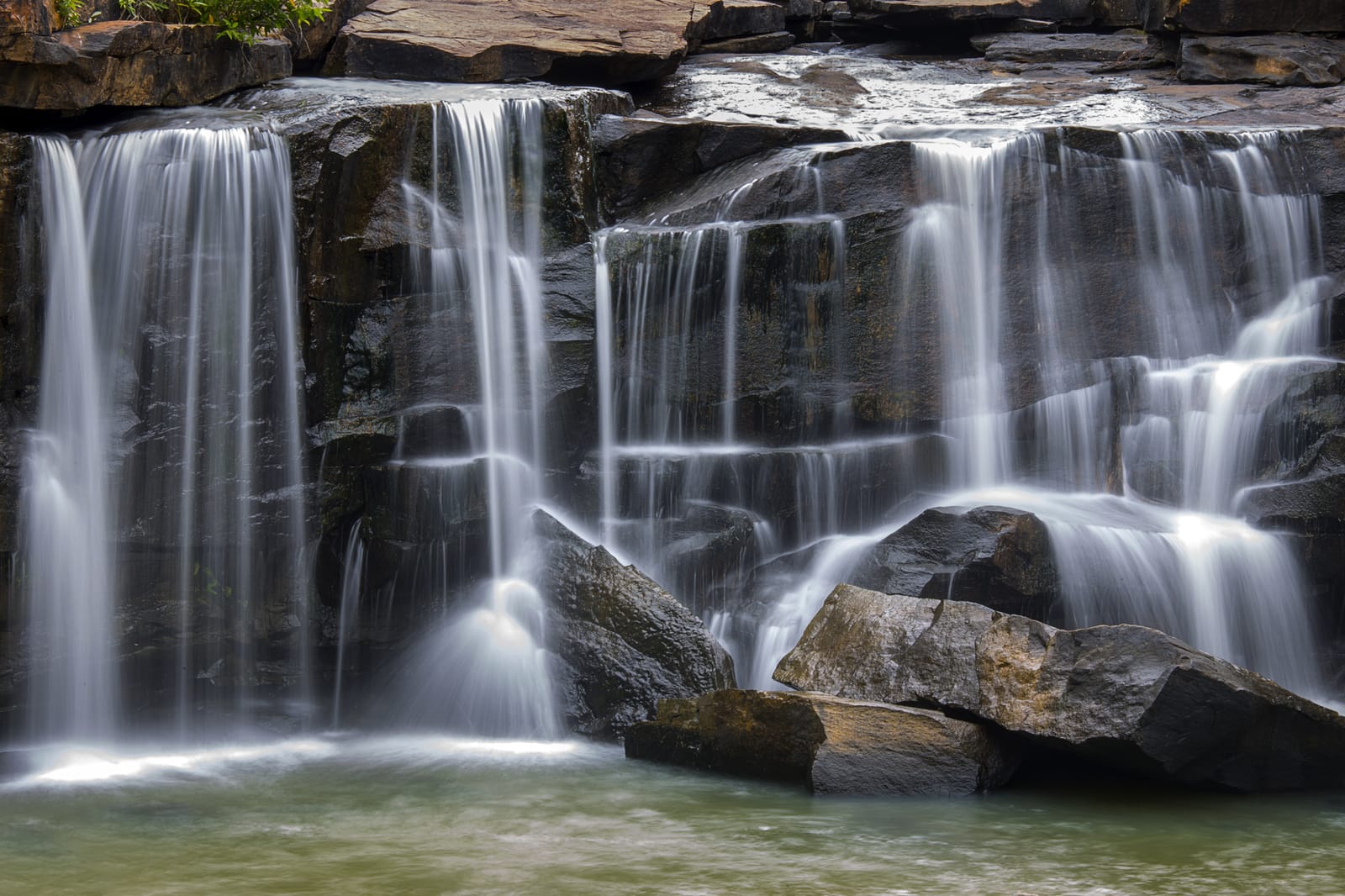
Tat Ton Waterfall sits inside Tat Ton National Park, about 21 kilometres from Chaiyaphum town. It's the one locals visit most often because it's close and has water flowing almost all year. The top is a wide rock platform around 50 metres across, running about 300 metres along the stream with big shady trees on both banks. The water slides down the rock and drops over a cliff about 6 metres high, spanning the full 50-metre width — in the rainy season the whole cliff turns into a curtain of water.
- Distance — about 21 km from Chaiyaphum town, roughly a 30-minute drive on good road the whole way
- Opening hours — daily, 08.00–18.00
- Entry (Thai rate) — adults 40 THB, children 20 THB, car around 30 THB
- Swimming spots — you can swim in the pools on the rock platform above the falls; pick a spot the rangers allow where the water isn't deep
Tip
Tat Ton is best in the morning before the crowds. On long weekends locals fill the rock platform with picnic mats. If you want it quiet, come on a weekday or before 10am.
Want more out of Chaiyaphum? Book tours & activities
Booking online ahead on Klook or GetYourGuide is usually cheaper than the gate and skips the queue. Pick only the experiences you actually want — prices and availability are shown live on each site.
Tat Fa Waterfall — A Natural Rock Slide
Tat Fa Waterfall is also within Tat Ton National Park, but about 18 kilometres east of the park headquarters, in the Ban Na Wang area of Na Siao subdistrict. What sets Tat Fa apart is its surface: the rock is fairly smooth and slanted with few ledges, so the water slides across the whole width like a long natural slide. It's especially full in the rainy season — the sheet of water across the cliff looks far better than in the dry months.
- Location — inside Tat Ton National Park, about 18 km east of the park headquarters; the last stretch is a narrow road, so ask the rangers for directions first
- Best time — the rainy season, when water fills the cliff and you see a sheet of water sliding across the whole rock face
- Watch out — the rock is very smooth and slippery; take care walking on it and wear rubber shoes with grippy soles
Thep Prathan Waterfall — Just Before Pa Hin Ngam
Thep Prathan Waterfall is in Ban Rai subdistrict, Thep Sathit district — a medium-sized fall surrounded by intact forest, about 7 kilometres before you reach Pa Hin Ngam National Park. It's fairly flat, with big boulders forming a wide platform that steps down in low tiers. It makes a good stop on the way up to Pa Hin Ngam or the krachiao flower fields.
Make the route count
Thep Prathan sits right on the road up to Pa Hin Ngam. Stop at the waterfall in the morning, then carry on up to see the krachiao flower fields and the Lan Hin Ngam rock field — all easily done in the same day.
Sai Thong & Chuan Chom Falls — Inside Sai Thong National Park
Sai Thong National Park covers the Phanghoei range across Nong Bua Rawe, Thep Sathit, Phakdi Chumphon and Nong Bua Daeng districts — a large stretch of forest with both waterfalls and krachiao flower fields (here called the Bua Sawan fields). Early in the rainy season, the main waterfall has two tiers you can walk between.
Sai Thong Waterfall (Wang Sai)
The fall itself is about 5 metres high, with a large pool below it called Wang Sai where you can swim. Above it is another big pool called Wang Ngueak, with the stream winding down the rock platform for about 150 metres.
Chuan Chom Waterfall
About 2 kilometres above Sai Thong along the nature trail, around 20 metres high and 50 metres wide, set under thick shade. This tier is taller and fuller, good for anyone who likes a short forest walk.
Sai Thong stands out because you can pair it with the Pha Sawan and Pha Ham Hot viewpoints and the krachiao flower fields on a single trip. Plan it for early in the rains and you'll get both full waterfalls and the krachiao in bloom at the same time.
The krachiao fields only bloom in the rains
The krachiao flower fields at Sai Thong and Pa Hin Ngam bloom only in the rainy season, roughly June to August, and the peak shifts from year to year. Before you go, check the park's Facebook page or hotline so you don't arrive to a field that hasn't bloomed yet or has already faded.
Full in the Rains — but Watch for Flash Floods
The rainy season is when Chaiyaphum's waterfalls look their best, but it's also when flash floods are the biggest risk. Floodwater comes fast and hard, sometimes when the sky right above the waterfall isn't even raining. Before you get in, always read the signs and listen to ranger announcements first.
- Watch the water level and colour — if it starts turning muddy red or you see branches and leaves floating down, get out immediately; that's a sign a flash flood is coming
- Only swim where the rangers allow it; don't climb over above the falls or get into pools deeper than you can handle
- Rock platforms are very slippery in the rains — wear rubber shoes with grippy soles, not flat-soled flip-flops
- Keep valuables in a waterproof bag, and never leave small children to swim alone
- Leave the park before dark — the forest roads have no lights and rain makes visibility poor
A 2-Day Waterfall Route
With two days you can cover both the falls near town and the ones deep in the forest. Splitting the zones across separate days makes for easier driving, since Pa Hin Ngam and Sai Thong are in a different direction from Tat Ton.
Near-Town Zone — Tat Ton + Tat Fa
Deep-Forest Zone — Thep Prathan + Sai Thong / Pa Hin Ngam
Plan a full nature trip around Chaiyaphum
See the Chaiyaphum travel guide →