🔄 Updated 21 Jun 2026
Most people who want to visit Mae Hong Son hesitate over the same thing: the road is so winding they're afraid of getting carsick, and they can't figure out how to split the days to make it worth it. Stop at Pai only and you'll regret skipping Mae Hong Son; push all the way to the town and you worry the driving will wear you out. This plan fixes that by running it as a loop — up via Pai (Route 1095) and back down via Mae Sariang (Route 108) — so you never retrace your steps, you see the scenery on both sides, and the curves are spread across several days. The whole trip stops feeling like you're sitting in a car all day.
The plan assumes you're driving yourself (a small compact rental in Chiang Mai runs about 800–1,200 THB a day), because Mae Hong Son's sights are scattered well outside town. Both Pang Ung and Ban Rak Thai sit deep up in the hills where public transport barely reaches. If you're not driving, we've put van and flight options at the end of the article.
The 4-day trip at a glance
- Day 1 — Leave Chiang Mai in the morning, take Route 1095 past Huai Nam Dang, stop for coffee, reach Pai by afternoon. Hit Pai Canyon and the Memorial Bridge, overnight in Pai.
- Day 2 — Morning around Pai: Wat Nam Hu, Wat Phra That Mae Yen, then drive Pai–Pang Mapha, stop at Tham Lod cave, into Mae Hong Son town by evening for the walking street.
- Day 3 — Town highlights: Wat Chong Kham and Wat Chong Klang, Phra That Doi Kong Mu, then up into the hills to Pang Ung and Ban Rak Thai for tea in the Yunnanese Chinese village.
- Day 4 — Leave Mae Hong Son, head south on Route 108 through Mae Sariang and Hot, stop at Op Luang, loop back to Chiang Mai by late afternoon.
Why loop instead of driving back the same way
Go up and back via Pai alone and you'll drive the 1,864 curves twice — carsickness guaranteed. Looping it (up Route 1095 through Pai, down Route 108 through Mae Sariang) gives you different scenery on each leg and spreads the curves across several days. It's a far easier drive.
Book the activities in your Mae Hong Son trip ahead
Booking online ahead on Klook or GetYourGuide is usually cheaper than the gate and skips the queue. Pick only the experiences you actually want — prices and availability are shown live on each site.
Day 1 — Chiang Mai to Pai via Huai Nam Dang
The route is Highway 1095, starting from Mae Taeng district in Chiang Mai and climbing north to Pai — about 135 kilometres, roughly 3 hours with rest stops. This is continuous mountain switchback, so take it slow. The classic stops along the way are Huai Nam Dang and the many roadside hill-coffee shops. Leave Chiang Mai before 9 a.m. so you reach Pai in the afternoon, in time for Pai Canyon at golden hour.
Up to Pai
Beating carsickness on the curves
If you get carsick easily, take a motion-sickness tablet about 30 minutes before setting off, sit up front, look far ahead, stay off your phone, and sip water as you go. The driver should keep it smooth and avoid sudden moves — even people who don't normally get carsick can feel dizzy if the corners are taken hard.
Day 2 — Around Pai, then on to Tham Lod and Mae Hong Son town
This morning you pick up the Pai sights you haven't done yet, then in the afternoon drive the second leg of the loop: Pai–Pang Mapha–Mae Hong Son, about 110 kilometres, roughly 2.5–3 hours. Tham Lod cave at Pang Mapha falls neatly along the way, and you'll reach Mae Hong Son town in the evening.
Pai → Tham Lod → Mae Hong Son
About Tham Lod cave
At Tham Lod you have to hire a local guide carrying a pressure lantern (it's the local rule and it spreads income to the community). The raft fee and guide fee are paid separately. Allow about 1.5–2 hours to walk through the cave. If you want to see the swifts flying back to roost, you need to be there in the late afternoon near closing — but that puts you arriving in town after dark, so weigh it against the plan.
Day 3 — The land of three mists: Pang Ung and Ban Rak Thai
This is the big day of the trip. The morning covers the highlights within Mae Hong Son town that you can reach on foot, then in the afternoon you head up into the hills to Pang Ung and Ban Rak Thai — the images that define the province. From town it's about 40–45 kilometres up, but it's a narrow, steep mountain road, so drive slowly and leave plenty of extra time.
In town + up the hills
Want the Pang Ung mist? Stay close by
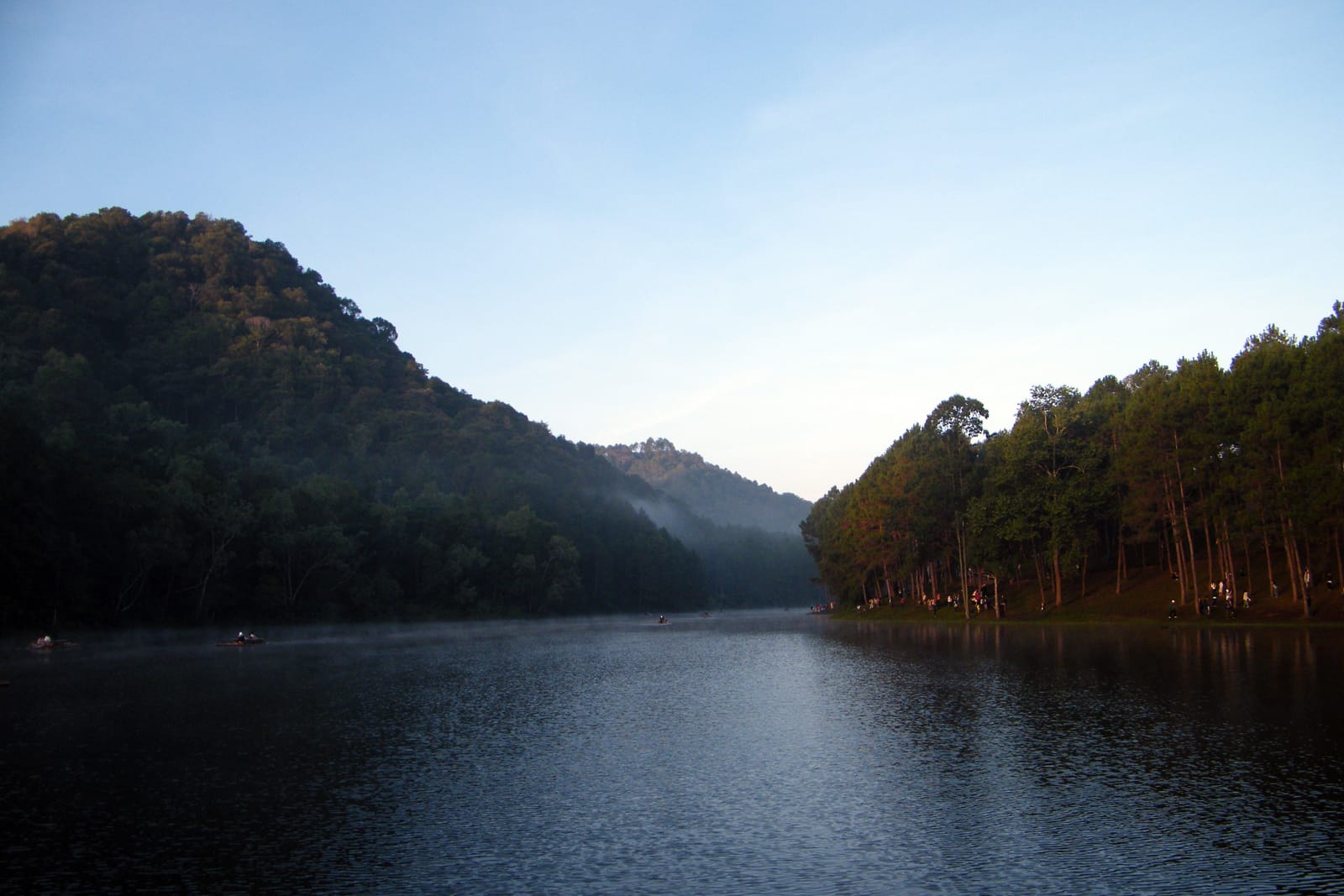
The famous Pang Ung sea of mist you see in photos happens at dawn, around 6 a.m. Drive up from town in the morning and you'll miss it. People who really want that shot usually spend a night at Ban Rak Thai or a resort near Pang Ung, then walk the waterside early. This plan does it as a day trip for simplicity — if you have an extra night, adjust accordingly.
Day 4 — Looping back to Chiang Mai via Mae Sariang
On the way back you don't retrace the Pai road — you drop south on Highway 108 through Mae Sariang and Hot back to Chiang Mai. This leg is longer than the way up, about 270 kilometres, roughly 6–7 hours with stops. The first part is winding too, but it eases into straighter road as you near Hot. Set off early and you'll be back in Chiang Mai before dark.
The southern way back
What to eat along the way and in Mae Hong Son town
Mae Hong Son food leans into its Shan character — khao soi, thua nao, khanom jeen nam ngiao — plus hill flavours like oolong tea and stewed pork leg with mantou at Ban Rak Thai. We've picked the places and dishes that reviews mention often and that are easy to find along the loop.
Khao soi and khanom jeen nam ngiao, Mae Hong Son morning market
Breakfast the local way. The morning market has khao soi, khanom jeen nam ngiao, and Shan noodle dishes at easy prices — a breakfast with real local flavour.
Shan street food, Mae Hong Son walking street
The evening market beside Nong Chong Kham lake has grilled thua nao crackers, khao gan jin, local Shan sweets, and snacks to graze on as you walk — good for your first dinner in town.
Oolong tea and stewed pork leg with mantou, Ban Rak Thai
The signature of the Yunnanese Chinese village. Hill-grown oolong tea to taste before you buy, paired with braised pork leg served with hot steamed mantou — an afternoon meal up in the hills with real atmosphere.
Khao soi shop in Pai town
Khao soi with chicken, beef, or pork — soft noodles in a rich curry broth, a classic lunch before driving on. Shops in Pai town centre are easy to find and open midday.
Coffee in Love, Pai
A mountain-view café on the road out of Pai, using a house Mae Hong Son coffee blend. Travellers like to photograph the café sign before driving on; sip a coffee and take in the view out back.
Pai walking street (dinner)
Food the whole length of it — Thai, Western, desserts, and drinks. Grazing here is easy any evening and makes a good first dinner on the loop, with a lively atmosphere.
Roadside hill coffee on Route 1095
Between Chiang Mai and Pai, mountain-view roadside coffee shops pop up here and there — a good place to stretch and sip a coffee to fend off carsickness. Many use beans from the surrounding hills.
Restaurants in Mae Sariang town (on the way back)
Mae Sariang is the halfway rest stop on the return leg, with rice-and-curry shops, noodle stalls, and coffee in town — fuel up before the long drive back to Chiang Mai.
Souvenirs to take home
The easiest souvenirs on this route are oolong tea from Ban Rak Thai, Mae Hong Son hill coffee, and Shan thua nao crackers. Perilla seeds (nga khi mon) and wild honey are also local products you'll find at the morning market and souvenir shops in town.
What you need to prepare for this loop
- Car condition — check the brakes and tyres before you go, because the long downhill stretches lean hard on the brakes. With an automatic, use a low gear to help slow you on the descents.
- Fuel — fill up every time you find a station in a town, because stations are far apart in the hills.
- Travel timing — plan to reach your accommodation before 18:00, because the mountain roads have no lighting, plenty of curves, and go pitch dark.
- Motion-sickness tablets — keep some for everyone in the car; even people who never get carsick can feel dizzy over 1,864 curves.
- Warm clothing — up at Pang Ung and Ban Rak Thai, especially in the cool season, the temperature drops well below the town.
How to go if you're not driving yourself
If you'd rather not drive the 1,864 curves yourself, you can still go — but accept that the hill sights like Pang Ung and Ban Rak Thai are harder to reach. Most people end up chartering a local car or booking a day tour.
- Van, Chiang Mai–Pai–Mae Hong Son — departs the Arcade bus terminal in Chiang Mai throughout the day. More relaxing than driving, but the seating is tight and the curves are many; if you get carsick, sit up front.
- Flight, Chiang Mai–Mae Hong Son — there are domestic flights, around 35–40 minutes, cutting out all the curves. Good if you get seriously carsick or are short on time, but you'll still need to rent or charter a car to get around once in Mae Hong Son.
- Chartered car with driver — if you're a group, splitting the cost works out well, and a local driver knows the road and handles the climb to Pang Ung most easily.
- Day tour — for the hill day, you can book a Pang Ung–Ban Rak Thai day tour and skip the risk of driving the mountain roads yourself.
When is the best time to do this loop
Nov–Feb (cool season)
The best time for this loop — cool, comfortable air, lovely mist at Pang Ung and Huai Nam Dang, clear hill views. But it's crowded and Pai accommodation fills fast, so book ahead.
Mar–Apr (hot / haze)
Northern Thailand often gets haze from crop burning; the hill views can turn murky and visibility on the curves drops. Avoid it if you can, or check the air quality before you set off.
May–Oct (rainy season)
Lush and green, fewer people, cheaper rooms — but the mountain roads get slippery and there can be landslides during heavy rain. Drive with extra care, pack a rain jacket, and allow more travel time.
Want a place to stay in Mae Hong Son before you start the loop? See our hand-picked options.
See the Top 10 Mae Hong Son hotels →