🔄 Updated 3 Jun 2026
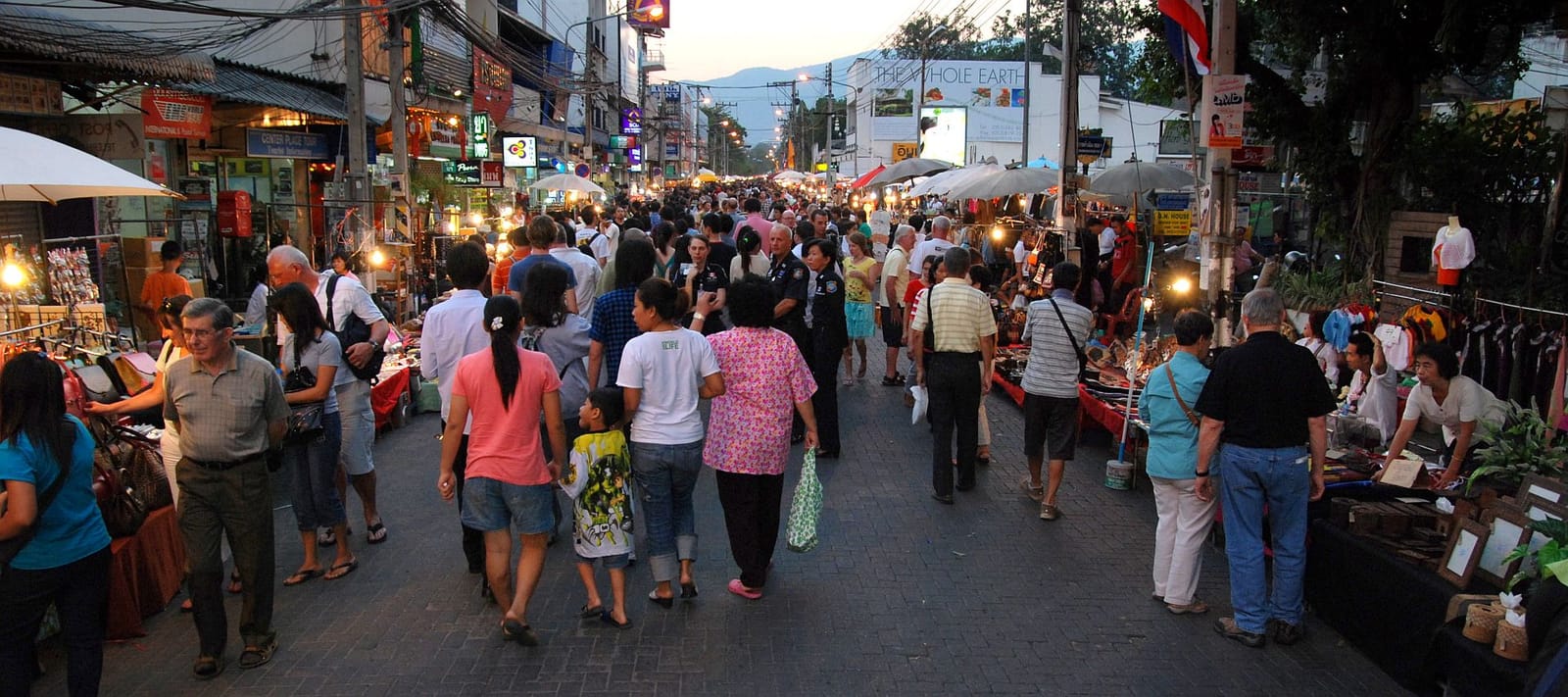
The Ratchadamnoen Sunday Walking Street runs Sunday nights only and is the biggest, liveliest walking market in Chiang Mai. What sets it apart is the setting, right in the old city: you start at Tha Phae Gate and walk straight down Ratchadamnoen Road to Wat Phra Singh at the far end, around 1 km in all. Both sides are lined with food stalls and handmade-craft tables, with food courts set up in several old temple courtyards along the way. The vibe is easygoing — just eat, browse, and drift along, no need to rush.
Hours and where it starts
The market runs Sundays only. Stalls start setting up in the late afternoon, around 4:00 PM, and it really gets going from 5:00 PM until roughly 10:30–11:00 PM. The whole road is closed to cars so you can walk down the middle of the street. The most popular place to start is Tha Phae Gate — it's an easy landmark to find and taxis and red trucks (songthaew) can drop you right there — then you walk in toward Wat Phra Singh. You can also start from the Wat Phra Singh end and walk out toward Tha Phae instead; it's less crowded at that end early on.
- Day: Sundays only (every week, except occasional dates when authorities cancel it for special reasons)
- Hours: stalls open ~4:00 PM · busiest 6:00–9:00 PM · packing up around 10:30 PM
- Start point: Tha Phae Gate → straight down Ratchadamnoen Road → ends at Wat Phra Singh (~1 km)
- Getting there: walk from your hotel if you're staying in the old city, or take a red truck / taxi / Grab to Tha Phae Gate
Crowd-dodging tip
Between 7:00 and 8:30 PM the stretch by Tha Phae Gate gets so packed you sometimes move one step at a time. If you don't love being shoulder to shoulder, come around 5:00 PM — the light is still good for photos and it isn't overflowing yet. Or start from the Wat Phra Singh end and walk against the flow to skip the worst of the crush.
Want more out of Chiang Mai? Book tours & activities
Booking online ahead on Klook or GetYourGuide is usually cheaper than the gate and skips the queue. Pick only the experiences you actually want — prices and availability are shown live on each site.
Food worth trying
Food is the heart of the walking street. Most things run ฿25–70 a portion, so bring plenty of small-denomination cash — a lot of stalls still take cash only. We've picked out the dishes you can genuinely find here and that actually draw a queue.
Sai ua / grilled sausage skewers
The local snack that's easiest to find — fragrant grilled northern herb sausage (sai ua) and hot grilled sausage on a stick you can eat as you walk. Plenty of vendors grill right out front along the road.
Khanom jeen nam ngiao
A mellow orange-red broth (the color comes from dried kapok flowers) ladled over rice noodles, with pork blood and tomato, eaten with crispy pork rind and fresh veg. A genuinely northern dish you'll find at the temple food courts.
Khao soi
Egg noodles in a coconut-milk northern curry broth, topped with crispy fried noodles, in chicken or beef. Some temple food courts sell it in the evening — a warm pick-me-up to refuel mid-walk.
Som tam / temple food courts
The temple food courts have well-known som tam (papaya salad) stalls with real queues, pounded to order — Thai-style, with crab, or with fermented fish sauce. There are proper tables to sit at, so it's a good spot to rest your legs and have an actual meal.
Grilled pork / beef skewers
Grilled pork (moo ping), beef, meatballs, and seafood on skewers — pick your own sticks and pay by the count. The smell of the grills runs the whole length of the street and pulls people in.
Mango sticky rice
A perennial favorite with travelers — sweet coconut sticky rice with ripe mango and a coconut-cream drizzle. Many vendors box it up so you can keep walking and eating.
Roti
Hot fried roti with banana, egg, condensed milk, or chocolate, made fresh right in front of you — a sweet finisher the kids love.
Coconut ice cream / fresh fruit juice
Coconut ice cream served in a real coconut shell, plus big cups of fresh-squeezed fruit juice. Great for cooling off while you walk, and easy on the wallet.
Khanom krok / fried Thai sweets
Hot khanom krok (coconut pudding cups) and fried treats like banana fritters and grilled sticky rice, made roadside. Cheap and easy to grab and nibble as you go.
Being honest
Some of the food aimed at tourists runs a touch higher than you'd pay elsewhere. If you want a filling meal that's good value, the temple food courts (like Wat Phan On) are the better deal — they have seating and restrooms. The roadside snacks are better for grazing a little at a time than buying in bulk.
Temple food courts — where to sit and have a real meal
One of the charms of this market is that several old temple courtyards along the way open up as small food courts, with vendors setting up tables, restrooms, and a spread of food all in one place. They're perfect for when you've walked yourself tired and want to sit down for a proper meal rather than eating on your feet.
Wat Phan On
One of the most popular food courts, right in the middle of Ratchadamnoen Road, with a big mix of northern food, som tam, khao soi, and khanom jeen nam ngiao all together. Has seating and restrooms.
Wat Phra Singh (the end point)
An important temple at the western end of the road. It's usually open to visitors on Sunday nights — take in the beautiful temple, then grab a bite around it before you head back.
Crafts and handmade souvenirs
Beyond the food, the other half of the street is handmade-craft tables — and that's what sets this market apart from an ordinary night market. A lot of it is genuinely made by hand by local artisans and younger Chiang Mai artists, not the same factory goods everywhere. It's a pleasant browse even if you don't plan to buy.
- Woven textiles, cotton, and local sarongs — scarves, cloth bags, and hand-woven clothing in northern patterns
- Silverwork and jewelry — earrings, bangles, and handmade necklaces, many sold by the artisans who make them
- Woodwork, ceramics, and pottery — home decor, bowls and cups, and cute little trinkets
- Sa paper, lanterns, and decorations — a signature of Chiang Mai craft
- Paintings, art, and postcards — artists drawing live in front of you, portraits on request
- Handmade soap, fragrances, and skincare — local herbal products, nicely wrapped and good as gifts
Can you haggle?
A little, politely — especially if you're buying several pieces. But genuine handmade work is already priced fairly, and pushing too hard sours the mood. If you spot something you love, grab it, because handmade pieces are often one-offs that won't be made again.
What else is at the market
- Roadside foot and shoulder massage — once your legs are tired, stop for a 30-minute foot massage; chairs are lined up along the road, starting at a couple hundred baht
- Live music and performances — buskers and local performances on street corners and in side lanes, including blind musicians playing at some spots
- Tha Phae Gate — the plaza in front of the gate is a photo spot and a gathering point for the pigeons; busy in the early evening but lively
Tips to walk it and have fun without wearing yourself out
- Bring small-bill cash — most stalls take cash only, and the ATMs around there have long lines
- Wear comfortable shoes — 1 km each way is 2 km round trip, plus all the stops; you'll be on your feet for hours
- Watch your valuables — it gets very crowded in the early evening, so wear your bag in front and don't carry your phone loosely
- Avoid the rain in rainy season — May–October sees frequent evening showers, so check the forecast; some Sundays the rain thins out the stalls
- Parking is hard to find — if you drive yourself, park outside the old city and walk in, or use a red truck / Grab, which is far easier
If the week you're visiting doesn't land on a Sunday, Chiang Mai also has the Saturday Walking Street (Wualai Road) by Chiang Mai Gate, which leans more toward silverwork, plus the Chang Khlan Night Bazaar, open every night — both good backup options.
Want a hotel within a 5-minute walk of the walking street?
See the Top 10 Chiang Mai hotels →