🔄 Updated 21 Jun 2026
Khon Kaen has plenty of different things to see — a lake in the middle of the city, a nine-storey temple, a big dam and a dinosaur museum. But the King Cobra Village at Ban Khok Sa-Nga is unlike anywhere else, because you get to watch an entire village live alongside king cobras, the longest venomous snakes in the world, in a way you simply can't see elsewhere. It isn't a zoo and it isn't a commercial snake farm — it's the real way of life of a community of herbal healers whose bond with snakes goes back several generations.
What kind of place is the King Cobra Village?
Ban Khok Sa-Nga sits in Sai Mun subdistrict, Nam Phong District — an old Isan village more than a hundred years old. The original villagers farmed rice and also worked as travelling herbal healers, selling medicines from village to village. Today almost every household still keeps king cobras under the house or in cages, and there's a show arena in the middle of the village where outsiders can come and watch. The place is known for its snake shows and for "man-vs-cobra boxing" that locals say exists nowhere else in Thailand.
- Where it is — Ban Khok Sa-Nga, Sai Mun subdistrict, Nam Phong District, Khon Kaen province, about 50 km from the city centre.
- Opening hours — open for visitors daily, from around 09:00 onwards. Show rounds are held once visitors arrive.
- Entry fee — no fixed admission charge; you give a merit donation to support the community as you see fit after the show.
- Who it suits — people who like the unusual, community-culture travellers, families with older kids, and anyone who wants to see a side of Isan life that's hard to find.
Call ahead to be sure
This is a real community, not a tourist attraction with set show times. If only a few of you turn up, you may have to wait until enough people gather before a show is put on. Calling the villagers or the community coordinator in advance (the number that gets shared around is 061-583-7888) makes it much easier to plan your timing.
Want more out of Khon Kaen? Book tours & activities
Booking online ahead on Klook or GetYourGuide is usually cheaper than the gate and skips the queue. Pick only the experiences you actually want — prices and availability are shown live on each site.
The history: how Isan people and king cobras began
It started back in 1951, when Por Yai Ken Yongla, a herbal healer in Ban Khok Sa-Nga, grew tired of trekking from village to village to sell his herbal medicines. He came up with a way to draw a crowd by bringing out a cobra to perform — and once people gathered to watch, he could sell his medicine too. But cobras can spit venom up to 2 metres, which was too dangerous, so Por Yai Ken switched to using king cobras for the shows instead, then taught the art of handling snakes to the rest of the village so it could be passed down.
From a small idea to help sell medicine, the snake shows gradually became the identity of the whole village. Today nearly every household keeps king cobras, with both older generations who are genuine snake handlers and younger people learning the craft. The story of people and snakes here isn't a show dreamed up out of nowhere — it has real roots in the village's old trade of herbal healing.
The snake show and man-vs-cobra boxing
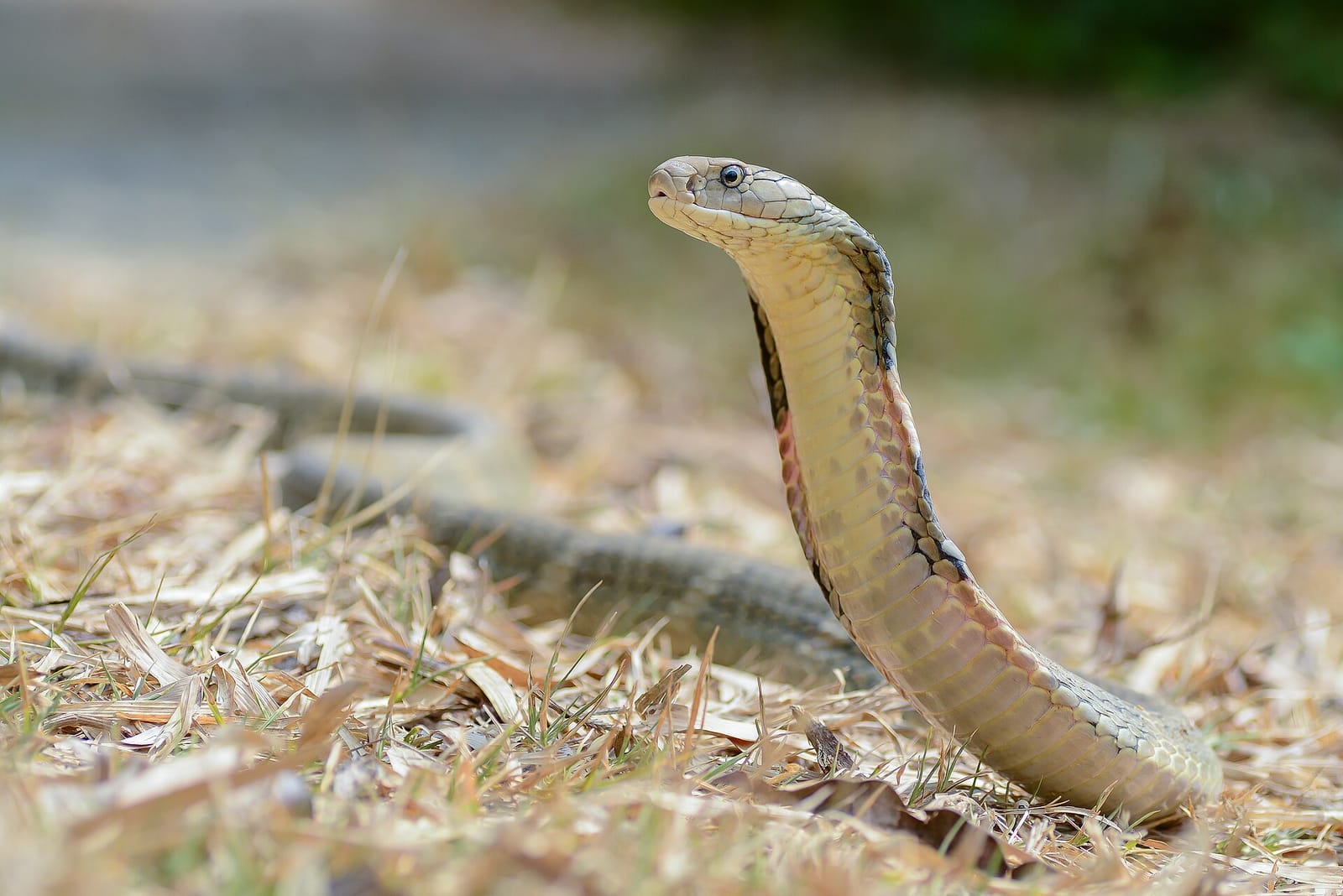
The heart of the place is the live king cobra show on the arena in the middle of the village. A handler brings out a live king cobra to perform in front of the crowd, with several different acts in rotation — from tamer snakes gliding along to a rhythm, all the way to the most heart-pounding act of all: the man-vs-cobra boxing.
Snake dance to rhythm
The handler brings out a king cobra to glide and rear up in time to the music — a gentle opener that lets the crowd see a real king cobra up close first.
Man-vs-cobra boxing
The highlight act: the handler taunts and dodges a king cobra reared up and ready to strike. It's a real gamble with danger that takes serious skill, and the whole arena holds its breath.
Bare-handed handling
The handler demonstrates catching and controlling a king cobra with bare hands, explaining the snake's behaviour and movements to the crowd as he goes.
Photos with a snake
After the show, some rounds let you pose for a photo with a snake at a safe distance, with a handler watching the whole time — a shot you can show your friends back home.
Straight talk on safety
This is a performance with real venomous snakes, not a fake show. No matter how skilled the handlers are, there's still risk. Watchers should sit or stand in the line the villagers set out, don't get closer than you're told, don't let small children run near the arena, and follow the handlers' instructions strictly. It's great fun to watch, but respect the fact that what's in front of you is a live king cobra.
Not just snakes: herbs and community souvenirs
Don't forget that this village started out as a community of herbal healers, so beyond the snakes there's also traditional herbal knowledge to see and to take home. The signature item is "Wan Phaya Ngu" (king-cobra herb) — a traditional folk remedy the villagers use for snakebites and various venoms, with recipes handed down generation to generation.
- Wan Phaya Ngu / herbal remedies — the folk recipes of the Khok Sa-Nga healers, which you can buy as a souvenir to take home.
- Snake exhibition — there's a spot with information about king cobras, their behaviour, and the way the village keeps them.
- Community souvenirs — local goods and small keepsakes that directly support the villagers.
Festival time: the King Cobra Merit Fair
If you want to see the King Cobra Village at its liveliest, come during Songkran, when the village holds its annual merit fair. There are full-scale snake shows, a procession, the bai sri su khwan blessing ceremony for the snakes, a "snake princess" pageant and folk-herb stalls. It's when the whole community comes out together, giving you a genuine Isan merit-fair atmosphere rather than just a show on its own.
Getting to Ban Khok Sa-Nga
The King Cobra Village is about 50 kilometres from Khon Kaen city — an easy drive of roughly an hour. The route runs straight out along the Mittraphap Road, then turns off towards Nam Phong District.
- Self-drive — from Khon Kaen city, take the Mittraphap Road (Highway 2) to around the 33 km mark near Nam Phong District, turn right onto Highway 2039 towards Kranuan District, and carry on about 16 km more — there are signs pointing to the village.
- Car / motorbike rental — the most convenient option here, since public transport is hard to reach. There are several rental companies in Khon Kaen city.
- Chartered taxi / van — if you're not driving, you can charter a vehicle from the city for a round trip; agree the price clearly in advance, including time to wait for the show.
- Pair it with other Nam Phong sights — Nam Phong is on the way to Ubol Ratana Dam, so you can plan a trip that stops at several places in one day.
Planning a King Cobra Village trip
The King Cobra Village is out of town, so a half-day trip or pairing it with other sights around Nam Phong–Ubol Ratana makes it more worthwhile. Here are two plans you can follow.
Morning half-day: see the snakes, head back to the city
Full day combined with Ubol Ratana Dam
Get ready before you go
Bring cash, since merit donations and buying things in the community are mostly cash only. Wear shoes you can walk comfortably on dirt ground in, bring a hat and water because the arena is out in the open, and if you bring kids, keep them close at all times whenever you're near the snake arena.
Where to go next from the King Cobra Village
Once you're over in the Nam Phong area, there's plenty more to see. Ubol Ratana Dam isn't far, with reservoir views and fish restaurants by the water. Or, on the way back into the city, you can stop at Wat Nong Waeng to see the nine-storey Phra Mahathat Kaen Nakhon pagoda, then round things off with a tasty Isan dinner in town.
Plan a full Khon Kaen trip — things to do, where to eat and where to stay
See the Khon Kaen travel guide →