🔄 Updated 21 Jun 2026
Say Lamphun and most people picture Wat Phra That Hariphunchai and longan fruit. But further out toward Mae Tha district sits Doi Khun Tan National Park. What sets this place apart from other parks is that it straddles the Lamphun–Lampang border, with the Northern Line railway running right through it. That makes it one of the few national parks in Thailand where you can take the train and step off right at the foot of the climb, no car needed.
The other highlight is the Khun Tan tunnel, a 1,352-metre railway tunnel that held the title of Thailand's longest for over a hundred years (it was only overtaken by a new tunnel in Saraburi in 2021). It was built during the reigns of Rama V–VI, between 1907 and 1918, under the supervision of German engineer Emil Eisenhofer. Boring through the mountain was brutally labour-intensive work for that era.
Why Doi Khun Tan
- The train takes you right there — get off at Khun Tan station and a few steps later you're at the entrance gate and the start of the climb. It's a national park you can visit with no car at all.
- You pass through a historic tunnel — every train stops at Khun Tan station to check the brakes before entering the tunnel, so you get a close look at the old tunnel mouth.
- Beginner-friendly hiking — the climb to the summit is broken into stages, Y.1 through Y.4, getting gradually steeper. You can stop at Y.2 and call it a day without pushing to the top.
- Cool air in the cold season — the summit sits around 1,373 metres, and on winter nights it drops to 7–10°C, perfect for camping in the breeze.
Want more out of Lamphun? Book tours & activities
Booking online ahead on Klook or GetYourGuide is usually cheaper than the gate and skips the queue. Pick only the experiences you actually want — prices and availability are shown live on each site.
How to get there — the train is easiest
The charm here is the train. Coming from Chiang Mai, hop on a Northern Line train and get off at Khun Tan station. An ordinary train costs around 15 THB and takes about 1.5 hours; a rapid or express runs around 50 THB and takes about an hour. Once you're off the train, it's a short climb up the stairs to the park gate.
Coming from Lampang, you can take the train to Khun Tan too, and it's a shorter ride. If you're driving yourself, you can park at the park's road-side lot, but the trailhead from there is on a different side than the railway station. It's worth checking the train timetable ahead with the State Railway of Thailand (SRT), since only a limited number of trains stop at Khun Tan. Miss your train back and you could be waiting a while.
A tip about the train
Plan your return train before you even start the climb, because only a handful of trains stop at Khun Tan each day. If you're aiming for a morning-out, evening-back day trip, leave plenty of time to walk back down for the last train, or just stay the night and save yourself the stress.
The hiking trail, Y.1 to Y.4
The trail to the Doi Khun Tan summit runs about 5 kilometres, divided into four old rest points called Y.1, Y.2, Y.3 and Y.4 ('Y' comes from 'yam', the old railway watchmen's huts from when the line was built). Today each point is a rest stop, campground and viewpoint. Reaching the summit takes around 2–3 hours, an easy half-day round trip.
Y.1 — the starting point
Close to the station and park headquarters. The first stretch is a paved road, easy walking like a public park, good for warming up your legs before the real forest trail begins.
Y.2 — the popular stop
About 4–5 km from the station, with park lodges, a campground and a few small food shops. Plenty of people stop here, and it's doable for beginners.
Y.3 — it starts getting steep
The trail turns into proper forest and steepens noticeably. Fewer people, a quiet and peaceful feel, good for anyone who wants to push on past Y.2.
Y.4 — the summit
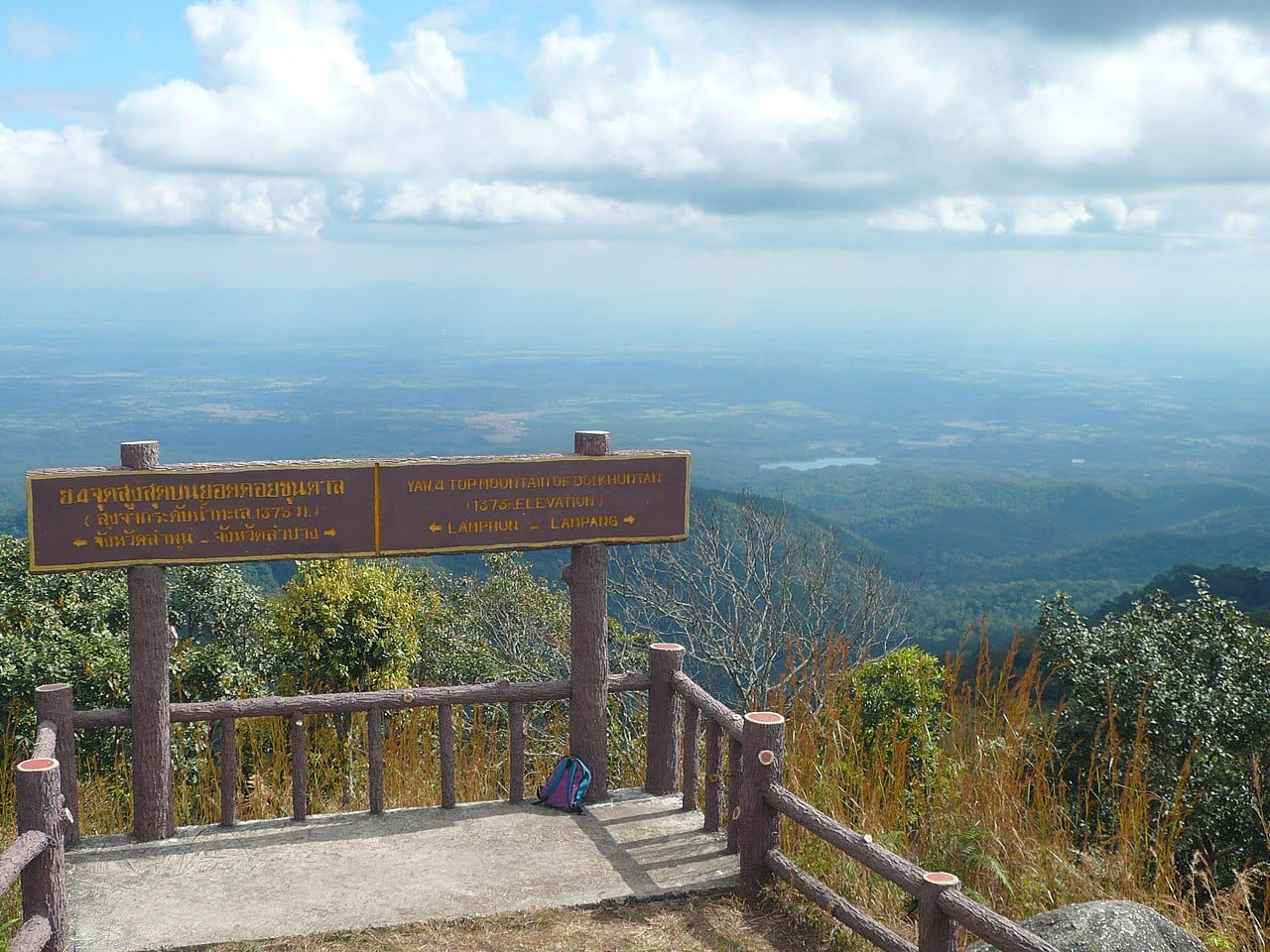
The final stretch is the steepest, but at the top you reach the summit viewpoint around 1,373 metres, with 360-degree mountain views all around. It gets busy by mid-morning.
If you're a first-timer or bringing kids or older folks, there's no need to force your way up to Y.4. Just reaching Y.2 gives you the full forest-and-mountain feel. If you're fit and want to bag the summit, set off early when it's cool and the crowds haven't filled in yet.
Prep before you hike
Wear sneakers or hiking shoes with good grip, carry enough water (supplies at the top are limited), a sun hat, and a warm layer if you're staying overnight. The Y.3–Y.4 stretch is steep and slippery when it rains, so take extra care in the wet season.
Camping and lodges
Doi Khun Tan is a favourite with campers, especially in the cold season. The main campgrounds are near the headquarters and around Y.2, set under the pines with a cool breeze. Park entry runs roughly 20–100 THB for adults and less for children (rates may change per Department of National Parks announcements, so check on site). Pitching your own tent costs around 30 THB per night for the site.
- Bring your own tent — the cheapest option, just the site fee of around 30 THB/night, ideal for campers who already have their own gear.
- Rent a park tent — available on site; a single tent runs around 150 THB and a double around 225 THB. Add a full bedding set and it costs more.
- Park lodges — several units ranging from a few hundred to over two thousand THB per night. Monday–Thursday often comes with a discount, good for anyone who'd rather not sleep in a tent.
- Book ahead — in the cold season and over long weekends it gets very busy, and lodges and campsites fill fast. Booking through the Department of National Parks' nps.dnp.go.th system in advance is the safe bet.
Something a lot of people miss
In the hot season (roughly April–June), the park often suspends overnight stays and camping in some areas to let the forest recover and reduce wildfire risk. If you're planning to stay the night, call the park first to check (Tourist Service Centre, tel. 081-032-6341).
When to go
The best window is November–February: cool, comfortable air, around 23°C by day and dropping to 7–10°C at night up on the mountain, with clear skies and easy walking. It's the best time to camp in the cold-season breeze, and also the busiest, so book ahead.
In the rainy season (June–October) the forest is lush and green, but the steep sections get slippery and need extra care. The hot season brings heat and partial overnight closures, so avoid it if you can. If you want a quiet trip with fewer people, try going on a weekday instead of a weekend.
Where to go next
Doi Khun Tan straddles Lamphun and Lampang, so you can carry on exploring either side. Head back into Lamphun town to pay respects at Wat Phra That Hariphunchai, wander the old town and grab local food like khanom jeen nam ngiao. If you've got time to spare, pairing it with a Chiang Mai–Lamphun trip works nicely since it's all on the same train line.
Plan a full Lamphun trip with temples, food and nature
See the Lamphun travel guide →