🔄 Updated 21 Jun 2026
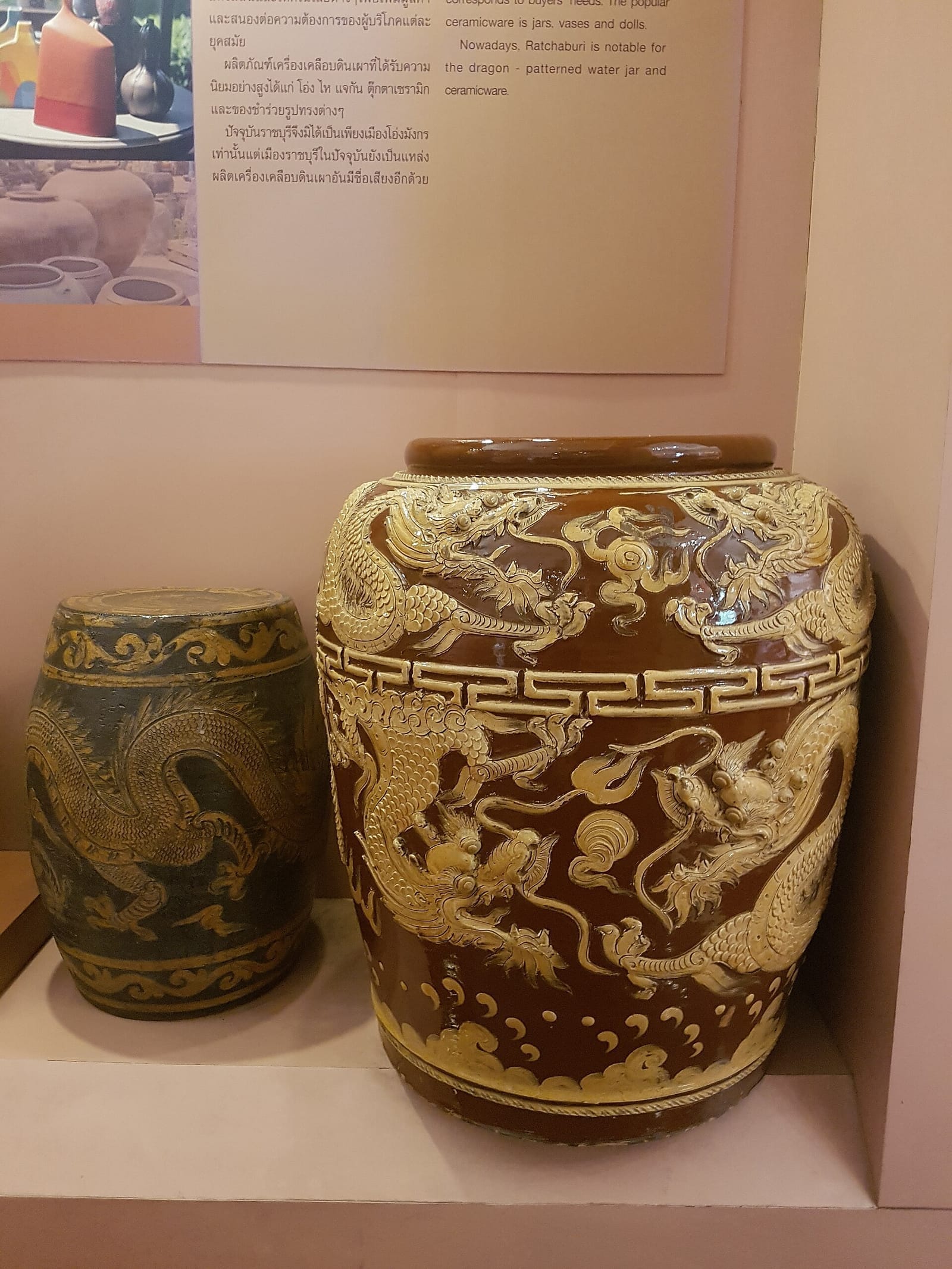
Mention Ratchaburi and a lot of people picture the dragon jar before anything else — the big deep-brown jar with a dragon coiling around it in relief. It started here around 1933, when Chinese immigrant craftsmen settled in the area and brought their glazed-stoneware skills with them. The clay along the Mae Klong River turned out to be perfect for the job, and the town grew into one of the country's biggest jar-making centres, a status it still holds today. What was once an everyday household item is now part art piece, part garden ornament, and part photo spot.
What is a dragon jar, and why come to see it in person
Dragon jars aren't thrown on a spinning wheel like ordinary pottery. Instead the clay is rolled into long coils and built up one ring at a time, with the potter smoothing the surface by hand. The dragon is then sculpted in separate pieces and pressed on around the jar, before it's brushed with a brown glaze and fired in a high-heat wood kiln. A single jar takes several days. Standing right in front of a potter as they shape that dragon is the real reason people want to come to the workshop itself — not just look at finished pieces in a souvenir shop.
- Entirely handmade — no two dragons are exactly alike, because each one is sculpted and applied by hand
- Local Ratchaburi clay — the dense clay from the Mae Klong riverbank holds up well for building big jars
- Wood-kiln fired — that signature deep brown comes from the glaze and the heat inside the kiln
- Plenty of sizes — from small tabletop jars up to jars taller than a person for the garden
Want more out of Ratchaburi? Book tours & activities
Booking online ahead on Klook or GetYourGuide is usually cheaper than the gate and skips the queue. Pick only the experiences you actually want — prices and availability are shown live on each site.
Where to watch, try, and buy pottery
Ratchaburi has both learning centres that put together a full experience for visitors and working jar yards that sell the real thing at factory prices. Pick whichever suits you. If you want to shape and paint a piece yourself and hear the story behind it, head for a learning centre. If you'd rather browse and buy plenty of jars and pots, go straight to the pottery yards.
Rueang Khong Ong (Dragon Jar Learning Centre)
The first place in Ratchaburi set up as a full learning centre. There's a museum tracing the jar's history from the early days to the present, a demonstration zone where you can watch potters shape and apply the dragon pattern in front of you, and a hands-on area to paint a mini jar or try shaping one yourself. The restaurant building is even designed in the shape of a jar, which makes for a fun photo.
Tao Hong Tai : d Kunst Art Space & Cafe
Ratchaburi's first contemporary art space, run by the family behind the Tao Hong Tai pottery. They converted a Manila-style wooden house from the reign of King Rama V into a gallery and cafe, with contemporary ceramic works on show, a corner where you can try painting ceramics, and pieces from the Tao Hong Tai factory for sale. It's a favourite with people who love design.
Tao Hong Tai (the original ceramics factory)
A long-established pottery yard founded back in 1954. It started out making dragon jars and fish-sauce fermenting jars before branching into all kinds of ceramics. The showroom runs from traditional pottery to contemporary art pieces, and you can walk through to see the production process and pick out things to buy.
Rueang Sin 3 & 4 Pottery Yard
A pottery yard focused on actually making and selling — dragon jars, dragon planters, lotus bowls, fermenting jars, feng-shui overflow water jars, and garden ceramics. They sell retail and wholesale at factory prices, so it's the right stop if you've come specifically to find real pieces for the house or garden. Nationwide delivery available.
If you want to catch the potters at work
At Rueang Khong Ong, the guided demo sessions only run Friday to Sunday, twice a day (10am–noon and 1.30–3.30pm). If you're set on seeing the full shaping-and-dragon-applying demonstration, aim for a Saturday or Sunday on one of those slots so you catch the potters mid-work.
Cafes inside the jar yards and where to take photos
The charm of Ratchaburi's pottery district these days is the way old industrial space has been reworked into somewhere you can actually hang out. Tao Hong Tai : d Kunst is the clearest example — a century-old wooden house turned cafe-plus-gallery with ceramic works dotted all over, indoors and out. Order a coffee or an Italian soda and wander the art; the brick walls, bare concrete and pottery pieces make a backdrop you won't get at an ordinary cafe.
Coffee inside the gallery
d Kunst has a cool air-conditioned indoor zone and an outdoor zone. Order a drink and take in the contemporary ceramics while you're at it. Free wifi, good for settling in a while.
The jar-shaped restaurant
At Rueang Khong Ong, the restaurant building is shaped like a jar — the standout photo spot here. Stop in for a bite or a drink after you've looked around.
How to buy a jar to take home and get your money's worth
If you're here to buy rather than just photograph, the yards that sell at factory prices like Rueang Sin or Tao Hong Tai work out better value than the souvenir shops along the road. Small pieces like fermenting jars or mini planters run in the hundreds of baht; a big jar or lotus bowl moves up into the thousands depending on size and pattern.
- Measure your space first — a big jar is heavy and takes up room, so be sure of where it'll go before you buy
- Check delivery — many yards ship nationwide, so you don't have to haul a large jar yourself
- Pick a pattern you really like — every handmade jar is different, so browse and choose the one that grabs you
- Small pieces make good gifts — mini jars, cups and ceramic plates are easy to carry back and light on the wallet
Planning a one-day pottery trip
An easy day around Ratchaburi's jar yards
Getting there from Bangkok
Central Ratchaburi sits about 100km from Bangkok, just over an hour's drive. The pottery spots are split between the Don Tako side and the town centre, close enough to string together in a single day. Having your own car makes it by far the easiest.
Plan a full Ratchaburi trip across the whole province
See the Ratchaburi travel guide →