📝 Written 1 Jul 2026 · ✅ Fact-checked 3 Jul 2026 · prices and schedules can change — check with the operator before booking
Bangkok is a sprawling city with attractions scattered all over — from the old quarter along the Chao Phraya River, with the Grand Palace and Wat Pho, to the central shopping districts of Siam and Ratchaprasong, all the way to the eating and drinking strips of Sukhumvit and Thong Lo. The one thing everyone runs into is traffic, especially during the morning and evening rush hours, and even more so when it rains. Choosing the right way to get around for each situation can save you a lot of both time and money.
The simple rule of thumb is: if your starting point and destination are both near a BTS or MRT line, always take the train first, because it runs above the traffic and keeps to a predictable schedule. In riverside and canal-side areas, boats are faster and come with a bit of atmosphere on top. For distances the trains and boats don't reach, fall back on a metered taxi or a ride-hailing app, and save tuk-tuks and motorcycle taxis for short hops only. Below, we compare all the options at a glance, then go into detail on each one.
| Mode of transport | Convenience | Cost | Best for | Watch out for |
|---|---|---|---|---|
| BTS / MRT | Skips traffic, predictable timing, air-conditioned, runs every few minutes | ~฿17–62 per trip depending on distance | Travelers going along the train lines who want to avoid traffic | Very crowded during rush hour, only reaches areas along the tracks |
| Chao Phraya boat / Khlong Saen Saep boat | Bypasses the roads by water, fast along riverside and canal routes | ~฿10–33 (Chao Phraya) · ~฿10–20 (Khlong Saen Saep) | Travelers visiting riverside/old-town areas, or the Pratunam–Thong Lo route | Piers have steps, water can splash in, service ends fairly early |
| Metered taxi | Hail one on the street, goes anywhere, fits multiple passengers | Starts at ฿35 + metered fare (traffic adds to the time-based charge) | Reaching places trains/boats don't cover, traveling with luggage or in a group | Insist the driver uses the meter; some refuse passengers; fares can climb in traffic |
| Ride-hailing app (Grab / Bolt) | Book through the app, see the price upfront, no need to haggle | Moderate · price shown before you book, surge pricing during peak times | Travelers who don't want to flag down a taxi, late nights, rain, or heavy luggage | Rush hour/rain brings surge pricing and longer waits; still stuck in the same traffic |
| Tuk-tuk | Easy to find near tourist spots, adds to the atmosphere | Flat negotiated fare, usually pricier than a taxi/app for tourists | A short one-off ride for the experience | Prices set high, scams steering you into shops, must haggle before you get in |
| Motorcycle taxi (win) | Best at weaving through traffic, fast over short distances | ~฿10–25 within a soi (longer distances negotiated) | Getting deep into a soi, connecting from the train, or rushing over a short distance | Accident risk, wear a helmet, not ideal with luggage or multiple people |
| Airport Rail Link | Connects Suvarnabhumi Airport to the city, skips road traffic | ~฿15–45 per trip | Travelers going to or from Suvarnabhumi Airport when traffic looks bad | Connect to BTS/MRT at Phaya Thai/Makkasan; lots of stairs if you have heavy luggage |
BTS Skytrain / MRT Subway

For getting around Bangkok, the train system should always be your first thought if your starting point and destination are both near a line, because it runs on tracks separate from the roads, so it skips traffic and keeps to a clear schedule. There are two main systems: BTS, the elevated Skytrain with the Sukhumvit Line and Silom Line, running through Siam, Asok, Thong Lo, On Nut, and Silom-Sathorn, and MRT, which includes the Blue Line running in a loop connecting Hua Lamphong, Yaowarat, Sam Yot, all the way to Chatuchak and Rama 9, plus other lines that keep opening. The two systems connect at several points — for example Asok-Sukhumvit — and Siam is BTS's main interchange station, so you can reach nearly every shopping and business district in the city without ever touching the road.
Fares are distance-based, running roughly 17–62 baht per trip. You can pay with a single-journey token or ticket from the machine, or use a stored-value card like BTS's Rabbit Card or an MRT card for convenience. The limitation to understand is that the trains only reach areas along the tracks — if your destination is deep in a soi or in an old riverside area the tracks don't reach, you'll need to connect via motorcycle taxi, taxi, or boat. Another thing to note is that during the morning and evening rush hours, the trains get very crowded — at some stations like Asok or Siam, you may have to wait for several trains before you can board. Avoiding peak hours makes for a much more comfortable ride.
- Genuinely skips traffic — runs on tracks separate from the road with predictable arrival times
- Air-conditioned, clean, and safe, suitable for all ages
- Covers the central shopping and business districts, with several BTS-MRT interchange points
- Fares are reasonable and predictable; a stored-value card makes tapping in and out fast
- Only reaches areas along the tracks — anywhere deep in a soi or by the river needs a connecting ride or boat
- Very crowded during rush hour, sometimes requiring several trains before you can board
- Some stations have a lot of stairs, inconvenient if you're carrying heavy luggage
Chao Phraya Express Boat + Khlong Saen Saep Boat

Boats are a mode of transport people tend to forget, but on certain routes in Bangkok they're actually faster and better at avoiding traffic than a car. There are two main systems travelers use often. The first is the Chao Phraya Express Boat, which runs up and down the river, stopping at major piers connected to old-town attractions — for example Tha Chang (Grand Palace–Wat Pho), Tha Tien (crossing to Wat Arun), Tha Phra Athit (Khao San Road), and Sathorn Pier, which connects neatly with the BTS Saphan Taksin station. Fares are very cheap, roughly 10–33 baht depending on distance and boat type. The boats run several lines distinguished by the color flag at the bow — some stop at every pier, others only at the main ones. The second system is the Khlong Saen Saep canal boat, which runs through a canal in the middle of the city, connecting the Pratunam-Ratchathewi area toward Thong Lo and Ekkamai — handy when the roads in that area are jammed, since the boat cuts through the canal much faster. Fares run roughly 10–20 baht.
One thing to keep in mind is that both boat systems are genuinely local transport. Most piers have steps and narrow walkways, so boarding and disembarking takes some care, especially with luggage or elderly travelers. The Khlong Saen Saep boat moves fast and some water may splash in — there are canvas curtains you can pull down to block it. During rush hour it gets crowded and you need to board and disembark quickly when the boat pulls in. Service hours are also fairly limited — the Chao Phraya Express Boat mostly runs during the day into the early evening, while the Khlong Saen Saep boat stops early in the evening. If you're heading back late at night, plan to use the train or a ride-hailing app instead. For travelers focused on temples and the old town, combining the Chao Phraya Express Boat with the BTS at Saphan Taksin is one of the best-value, most traffic-free combos available.
- Avoids traffic well on riverside and canal routes — sometimes much faster than a car
- Very cheap fares, roughly 10–33 baht per trip
- The Chao Phraya Express Boat connects old-town attractions and links to the BTS at Saphan Taksin
- Riverside atmosphere and local life that a car can't offer
- Piers have steps and narrow walkways, awkward with luggage or elderly travelers
- The Khlong Saen Saep boat moves fast and water may splash in; crowded during rush hour
- Limited service hours, ending fairly early — not suited to late-night travel
Metered Taxi

Metered taxis are plentiful in Bangkok and easy to hail, whether you flag one down on the street or grab one from a stand outside a mall or hotel. The advantage is that they go anywhere, including places trains and boats don't reach, they fit multiple passengers, they can carry luggage, and the legal fare starts at roughly 35 baht, then adds up based on distance and time on the meter. Split per person for a group ride, it can even work out cheaper than a ride-hailing app. The single most important point is that you must confirm the driver switches on the meter every time before setting off. If a driver offers a flat rate instead of using the meter, decline and hail a different cab, because a flat rate is usually far more expensive than the meter, especially in tourist areas.
To be candid, Bangkok taxis are a mixed bag. Some drivers refuse passengers if the destination is stuck in traffic or somewhere they don't want to go; some claim they won't switch on the meter at night or when it's raining; and because Bangkok traffic is heavy, fares during rush hour can climb since the meter also charges for time when the car isn't moving. If you take an expressway, there's an extra toll the passenger pays. A more reassuring option for many people is to book through an app so you know the price and have the driver's details on hand, but if you flag down a taxi yourself, pick one that agrees to use the meter from the start, have your destination ready in Thai or pin it on a map to show the driver, and carry small cash since many drivers can't break large bills.
- Easy to hail, whether flagging one down or grabbing one from a stand, available around the clock
- Goes anywhere, including places trains/boats don't reach, and can carry luggage
- Fits multiple passengers — split per person, it's often cheaper than a ride-hailing app
- Metered fare starts cheap, at roughly 35 baht
- Some drivers refuse passengers or won't switch on the meter — always confirm before setting off
- Heavy traffic can make fares climb during rush hour
- Communication can be tricky if the driver isn't comfortable in English — pin your destination on a map
Ride-Hailing Apps (Grab / Bolt)

Ride-hailing apps like Grab and Bolt are the go-to option for many travelers in Bangkok because they're convenient and transparent. The main advantage is seeing the price before you book, so there's no haggling or worrying about whether the driver will use the meter, unlike flagging down a taxi. The app matches you with a nearby driver and shows you their details, license plate, and the route on the map, and you can pay in cash or by card. It's especially handy when heading out late, in the rain, carrying heavy luggage, or if you'd rather not risk being turned down by a taxi. Grab offers several vehicle options, including cars and motorcycles (GrabBike), which move faster in heavy traffic. Many people keep both Grab and Bolt open and compare prices before booking, since Bolt is sometimes slightly cheaper.
The limitation to understand is that ride-hailing apps still use the same roads as regular traffic, so they hit the same jams. During rush hour or when it's raining, demand spikes and prices surge, and you may have to wait longer than usual. In some spots, like in front of a big mall or in tourist areas, it can be hard for a driver to reach you because of circular traffic patterns and limited parking. In those cases, if your destination is near a train line, taking the BTS/MRT is often faster and cheaper. The best approach is to use ride-hailing apps as a backup for distances the trains and boats don't reach, or at night once public transit has stopped running. It's worth downloading both Grab and Bolt before your trip and linking a card, so you can book immediately whenever you need to.
- See the price before boarding — no haggling or worrying about the meter
- Driver and license plate details provided; pay by cash or card
- Available almost 24 hours, handy for late nights, rain, or heavy luggage
- Open both Grab and Bolt to compare prices, with both car and motorcycle options
- Uses the same roads as regular traffic, so it hits the same jams
- Surge pricing and longer waits during rush hour/rain
- Hard for drivers to reach you in some spots, like in front of big malls or tourist areas
Tuk-Tuk

The three-wheeled motorized tuk-tuk is an icon of Bangkok, parked and waiting around tourist attractions, the old town, and many markets. Plenty of people want to try one at least once for the open-air breeze and the experience an air-conditioned car simply can't offer. Tuk-tuks work best for short hops within the same area — for example from Khao San Road to the Giant Swing, or around the old town. The one thing you need to know from the start is that tuk-tuks have no meter, so you must haggle over the price before boarding every time, and for tourists, the price is usually set noticeably higher than a taxi or ride-hailing app would charge for the same distance. If you do want to ride one, ask for a clear price and agree on it fully before setting off.
One thing to watch out for in particular is the tuk-tuk scam, common in tourist areas. The classic version offers a suspiciously cheap rate, such as a full day for just a few dozen baht, and then takes you to gem shops, tailor shops, or souvenir stores where the driver earns a commission, wasting your time and pressuring you to buy. Sometimes they'll also claim the place you want to visit is closed in order to steer you elsewhere instead. The safe approach is to decline offers that seem too good to be true, refuse to be taken to shops you didn't ask to visit, and if your destination is far or you want a predictable price, calling a Grab/Bolt or hailing a metered taxi will be better value and less stressful. In short, treat the tuk-tuk as a one-off experience to try rather than your main way of getting around for the trip.
- Open-air feel, a distinctive Bangkok experience
- Available immediately near tourist attractions, no app needed
- Convenient for short hops within the same old-town area
- Good for trying once for photos and the experience
- No meter, requires haggling, and usually pricier than a taxi/app for tourists
- Scams exist involving suspiciously cheap offers that lead to gem shops/souvenir stores
- Open-air, exposed to dust, exhaust, and noise — not ideal for long distances or with luggage
Motorcycle Taxi (Win Motorcycle)

The motorcycle taxi, known to locals as a win motorcycle, is a short-distance mode of transport Bangkok residents use every day. You can spot them from the numbered vests the drivers wear, gathering at motorcycle taxi stands near the mouths of sois, in front of train stations, and in market areas. Their biggest strength is weaving through traffic better than any other option, slipping through gaps between cars, which makes them very fast over short distances when the road is jammed. They're best suited for getting deep into a soi that a taxi or ride-hailing car isn't worth taking, or for connecting from a train station to your accommodation or workplace at the end of a soi. Fares within a soi usually run around 10–25 baht, and many stands post a price board listing rates by destination; longer distances need to be negotiated beforehand.
To be candid, motorcycles carry a higher accident risk than other vehicle types, especially when weaving through Bangkok's heavy traffic at speed. You should ask the driver for a helmet and wear it every time (it's also required by law for passengers), hold on securely to the rail or grip, and it's not suitable if you have a lot of luggage or are traveling in a group, since it only carries one passenger at a time. For travelers, a win motorcycle works best for specific situations — for example connecting from a train station into the soi where you're staying, or rushing a short distance — rather than as a way to cover long distances. If you're not confident about the safety aspect or have a lot of belongings, a taxi or ride-hailing app is the better choice.
- Best at weaving through traffic, very fast over short distances when the road is jammed
- Ideal for reaching deep into a soi where a car isn't worth taking, or connecting from the train
- Cheap fares within a soi, roughly 10–25 baht; many stands post price boards
- Stands are spread throughout the city, easy to find near soi mouths and train stations
- Higher accident risk than other vehicle types — wear a helmet and hold on securely
- Carries only one passenger at a time, not suitable with a lot of luggage or a group
- Longer distances require negotiation, and you're exposed to dust, exhaust, sun, and rain
Airport Rail Link (Suvarnabhumi Airport Connector)
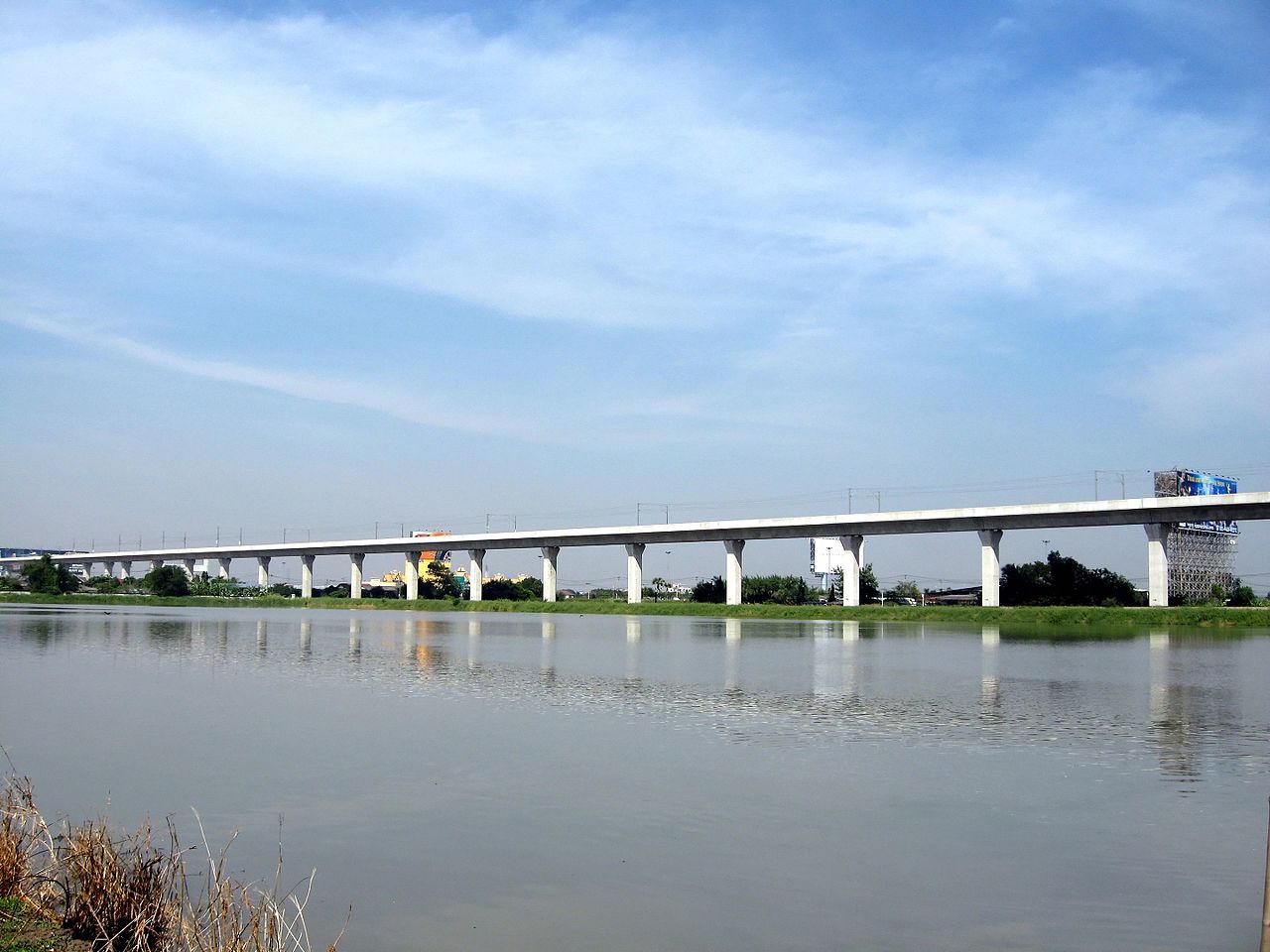
The Airport Rail Link (ARL) is the train connecting Suvarnabhumi Airport to the city center, running from Suvarnabhumi Station through Lat Krabang and Ramkhamhaeng, ending at Makkasan and Phaya Thai stations. It's the way into the city from the airport that best avoids traffic, especially during the morning and evening when the motorway and expressway can back up for a long stretch. Fares are very cheap compared to a taxi or ride-hailing app, running roughly 15–45 baht depending on distance, and trains run frequently every few minutes. What makes the ARL worthwhile is that its city-end stations connect directly to other systems — at Phaya Thai you can transfer to the BTS Sukhumvit Line, and at Makkasan you can walk to the MRT's Phetchaburi station — making it convenient to spread out to different parts of the city.
One thing to keep in mind is that the ARL is a train system, so it involves stairs and escalators at the stations. If you have several large suitcases or are traveling as a group with a lot of luggage, hauling bags up and down and then connecting to your accommodation may be less convenient than a taxi or ride-hailing car that takes you straight to the hotel door, and during rush hour the trains get crowded just like other lines. The best approach: if you're traveling alone or with one other person with light luggage, and your accommodation is near a BTS/MRT line you can connect to, the ARL will be the fastest and most economical option. But if you're traveling as a family with a lot of bags, or your accommodation is far from a station, calling a ride-hailing app or taxi straight from the airport to your accommodation may be more comfortable.
- Best at avoiding road traffic on the Suvarnabhumi Airport–city route
- Very cheap compared to a taxi/ride-hailing app, roughly 15–45 baht
- Connects to the BTS at Phaya Thai and the MRT at Makkasan, convenient for spreading out across the city
- Runs frequently every few minutes with predictable timing
- Involves stairs, awkward for hauling several large suitcases
- Still requires a connecting ride/walk to your accommodation at the city end
- Trains get crowded during rush hour, just like other lines
How to choose
In short, by situation: if your starting point and destination are near a train line, BTS/MRT is always the first choice, since it avoids traffic and keeps to a predictable schedule · for visiting the old riverside town or the Pratunam–Thong Lo route when the roads are jammed, the Chao Phraya/Khlong Saen Saep boat is faster and cheaper · for reaching places trains and boats don't cover, carrying luggage, or traveling in a group, use a metered taxi (confirm the meter is on) or Grab/Bolt if you want to know the price upfront and avoid flagging down a cab · for getting deep into a soi or rushing a short distance in traffic, a motorcycle taxi is fastest (don't forget the helmet) · for trips to and from Suvarnabhumi Airport, the Airport Rail Link avoids traffic and saves money if you're not carrying much luggage · and save the tuk-tuk for a short one-off experience, always agreeing on the price before boarding.
Book Activities & Tickets in Advance
Popular activities and tours in Bangkok fill up fast — booking online ahead of time is more convenient.
Where to stay when visiting Bangkok?
Choose accommodation along a BTS/MRT line for convenient access anywhere, without hitting traffic. Compare prices across 3 sites before booking.
Search accommodation on AgodaGot your route planned? Now pick accommodation along a train line for easy access anywhere.
See well-located hotels in Bangkok →