🔄 Updated 21 Jun 2026
If you're in Hat Yai and want to fit in some shrine visits, the good news is that most spots sit close together. They fall into roughly two zones: the downtown Chinese shrines you can walk between, and the Khao Kho Hong cluster that takes a drive or a motorbike-taxi ride up the hill. We'll go through each one first, then map out a combined route at the end.
White Jade Guan Yin, Khao Kho Hong
This is the first place that comes to mind when people talk about shrine-hopping in Hat Yai. The Guan Yin shrine sits up on Khao Kho Hong in the Ban Plak Thong area of Kho Hong sub-district. The highlight is the blessing-pose Guan Yin, carved from a single block of white jade, about 9.9 metres tall and weighing around 58 tonnes, imported from Taiwan — one of the largest single pieces of white jade you can see in Thailand. Its roots actually trace back to a century-old Guan Yin shrine built by Khun Niphat Chin Nakhon in the town's pioneer days, which is why locals treat it as the original blessing spot of Hat Yai.
- What people pray for — health, family, success, and a smooth life overall
- The view — set on the hill, you get a wide look over Hat Yai, and the light is lovely toward late afternoon
- Dress code — it's a sacred site, so wear something modest, cover your shoulders, and skip very short bottoms
Tip
The way up is a hill with steps. If you're with elderly family, you can drive up and park at the top. Long weekends get very crowded — go early or in the late afternoon for an easier walk.
Want more out of Hat Yai? Book tours & activities
Booking online ahead on Klook or GetYourGuide is usually cheaper than the gate and skips the queue. Pick only the experiences you actually want — prices and availability are shown live on each site.
Brahma Shrine, Hat Yai Municipal Park
The Brahma shrine sits inside Hat Yai Municipal Park, also on Khao Kho Hong. It's where the city's business owners and traders like to come, praying for work, money, and good fortune. Each of the four-faced Brahma's faces grants a different blessing, so people tend to pay respects at all four directions. It's in the same area as the cable car and the Phra Phuttha Mongkhon Maharat statue, so it's easy to combine.
- What people pray for — work, finances, and a smooth-running business
- Opening hours — roughly 07:00–18:00 daily
- Offerings — there are stalls selling incense, candles, marigolds, and garlands right in front of the shrine
Nearby you'll find Phra Phuttha Mongkhon Maharat, the large standing Buddha that watches over Khao Kho Hong, and the stainless-steel pagoda that marks the summit. Once you're up there, the city view makes for good photos — a chance to pay respects and take in the city in one place.
San Shen Tang, the Downtown Chinese Shrine
If you'd rather not climb the hill, the downtown spot people have been talking about lately is San Shen Tang shrine, at 170/2 Thamnoonvithi Road, in front of the Hat Yai Hakka Association. You can walk there from the Kim Yong Market area and the downtown hotels. Inside are three white jade figures: Guan Yin as the central deity, the warrior god Guan Yu, and Cai Shen Ye, the god of wealth.
- Guan Yin — for health, family, and compassion
- Guan Yu — for honesty, work, and business partners; people often offer tea and liquor
- Cai Shen Ye — the god of fortune, for money and trade
Tip
Open roughly 08:00–18:00. There are staff inside who can guide you through the order of worship, so if you're not sure about the ritual, just ask. You can buy offerings at the shrine or bring your own.
Tiger God Shrine, Niphat Uthit Road
Hat Yai's Tiger God shrine sits on Niphat Uthit 2 Road, right in the commercial district. It's an old Chinese shrine that the local traders have worshipped at for ages, where people come to ask for authority and standing, protection, and good luck through the year. It's also a popular spot to resolve a bad zodiac year (kae chong) and shake fortune sticks, especially early in the year and around Chinese New Year.
- What people pray for — fortune, protection, and clearing a bad zodiac year
- Location — central, walkable from Kim Yong Market and the hotel district
- Busiest times — Chinese New Year and early in the year, when crowds come to clear their zodiac year
Wat Hat Yai Nai, the Giant Reclining Buddha
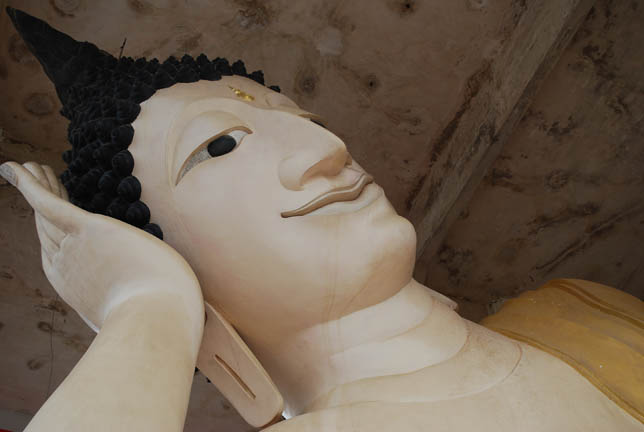
Wrap up the shrine trail at the city's own temple, Wat Mahatthamangkalaram — better known as Wat Hat Yai Nai. The highlight is Phra Phuttha Mahatthamongkhon, a large blessing-pose reclining Buddha about 35 metres long and 15 metres tall, once ranked among the biggest reclining Buddhas in Asia. The base is built out as a hall where you can walk through and pay respects inside. People come here to pray for a smooth life, health, and getting ahead.
Reclining Buddha at Wat Hat Yai Nai
The large Phra Phuttha Mahatthamongkhon, with a walk-through hall in the base — good for praying for a smooth life.
Guan Yin + Brahma on Khao Kho Hong
Two blessing spots on the same hill you can visit back to back, plus the city view and the stainless-steel pagoda.
A One-Day Blessing Route
If you have a single day and want to cover both the Chinese and Thai spots, here's roughly how it works. Start downtown in the morning while the crowds are still thin, head up Khao Kho Hong mid-morning, then finish at the temple.
Downtown Chinese shrines
The Khao Kho Hong cluster
Finish at the temple
Before you set out
Most shrines and temples don't charge admission, but offerings and donations are up to you. Keep some cash and small notes handy. Weekdays are quieter and easier to walk than weekends, and Khao Kho Hong gets strong sun midday — bring an umbrella or a hat.
Keep planning your Hat Yai trip — where to stay, what to eat, and what to see
See the Hat Yai travel guide →