🔄 Updated 21 Jun 2026
Huai Chorakhe Mak is a large irrigation reservoir for Buriram, covering around 3,876 rai across the sub-districts of Ban Bua, Samet, and Sakae Phrong in Mueang district, out along the road toward Prakhon Chai and Nang Rong. What makes this more than an ordinary reservoir is that it has been declared a non-hunting area and has become a wetland where large numbers of resident and migratory birds come to live. In total, at least 170 bird species have been recorded here.
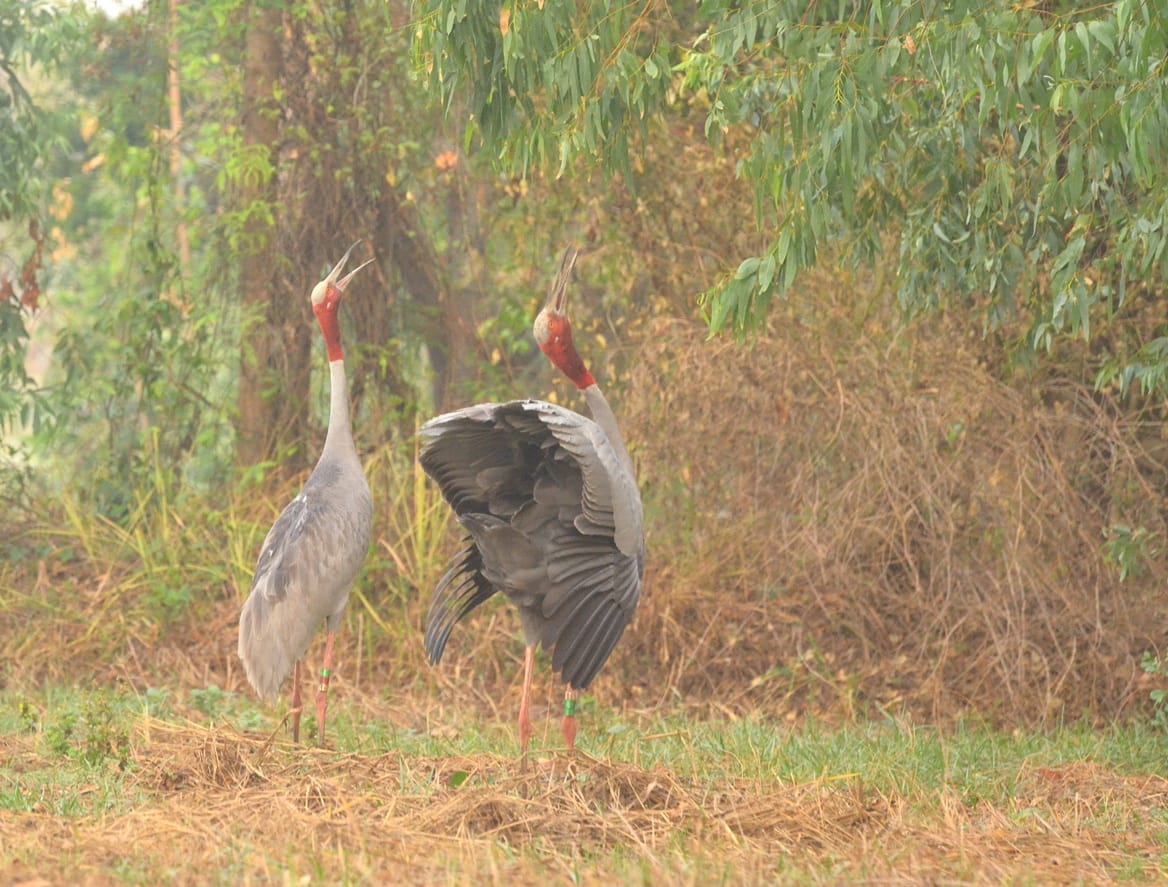
The thing people talk about most is that this is a release site for the Sarus crane, returned to the wild. This bird had gone extinct in Thailand, and the Zoological Park Organization began releasing them back at Huai Chorakhe Mak in 2011. Today there is a flock that lives and nests on its own in the area. If you love nature and birdwatching, this is a rare spot in Isan — you get to see the real bird in the place where it has managed to come back.
What there is to do here
Huai Chorakhe Mak isn't a tourist attraction with an entry fee or an official gate. It's an open space that townspeople actually use day to day — people come to run, cycle, fish, and sit out in the evening breeze. For visitors who come on purpose, the main activities are birdwatching and the boat trips, both looked after by a learning centre.
Walking and cycling around the reservoir
There's a path along the water for walking and cycling, with a steady cool breeze because you're right by the lake. Locals come out to exercise in the morning and evening, and the mood is quiet and calm. It's a place to sit and breathe, not somewhere you rush around ticking off photo spots.
Birdwatching from the tower
The learning centre has a four-storey tower with a spotting scope for picking out Sarus cranes and other birds across the wetland. You get a wide view over the whole reservoir, and birds are easier to spot in the morning and evening when they head out to feed.
Sunrise birding boat trip
The centre runs boats that take you out to spot birds and watch the sunrise in the early morning. The boat costs around THB 300 and seats two. Heading out before dawn, you get still water, thin mist, and birds skimming the surface. Best to call ahead and book.
Book the boat before you go
If you're set on a morning birding boat trip, don't just turn up — boats are limited and head out before dawn. We'd call the Wetland and Sarus Crane Learning Centre ahead of time (the number is around 09 0286 8327) to ask about boat times and the water conditions that day, so you don't make the trip for nothing.
Want more out of Buriram? Book tours & activities
Booking online ahead on Klook or GetYourGuide is usually cheaper than the gate and skips the queue. Pick only the experiences you actually want — prices and availability are shown live on each site.
Birdwatching at Huai Chorakhe Mak — what you'll see
The star here is the Sarus crane — a tall, long-legged bird that had vanished from the wild in Thailand and was reintroduced at this site. When the cranes feed out in the rice fields around the reservoir, that's your chance to see them clearly. But cranes are wary of people, so watch from a distance and stay quiet — don't chase them or move in close.
Beyond the cranes, this wetland has plenty of other water and field birds, both residents and migrants that arrive in the cool season. If you're a serious birder, bring your own binoculars or a telephoto lens, because the birds stay far from shore.
- Sarus crane — the highlight of the area, tall and long-legged, seen out in the rice fields around the reservoir; watch from far away
- Resident water birds — lesser whistling ducks, purple swamphens, cormorants, and several heron species, feeding on the surface and among the lotus beds
- Cool-season migrants — November to February is when migratory birds stop by in the greatest numbers, and birding is more fun than the rest of the year
- Field birds around the reservoir — weavers, mynas, and sunbirds along the tree lines and rice fields by the water
Red lotus at dawn — when to come to catch it
In parts of the reservoir, lotus grow in wide patches across the surface. At first light the red lotus open to greet the sun, and as the morning warms up and the sun gets stronger, the flowers start to close. So if you want to see them blooming nicely, you have to come genuinely early — around 6 to 8 a.m. That's when there's still a cool breeze and thin mist over the water too. It's the best time of day to be here.
Straight talk about the lotus
The red lotus here aren't a vast red-lotus sea like Nong Han or a huge lotus field. They're scattered lotus beds across the water surface, and how many flowers there are depends on the water level and the season each year — sometimes plenty, sometimes few. If you come just for the lotus you might be let down. Treat them as a bonus while you watch birds and take in the morning air, and you'll be happier.
Walking street market by the reservoir
On Friday to Sunday evenings, a walking street market opens by Huai Chorakhe Mak Reservoir, roughly 4 to 9 p.m. There's local food, souvenirs, OTOP products, and clothing — easy to stroll, snack, and shop. If you visit the reservoir on a weekend evening and follow it up with this market, it works out nicely: you get both the sunset view over the water and dinner.
How to get there and when to come
Huai Chorakhe Mak Reservoir is about ten-something kilometres from Buriram town, a 15–20 minute drive from the centre out along the Buriram–Prakhon Chai road. The reservoir is a wide area you can enter from several points, while the Wetland and Sarus Crane Learning Centre sits near the far end of the reservoir on the Ban Nong Makhuea side, in Sakae Phrong sub-district. Setting your map to the learning centre makes it easier to find.
- Your own vehicle is easiest — public transport doesn't reach here, so renting a car or motorbike from town is the smoothest way to get around
- Mornings give you both lotus and birds — around 6 to 8 a.m. the lotus open, the air is cool, the mist is thin, and birds head out to feed; good for the boat trip
- Evenings give you the sunset — from around 4 p.m. to dusk it's cool, locals come out to exercise, and there's a market Friday to Sunday
- The cool season is best — November to February the air is cool, migratory birds are plentiful, the water looks good, and photos come out better than in the hot season
- Come prepared — there aren't many shops here like at big attractions, so bring water, a hat, and mosquito repellent
How to fit it into a Buriram trip
Huai Chorakhe Mak Reservoir suits a morning or evening activity more than a full day out, since it doesn't take long. So we'd treat it as a morning opener before the temples, or an evening closer after sightseeing in town, depending on the mood you're after. Here are two versions that actually flow.
Morning birds, then on to the temples
Evening breeze, then the lakeside market
Straight tips before you go
- Come morning or evening, not midday — from late morning into the afternoon the sun is harsh, birds take cover, lotus close up, and it gets hot and bare with little to see
- Respect the birds, watch from afar — Sarus cranes are wary of people, so don't chase them or make loud noise; use a zoom lens instead of walking in close
- Pack sun and mosquito protection — it's an open wetland with plenty of mosquitoes morning and evening, so bring a hat, sunglasses, and repellent
- Check the market if you come in the evening — the walking street is Friday to Sunday only; on a weekday the lakeside is quiet with no market
- Don't expect a big attraction — this is about nature and quiet, not full facilities like a major tourist site; come in a relaxed frame of mind and the atmosphere will match what you hoped for
Want a detailed day-by-day Buriram itinerary?
See the Buriram travel guide →