🔄 Updated 21 Jun 2026
If you've been to Sukhothai and liked the feel of ancient ruins out in the open, Kamphaeng Phet gives you something similar but with a fraction of the crowds. For long stretches you might find yourself alone with 600-year-old laterite stupas and barely another soul around. The park splits into two main zones that sit some distance apart: the old walled city, and the Aranyik or forest-temple zone to the north. Each has a different character, so set aside a full day if you want to see it all.
Why bother coming to Kamphaeng Phet
What sets Kamphaeng Phet apart is the material. Most of the ruins are built from laterite, a porous reddish-brown stone cut into blocks and stacked, rather than the brick you see more of in Sukhothai. The huge laterite columns at Wat Phra Non are said to be the largest in Thailand. Set within a big shady forest, the whole place feels more solemn and peaceful than other World Heritage cities here, which makes it perfect if you want to walk slowly, take photos, and never have to fight anyone for an angle.
- UNESCO World Heritage — inscribed in 1991 together with Sukhothai and Si Satchanalai as the "Historic Town of Sukhothai and Associated Historic Towns"
- Few crowds — especially on weekdays, when it's often just you and the birds in the forest
- Walkable and bikeable — the city zone is on foot, while you can comfortably cycle the forest roads of the Aranyik zone
Want more out of Kamphaeng Phet? Book tours & activities
Booking online ahead on Klook or GetYourGuide is usually cheaper than the gate and skips the queue. Pick only the experiences you actually want — prices and availability are shown live on each site.
The two zones to know
The park isn't all inside one fence. It splits into two zones about a 5-minute drive apart. If you're short on time and have to pick one, the Aranyik zone is the highlight most people come away more impressed by, thanks to the forest setting and the lovely elephant-ringed stupa.
Aranyik zone (forest-temple zone)
North of the old city walls, this is a cluster of forest temples among big trees. The highlights are Wat Chang Rop, Wat Phra Si Iriyabot, and Wat Phra Non. You can walk between them or cycle the roads within the zone. It's the shadiest, most atmospheric part of the park.
City zone (old town center)
Inside the ancient walled city by the Ping River, centered on Wat Phra Kaeo and Wat Phra That, right next to the National Museum. It's walking only — no cars or bikes inside — so it suits a morning stop before the sun gets harsh.
Planning tip
Start with the city zone in the morning, when the sun is gentler and crowds are thin, then move on to the Aranyik zone later in the day. The forest has plenty of big trees for shade, so midday walking there is far more comfortable than in the fairly open city zone.
The highlights you shouldn't miss
Wat Chang Rop
A large bell-shaped stupa on a laterite mound, its base ringed by 68 stucco elephant sculptures. It's the signature image of Kamphaeng Phet.
Wat Phra Si Iriyabot
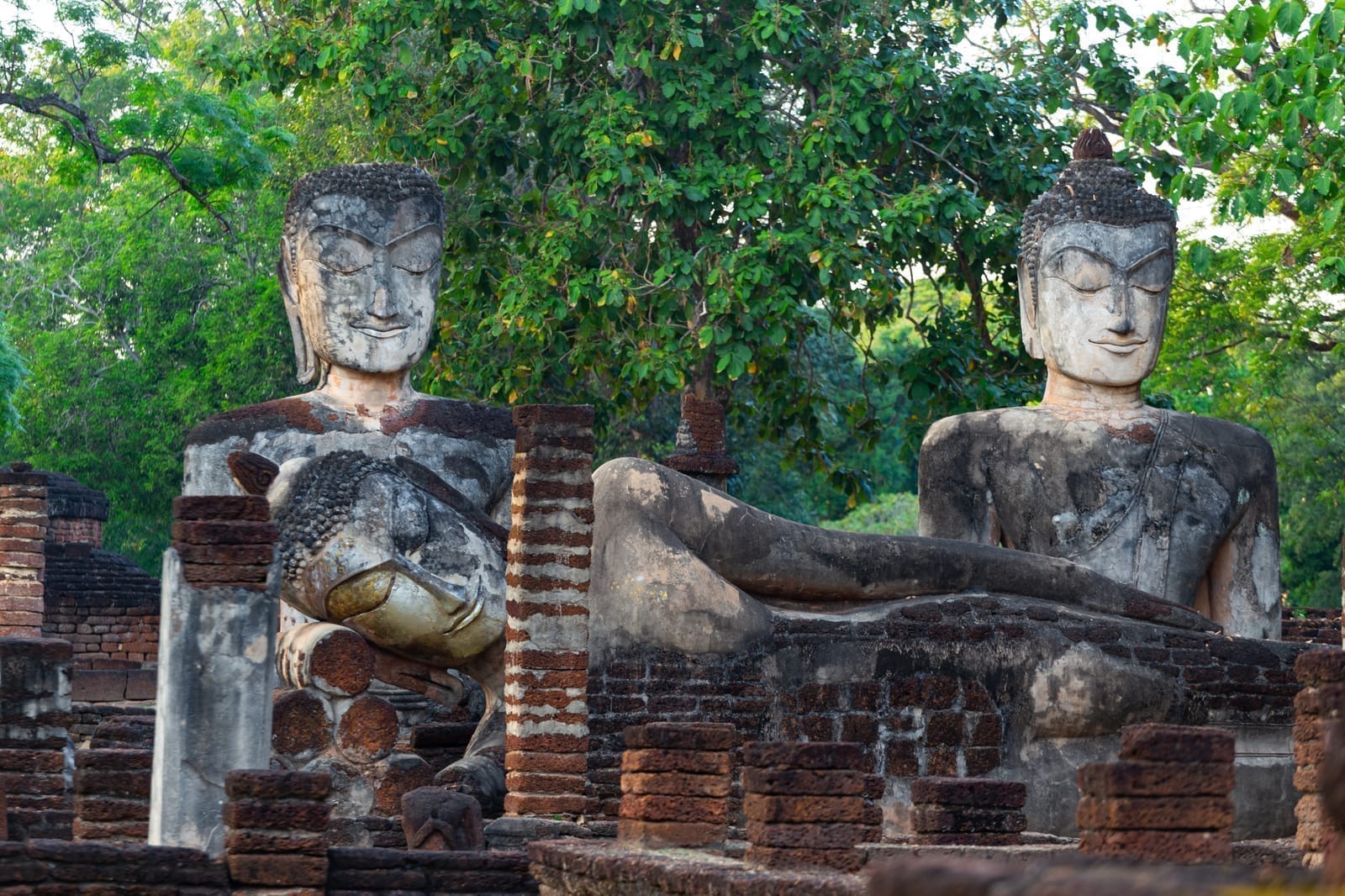
A raised-platform sanctuary with Buddha images in four postures — standing, walking, seated, and reclining — molded against the walls of the central mondop.
Wat Phra Non
Known for its massive laterite columns, said to be the largest in Thailand. Walk between them and you really feel the scale of the original sanctuary.
Wat Phra Kaeo
A temple in the old town center with laterite Buddha images lined up across the courtyard. By legend it once housed the Emerald Buddha.
Wat Phra That
Just east of Wat Phra Kaeo, with a square-based stupa as its centerpiece. You can walk straight over from Wat Phra Kaeo.
Entry fees and opening hours
The park is open daily, roughly 08:30–16:30. Aim to get in before 3pm if you want to walk both zones without rushing. Fees are charged separately per zone, and the prices below are the ones you'll most often see — just bear in mind the park can adjust them, so check at the ticket booth by the entrance.
- Thai nationals — around ฿20 per zone
- Foreign visitors — around ฿100 per zone, or a combined ticket for both zones around ฿150
- Bringing a bike in — around ฿10 · Car — around ฿50 (Aranyik zone only, where driving in is allowed)
- Bike rental — available near the entrance and at shops/guesthouses close to the park, around ฿50 per day
On cash
Carry small bills. The ticket booths and many of the bike-rental spots take cash only, so don't count on being able to scan-to-pay everywhere.
Walk or cycle?
It depends on the zone. The city zone is walking only — no cars or bikes inside the walls — but the area is small and easy to cover in about an hour. The Aranyik zone has forest roads connecting the temples with very little traffic, so cycling is fun and saves your legs. The ground is mostly flat with a few gentle rises. You can walk it if you prefer, just bring enough energy and water.
- Solo or as a couple, taking it easy — rent a bike and cycle the Aranyik zone; best value
- With small kids or older travelers — drive into the Aranyik zone and park to walk each spot
- Into walking and photography — do both zones, allow half a day to a full day, and pack an umbrella and water
Getting to Kamphaeng Phet
Kamphaeng Phet has no airport and no train. Most people arrive by road. From Bangkok it's about a 5-hour drive or bus ride along the Asia Highway (Highway 1), or you can fly into Phitsanulok and continue by road for about 1.5 hours. The park sits on the west bank of the Ping River, just a short way from town, and you can easily reach it by songthaew or motorbike taxi from the center. If you drive yourself, both zones have parking.
- From Bangkok — bus/van from Mo Chit, around 5 hrs, arriving at Kamphaeng Phet bus terminal
- From Chiang Mai — drive south around 4 hrs via Tak; a good stop along the way
- From Phitsanulok — fly into Phitsanulok and continue by road, around 1.5 hrs; the fastest way in if you're coming from far
- From town to the park — songthaew, motorbike taxi, or rent a motorbike and ride yourself
Before you go
- Comfortable walking shoes — the ground is dirt, grass, and uneven laterite; not the place for heels
- Sun protection — hat, sunscreen, umbrella, especially in the open city zone where the midday sun is harsh
- Drinking water — there are few shops inside the zones, so buy some before you go in
- Dress modestly — these are religious ruins, so dress neatly
- Golden hours — morning and evening light is best for photos; skip high noon, when it's hot and the light is harsh
If you have time to spare, stop by the Kamphaeng Phet National Museum next to the city zone before or after the park. It helps you understand the city's history and the artifacts unearthed here, and from there you can head back into town for some local food.
Plan a full day in Kamphaeng Phet — ruins, cafes, and local food
See the Kamphaeng Phet travel guide →