🔄 Updated 21 Jun 2026
Most people know Nakhon Si Thammarat for Wat Phra Mahathat and the Ai Khai shrine, but the coastal side of the province has things that are hard to find elsewhere — especially in Khanom district, home to a pod of pink dolphins, or Indo-Pacific humpback dolphins, that actually live in this bay as residents. These aren't captive dolphins kept for a show; they're wild animals in their natural habitat. Watching one surface to breathe out in the open sea feels nothing like a regular beach day. This article covers everything from how to catch a boat to the spots around Khanom worth fitting into a single trip.
What are the Khanom pink dolphins, and why come see them?
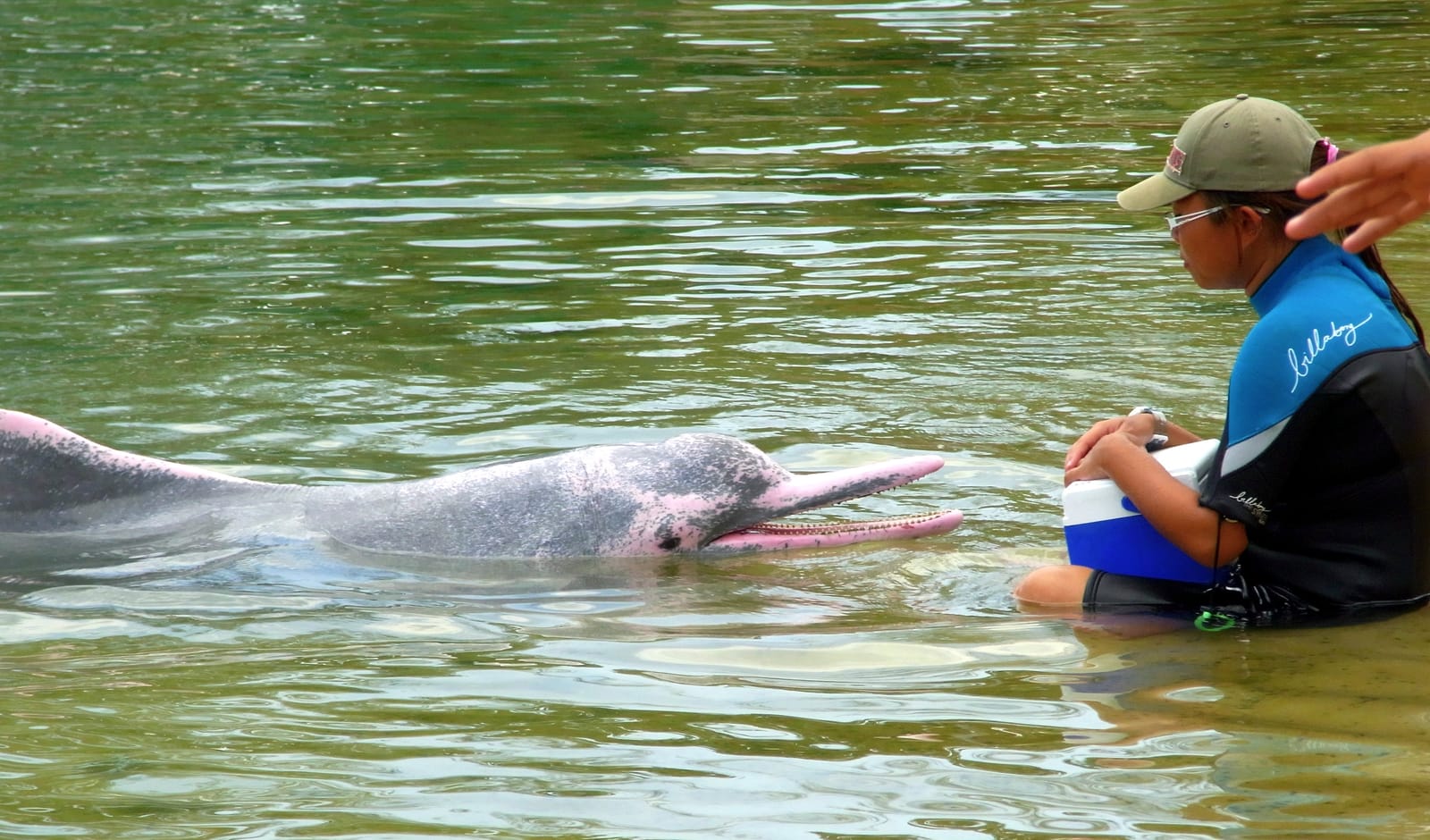
The pink dolphins at Khanom are Indo-Pacific humpback dolphins. As calves they're greyish, and as they grow the colour slowly shifts to a pinkish-white — the older they get, the pinker they look. It's the natural colour of their skin, not dyed or staged. This pod feeds in Khanom Bay and the islands around it all year because the water is shallow and full of fish. You'll most often see them around Ao Thong Nian, Ao Talet, and the waters off Koh Nui. The nice part is you don't have to sit on a boat for an hour like with whale-watching elsewhere — some days you're not even ten minutes out of the pier before a fin breaks the surface.
Watching dolphins responsibly
Dolphins are wild animals. Every boat cuts the engine or idles slowly when it gets close — no chasing, no feeding. Please keep the noise down and don't throw rubbish in the sea, because this pod is the only reason Khanom has visitors at all. Disturb them too much and the dolphins will move away.
Want more out of Nakhon Si Thammarat? Book tours & activities
Booking online ahead on Klook or GetYourGuide is usually cheaper than the gate and skips the queue. Pick only the experiences you actually want — prices and availability are shown live on each site.
Which season makes the dolphins easiest to spot?
The dolphins are in Khanom Bay year-round, but your odds aren't the same every month. The window locals point to as easiest — and when the sea cooperates — is roughly March to September. The water is fairly calm, fish come in, and the dolphins feed close to shore, so some stretches give you very high chances. During the monsoon late in the year the swell picks up, boats struggle to head out, and the dolphins retreat to deeper water, so spotting them gets harder. Whatever the season, it's best to set out early, around 7–8 a.m., when the water is calm and the dolphins are feeding.
- March–September — the best window: calm sea, high chances, ideal if you're planning a trip specifically for the dolphins.
- October–February — the rainy and monsoon season, with strong swell; some days boats don't go out. Check the forecast and phone the pier first.
- Every season — an early-morning departure beats a late one, because the water is calmer and the sun isn't yet harsh.
Straight talk
Dolphins are wild — no one can guarantee 100% that you'll see them. Some days you spot them before you've even cleared the mouth of the bay; other days you circle for an hour. The local boat drivers know where the pod likes to hang out. If you're coming specifically for the dolphins, give yourself extra time and keep an easy mind — at worst you've had a boat cruise around Khanom Bay either way.
Where do you catch the boat, and how much does it cost?
Dolphin-watching at Khanom means catching a boat with local villagers, not joining a big tour. There are several piers to choose from, each run by a group of fishermen or a community-tourism group that has turned to taking visitors out. Prices are per boat, not per person — one boat seats several people, so the more of you there are, the cheaper it works out. A normal trip runs about 2 hours, covering both the dolphins and a stop or two elsewhere in the bay.
Ban Khao Ok Pier (community conservation tourism group)
The best-known and most organised pier, run by the Ban Khao Ok community-tourism group. There are local guides who know where the dolphins like to be. The trip runs about 2 hours, taking in the dolphins plus a stop at the Hin Phap Pha rock formation and viewpoints around the bay. Good if you want order and information straight from locals.
Laem Prathap Pier
The pier most people use to do both the dolphins and a trip out to Koh Nui Nok. Whole-boat longtails run from here; the round trip to Koh Nui Nok takes about 2 hours. Good if you want to combine the dolphins with paying respects to Luang Pu Thuat on the island in a single run.
Ao Talet Pier
Run by the Ao Talet fishermen's group, close to where the dolphins like to come in and feed. Plenty of reviews say boats from this pier find the dolphins fast. It has a down-to-earth, genuine going-out-with-the-locals feel — good if you want the real thing with no middleman.
Booking a boat through your Khanom hotel/resort
If you're staying at a beachfront resort in Khanom, many of them can arrange a dolphin boat for you, which is handy because you don't have to track down a pier yourself. The driver picks you up at the resort or meets you nearby. Good for families or anyone who'd rather not plan it themselves, in exchange for a small arrangement fee on top of the price.
How to lock in a boat
On long weekends boats fill up fast, so phone or message the pier's page to book at least a day ahead and set an early-morning time right away. Ask clearly what the whole-boat price covers — whether it includes a stop at Koh Nui or the Hin Phap Pha rocks, and whether there are enough life jackets for everyone. Let the driver know in advance if you have small children or older travellers along.
Koh Nui Nok: a freshwater pool in the sea and Luang Pu Thuat
Koh Nui is a cluster of small rocky islands in Thong Nian sub-district, split into Koh Nui Nai, Koh Nui Nok, and Koh Nui. The one people come for is Koh Nui Nok, because of a pool in a crack between the rocks that holds fresh water even though it sits in the middle of the salt sea. At high tide the sea floods over it; when the tide drops, you see a clear freshwater pool. The legend goes that Luang Pu Thuat was travelling through these waters and ran out of fresh water, so he dipped his foot into the sea and turned it fresh — which is why people come to pay respects to Luang Pu Thuat at the shrine on the island. There are steps up and a pretty viewpoint. A round trip by boat from Laem Prathap pier takes about 2 hours and can be combined with the dolphins in one run.
- The freshwater pool in the rock — a freshwater pool out in the sea that appears at low tide; check the tide table with your boat driver first so you arrive when the pool is clearly visible.
- Luang Pu Thuat shrine — there are steps up to pay your respects, a spot southern Thais hold in great faith. Dress modestly.
- Viewpoint on the island — looking out over the Khanom sea and the islands around it; a photo angle a lot of people love.
- Clear water around the island — in places the water is clear enough for a shallow dip, though it's not a deep-diving spot — better for an easy soak than serious snorkelling.
Khao Phlai Dam: the coastal road locals call the south's prettiest
Khao Phlai Dam is a seaside mountain right on the boundary between Khanom and Sichon districts, about 86 km from the city of Nakhon Si Thammarat. The Khanom–Khao Phlai Dam road runs along the coast, winding around the mountainside, with clear blue sea on one side and green forest and coconut groves on the other. Many people rate it as one of the prettiest coastal roads in the south. Along the way there are viewpoints to pull over and photograph the curving road hugging the hill, looking down on the wide sweep of Ao Thong Yang. Best driven in the early morning or evening when the sun is soft.
Khao Phlai Dam Viewpoint
A pull-over photo spot on the hillside road, looking at the curving road and the wide sweep of Ao Thong Yang — the signature shot of this stretch. You can stop to shoot, but watch for oncoming traffic.
Khao Phlai Dam Beach
A wide sandy beach that's still quiet and natural, with few people — good for a stroll in the breeze without fighting anyone for space.
Ao Thong Yi
A small bay off the coastal road, clear water and a calm feel — a good spot to rest your eyes while driving.
Driving this road
The Khao Phlai Dam coastal road is winding and narrow in places, so drive slowly — especially in the rainy season when the road is slick. If you watch the dolphins in the morning and then drive this stretch from late morning into the afternoon, the timing works nicely: the angled sun makes the sea look good and photographs well.
Quiet beaches around Khanom that haven't been overrun
Khanom isn't only about the dolphins. Its long coastline has small beaches that aren't as crowded as Hua Hin or Pattaya — many with white sand, clear water and few people, ideal if you want a calm stretch of sea to sit by for a long while.
- Nai Phlao Beach — Khanom's main beach, long and white-sanded, with places to stay and seafood restaurants right on the sand. A good base for an overnight.
- Thong Ching–Thong Nod Beach — quiet beaches south of Khanom, few people and clear water, good for a stroll in the breeze.
- Kho Khao Beach — a small, calm beach, good for photos and an undisturbed chill.
- Khao Phlai Dam Beach — a wide, still very natural beach at the Khanom–Sichon boundary, a favourite of people who love quiet.
Planning a Khanom trip that fits together
Khanom is about an hour and a half by car from the city of Nakhon Si Thammarat, so most people stay overnight in Khanom or stop on the way up to Surat Thani. We've laid out two plans — a morning-out-and-back version and an overnight version that covers everything.
Dolphins + Koh Nui Nok + Khao Phlai Dam
Easy beach time + on to Sichon
How to get to Khanom
- Private car / rental — the easiest option. About 90–100 km from the city of Nakhon, roughly an hour and a half, giving you the freedom to stop at Khao Phlai Dam and the quiet beaches.
- From Nakhon airport — rent or charter a car at the airport and head north straight to Khanom without going into the city.
- From Koh Samui — Khanom sits across the bay from Samui; take a ferry to the Don Sak–Khanom side and continue by road.
- Public transport — there are vans and buses into Khanom town, but the sights are spread out, so without your own car you'll want to charter one locally.
Want a beachfront base in Khanom for dolphin-watching and roaming the quiet beaches?
See the Top 10 Nakhon Si Thammarat hotels →