🔄 Updated 21 Jun 2026
Khao Yai National Park has two main entrances: the well-known Pak Chong side (Nakhon Ratchasima province) and the Prachinburi side, which you reach via the Noen Hom checkpoint. If you're staying around Prachinburi or already planning to visit the town, going up the Prachinburi side saves time and gets you to highlights like Haew Narok Waterfall faster. The stretch around Noen Hom is a steep, winding mountain road, and the views on both sides are real forest — not rows of resorts.
Getting up via Noen Hom from Prachinburi
The Noen Hom checkpoint is in Noen Hom subdistrict, Mueang district, Prachinburi — a ranger station and the start of the southern climb. From Prachinburi town, take Highway 3077 (Prachinburi–Khao Yai) and keep heading up; the checkpoint sits roughly 25–30 km from town, after which the road starts climbing the ridge. This section is steep with plenty of bends, so if you're driving yourself, use low gear on both the way up and down. Small cars can manage it, but keep a close eye on your brakes.
From Bangkok, it's about 190 km to the Noen Hom side, running through Rangsit–Hin Kong–Prachinburi before turning onto Highway 3077. Many people choose this side because if you're already visiting Prachinburi, you can carry straight on up the mountain without looping around to Pak Chong.
Check before you go
Haew Narok Waterfall has closed temporarily from time to time depending on the weather and safety conditions. Before you head out, check the "Khao Yai National Park" page or call the visitor centre first so you don't make the trip for nothing.
Want more out of Prachinburi? Book tours & activities
Booking online ahead on Klook or GetYourGuide is usually cheaper than the gate and skips the queue. Pick only the experiences you actually want — prices and availability are shown live on each site.
Waterfalls worth stopping for
The charm of the Prachinburi side is that the waterfalls aren't far from the climb. The water is strongest in late rainy season (Sep–Nov); in the dry months the flow drops off, but the forest stays green and the air stays cool and pleasant.
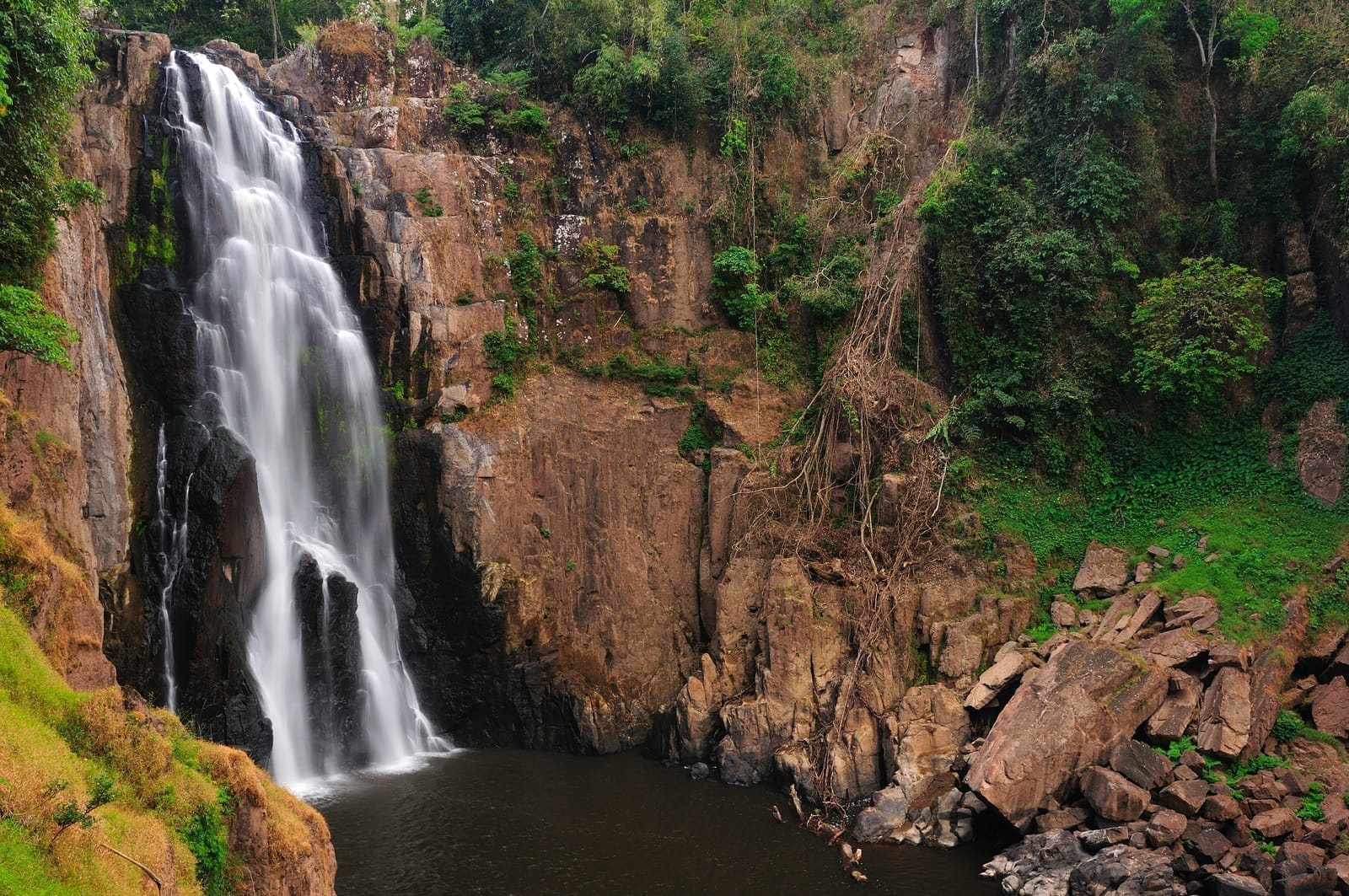
Haew Narok Waterfall
The tallest and most dramatic waterfall in Khao Yai — three tiers cascading down a high cliff in the middle of evergreen rainforest. It's a short walk from the car park down to the upper viewpoint, but to see the full lower tier you'll need to keep going another 400 metres or so on a fairly steep path. When the water is running hard, the roar is deafening.
Pha Kluai Mai Waterfall
A mid-sized waterfall about 10 metres high, with a wide pool below. The name comes from the wild orchids that once grew around here. The setting is shady and relaxed — good for a rest and some photos — and you can walk in along a nature trail.
Kong Kaeo Waterfall
A low waterfall near the Khao Yai visitor centre, with a wide rock platform. Kids can play in the water when the flow is gentle. It's an easy spot to stop and rest before moving on to somewhere else.
Haew Suwat Waterfall
A single-tier waterfall about 20 metres high that drops straight into a wide pool — a popular photo spot. It sits deeper in on the inner side of the park, so if you've come up from Prachinburi and keep driving across, you can stop in.
Ridgeline viewpoints
Once you've reached the ridge, don't rush back down. The viewpoints up on Khao Yai give you a sea of mountains you won't find in the city, and around dawn in the cool season (Nov–Feb) there's a chance of a sea of mist.
- Pha Diao Dai — a clifftop viewpoint that many people rate the most beautiful on Khao Yai, with mountain ranges spread out in a panorama. You have to walk in from a nature trail, so it suits anyone up for a bit of a hike.
- Pha Trom Jai — a viewpoint close to Haew Narok Waterfall, looking down over the valley and a wide stretch of forest. It's in the same zone as the Haew Narok trail.
- Km 30 Viewpoint — a roadside viewpoint that's easy to stop at, with layered mountain views; sunrise and sunset here are lovely. (This one is in the Thanarat Road zone on the Pak Chong side, so you can pull in if you're driving across.)
Hiking trails
Khao Yai has several short nature trails, ranging from about 1.2 km up to 8 km and taking anywhere from 45 minutes to half a day. The longer trails and those going deep into the forest require a ranger guide — you can arrange that at the visitor centre. Wear shoes with good grip, bring water, and watch out for leeches in the rainy season.
Kong Kaeo–Nong Phak Chi trail
A popular trail that ends at the Nong Phak Chi wildlife tower. The path isn't too steep, and along the way you may spot birds and animal tracks.
Pha Kluai Mai–Haew Suwat trail
Follows a stream past Pha Kluai Mai Waterfall and finishes at Haew Suwat. Shady the whole way — good for anyone who likes a longer walk.
Trail to Pha Diao Dai
Walk in to the clifftop viewpoint; the reward at the end is a panoramic mountain view. A ranger guide is recommended.
Spotting wildlife
Khao Yai is one of the few places near Bangkok where you can realistically hope to see wild animals. During the day you'll often spot deer, pig-tailed macaques, and various birds along the road, while around dusk at the Nong Phak Chi wildlife tower (about 20 metres tall) there's a chance to see deer, gaur, and sometimes wild elephants coming to the salt lick.
The night wildlife safari is a highlight for many. You ride in a park vehicle with a ranger who uses a spotlight to find animals that feed at night — deer, porcupines, civets, palm civets, and on some nights wild elephants. You need to book at the visitor centre before around 6 pm.
If you meet a wild elephant on the road
Switch off your high beams, turn off the engine if you have to, stay in your car, don't honk, don't get out to take close-up photos, and give the elephant room to walk past on its own. Khao Yai's wild elephants often feed along the road in the evening and at night, so drive slowly and keep your wits about you.
Entry fees, opening times, and what to know
- Entry (Thai nationals): adults 40 THB, children 20 THB · foreigners adults 400 THB, children 200 THB
- Vehicle fee: cars around 30–50 THB, motorbikes around 20–30 THB (charged on top of the entry fee)
- Access hours: vehicles are let up from daytime until evening, per park notices; go up early to leave time for hiking and to avoid afternoon rain
- Lodging/camping: there are campgrounds and park bungalows in the upper zone; book ahead through the National Park Department system during high season
- Signal/coverage: there are dead spots up on the mountain, so download maps and save contact numbers before you head up
Fees and opening times can change per National Park Department announcements; the figures above are the ranges in common use in 2026, so it's worth checking again before you actually travel.
Done with the Prachinburi side of Khao Yai? Carry your trip on into Prachinburi town.
See the Prachinburi travel guide →