🔄 Updated 21 Jun 2026
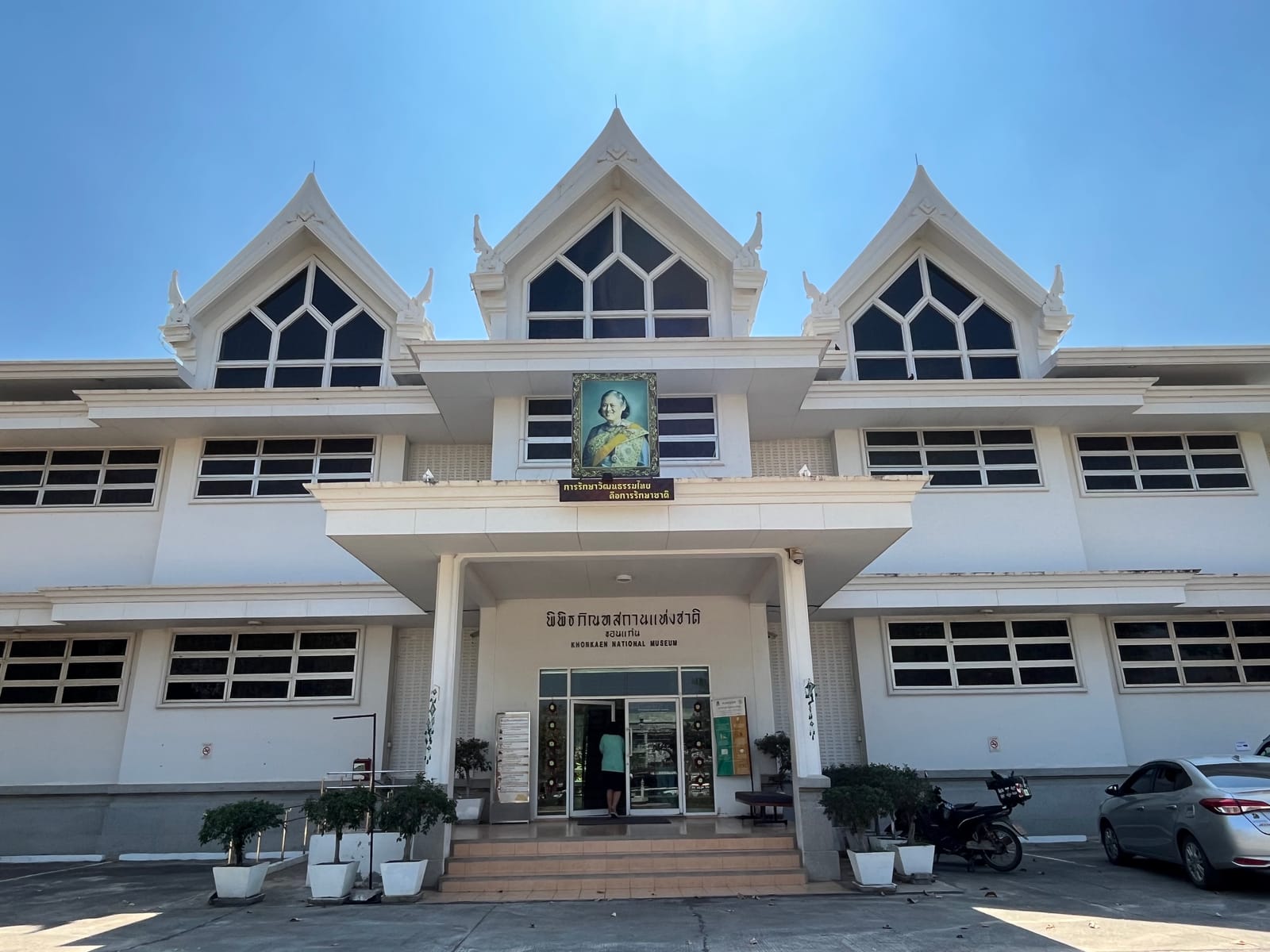
Khon Kaen National Museum sits right in town, in the district behind the government center, just a few minutes' drive from Bueng Kaen Nakhon lake and Wat Nong Wang. It's a comfortably sized museum — you can walk the whole thing in an hour to an hour and a half. It opened back in 1972 and is run by the Fine Arts Department, holding a good stack of finds from archaeological sites across the upper Isan region. Most people come for the sandstone sema stones, but once you start walking you'll find plenty of other interesting pieces that rarely get mentioned.
Why this place stands out for sema stones
Sema stones are markers planted to define the sacred boundary around a spot used for Buddhist ceremonies in the Dvaravati period, roughly the 7th to 11th centuries CE. The Isan region is where the most sema stones have been found in Thailand, and the Khon Kaen museum holds the largest and most complete set. Many of them aren't just blank slabs — they're carved with scenes from the Buddha's life and from the Jataka tales, so you can read the beliefs of Isan people from over a thousand years ago straight off the carvings.
The piece people talk about most is the Phimphilap sema, a large sandstone slab about 190 centimeters tall, carved with the scene of Princess Yasodhara grieving after Prince Siddhartha left to become an ascetic. The carved lines are still sharp and the composition reads clearly. It was excavated at Mueang Fa Daet Song Yang in Kamalasai District, Kalasin Province — one of the Dvaravati-era ancient towns where sema stones were found in the highest density. If you're into art history, this one is worth the trip to see in person.
How to enjoy the sema stones
Try to work out what story each slab is telling. Some show scenes from the Buddha's life, others are Jataka tales. If you read the label first and then look at the carving, you'll catch details you'd have walked straight past. If you're here with kids, turn it into a guessing game about what's happening in each scene — it makes the visit a lot more fun than just drifting through.
Want more out of Khon Kaen? Book tours & activities
Booking online ahead on Klook or GetYourGuide is usually cheaper than the gate and skips the queue. Pick only the experiences you actually want — prices and availability are shown live on each site.
Room by room — what you'll find
The museum splits its displays into seven sections, running in order from the oldest era to the most recent. Walk them in sequence and you get a continuous picture of Isan as a single story. Here's what you'll find in each zone.
Prehistoric room — Ban Chiang pottery
It starts in the era before writing, with painted earthenware vessels in the Ban Chiang style, stone tools, bronze pieces, and skeletons excavated across Isan. It drives home that people settled here and were making pottery for thousands of years, even before the Dvaravati period.
Dvaravati room & the sema sculpture group
The heart of the museum. It gathers the sandstone sema stones carved with scenes from the Buddha's life and the Jataka tales, including the standout Phimphilap sema. This is the zone people linger in longest because there's so much detail to read. If you came for the sema stones, give this room a bit more of your time.
Khmer culture room
Once Isan picked up Khmer influence, in came lintels, dvarapala guardians, and Khmer-style sandstone sculpture. This zone shows that long before Isan became what it is today, the area was a corridor for several cultures. Good for anyone who has visited the stone sanctuaries and wants to understand where they came from.
Lan Xang culture room
The era when Isan was tied to the Lao side and the Lan Xang kingdom, with wooden Buddha images, palm-leaf manuscripts, and objects that reflect Mekong-basin beliefs. This zone connects the dots on why Isan art and language sit so close to Lao.
Rattanakosin room
On to the era when Isan was folded into Rattanakosin-era Bangkok, with everyday objects, documents, and the story of how the Isan provinces were governed. It closes out the long timeline from prehistory right up to recent memory.
Isan folk arts & culture room
The visit ends with everyday life and local know-how — farming and fishing tools, basketry, woven textiles, and household items from a traditional Isan home. This is the zone closest to home, and people love it because it brings to mind their grandparents' house.
Hours, entry fee, and location
- Location — No. 193, Lang Sun Ratchakan Road, Nai Muang Subdistrict, Muang District, Khon Kaen Province. It's in town, near Bueng Kaen Nakhon lake and Wat Nong Wang.
- Hours — open Wednesday to Sunday, 9:00 AM–4:00 PM, closed Monday and Tuesday (some sources say it's open daily, so it's best to avoid the start of the week or call ahead).
- Entry fee — around ฿20 for Thais, ฿100 for foreigners; students in uniform, monks, and clergy enter free (rates may change, so check before you go).
- Phone to check — 0-4324-6170 or 0-4323-8173 if you're coming as a group or want to arrange a guide.
- Time needed — about 1 hour for a general walk-through, or 1.5 hours if you read the labels in detail.
Straight talk
The opening hours and entry fee don't line up exactly across different sources. Some say it's open daily, others say closed Monday–Tuesday; the Thai fee shows up as both 10 and 20 baht. If you're making a special trip just for this place, a quick call to the museum first is the safer bet so you don't waste the trip.
Where to go after the museum
The good thing about this spot is that it's in town and easy to carry on from. The sights in Khon Kaen city are clustered close together, so you can easily build it into a half-day. Here's what's worth stopping at within a short radius.
Wat Nong Wang, the 9-tier pagoda
A few minutes' drive from the museum. Climb the 9-tier Phra Mahathat Kaen Nakhon pagoda — the top floor gives you a full view over Bueng Kaen Nakhon lake and the city. A nice way to build on the history you just saw in the museum.
Bueng Kaen Nakhon
A big lake in the middle of town — stroll or cycle a loop around it. Save it for the evening to catch the sunset behind the water, an easy way to wind down the day.
Old town & Isan eats
Leave the museum around midday and grab som tam, grilled chicken, and laap at a spot in town. If it's a Friday or Saturday, there's a walking street to eat your way through in the evening.
A half-day for history lovers
If you want a day that fills you up on both knowledge and good food, try this half-day morning loop around town. Everything is close together, so there's no long driving involved.
Start at the museum before the sun gets harsh
Isan food and lakeside time
Plan your whole Khon Kaen trip before you set off
See the Khon Kaen guide →