🔄 Updated 21 Jun 2026
Say Nonthaburi and a lot of people think of durian and the skytrain. But what really gives Ko Kret its own identity is the riverside clay and the Mon potters who have passed their craft down for over a hundred years. Ko Kret was formed in the Ayutthaya period when a canal was dug to cut across a bend in the river, turning the land into an island. When Mon people from the city of Sathiam fled war and came to seek refuge under King Taksin the Great, they settled here and made earthenware just as they had back in the Mon homelands — and it became both a livelihood and the community's signature, right up to today.
Ko Kret pottery has been registered as a Geographical Indication (GI) of Thailand, which means it is a craft genuinely tied to this place and this local know-how — not something that can be made anywhere and still carry the name.
What makes Ko Kret Mon pottery special
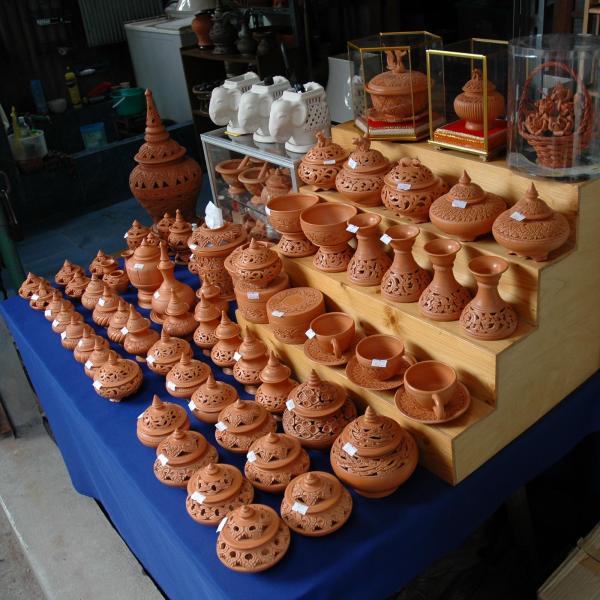
Ko Kret pottery is unglazed earthenware. Once fired, it takes on a natural pale-orange to brick-red colour from the clay itself. The charm is in the patterns, which are carved by hand rather than stamped on. Mon potters work in three main techniques.
- Incised lines — a sharp-tipped tool scratches grooves into the clay while it is still damp, leaving a pattern of fine channels.
- Openwork — sections of the clay are pierced right through, creating a perforated design you'll see on planters and lanterns that let light pass through.
- Pressed / relief work — the clay is pushed up into raised patterns, giving the surface of the pot real depth.
The most famous piece is the finely carved pot — what older locals call a carved jar or carved pot — a beautifully shaped vessel detailed all over by hand. This piece dates back to the Thonburi era and is a hallmark of the Ko Kret school of craftsmanship that is hard to match elsewhere. If you're walking the market and spot a pot carved across its whole body, sitting out front and catching the eye, that's the real thing from here.
How to tell genuine Ko Kret work
The real thing is unglazed earthenware in a natural orange-red, and because the patterns are carved by hand, no two pieces are exactly alike. Pieces with very bright colours or a shiny glaze are usually decorative goods brought in from elsewhere and sold alongside. If you want the genuine article, buy directly from the potters' workshops in the village.
Want more out of Nonthaburi? Book tours & activities
Booking online ahead on Klook or GetYourGuide is usually cheaper than the gate and skips the queue. Pick only the experiences you actually want — prices and availability are shown live on each site.
The potters' village — Kwan Aman
The heart of the craft is Ban Kwan Aman. In the Mon language, Kwan Aman means potters' village, and it covers villages 1, 5, 6, and 7 of Ko Kret sub-district. Scattered around this area are working potters' houses still in operation. Step into the little lanes and you'll come across drying yards full of pots, old kilns, and people sitting there carving patterns in front of you.
In the same area is the Pottery Museum (Ban Kwan Aman), a Mon folk-culture centre displaying antique patterned pots, the potters' tools, and the story of Mon life on the island. It's worth stopping here before you browse the actual shops, so you understand where each pattern comes from and how hard it is to make.
Pottery Museum (Ban Kwan Aman)
Displays antique patterned Mon pottery, the potters' tools, and the community's history — a good starting point to understand the craft before you hit the market.
Potters' houses in the lanes
Working potters' homes with drying yards and kilns; at some you can stand and watch the carving process, and buying direct from the potter gets you a better price.
Try it yourself + workshops
If you want more than just watching, several houses on the island let you have a go at the wheel yourself. The best-known spot is Pa Tum Pottery Workshop, which has carried on its pottery and kiln through several generations and is a real place to learn traditional hand-throwing. A session runs around 100 THB per person — you get to sit at a real spinning wheel and take home the feeling of clay turning in your hands.
- Hands-on session around 100 THB per person at the workshop.
- Small souvenirs like clay figurines or mini planters, starting from around 10–20 THB.
- Carved pots / jars larger OTOP-grade pieces priced by size and how detailed the carving is, from a few hundred to a few thousand THB.
Getting it home in one piece
Unglazed earthenware is more fragile than it looks. If you buy a large carved pot, ask the shop to wrap it well against knocks and don't leave it at the bottom of your bag. If you're taking the ferry back, hold it on your lap to be safe.
Exploring the island — beyond the pottery
Ko Kret isn't only about pots. The island is ringed by an easygoing riverside way of life you can take in on foot or by bike — waterfront paths, fruit orchards, and old temples of the Mon community. The spots you shouldn't miss are just a few steps from the pier.
- Wat Poramai Yikawat — the island's main Mon temple, with a leaning riverside chedi as its landmark and a Mon-style reclining Buddha, right by the island-side pier.
- Ko Kret Market — a long lane packed with Thai sweets, Mon food, and pottery souvenirs, busiest on Saturdays and Sundays.
- The island cycling loop — a route of about 5–6 km around the island, passing orchards and waterfront homes. Rent a bike near the pier.
The snack most people carry home from Ko Kret is tod man no kala (fried fish cakes with bamboo shoots), plus old-style Thai palace sweets and Mon desserts. If you want to eat seriously, read on in the food guide below.
How to get to Ko Kret
Ko Kret is in Pak Kret district, about 20 km north of Bangkok. There's no road onto the island — you have to take the ferry across from the Wat Sanam Nuea side and land at the Wat Poramai Yikawat pier. The crossing costs 3 THB per person, the boats run often, and it takes under 10 minutes to get there.
- Pink Line skytrain — get off around Pak Kret / Muang Thong Thani, then catch a songthaew or taxi to Wat Sanam Nuea. The easiest option if you don't have a car.
- Purple Line skytrain — get off at Yaek Nonthaburi 1 or Phra Nang Klao Bridge, then take a taxi or songthaew to the pier.
- Driving yourself — park at Wat Sanam Nuea opposite the island, then take the ferry across. Parking fills up fast on weekends, so arriving early is easier.
- Chao Phraya Express Boat — ride from Sathorn pier up to Nonthaburi pier (the end of the line), then connect by road or boat to the island. It's a fun riverside route, but it takes longer.
Which day to go
On weekdays only some shops are open and it's quiet — good for browsing the potters at a relaxed pace. On Saturdays, Sundays, and holidays almost everything is open and the market is at its liveliest, but it's crowded and the ferry queues get long. If you like a lively atmosphere, come on a weekend; if you prefer it quiet and want to chat with the potters, come on a weekday.
A half-day plan for Ko Kret
Pottery trail + market
Plan a full Nonthaburi trip with temples, floating markets, and riverside food.
See the Nonthaburi travel guide →