🔄 Updated 21 Jun 2026
Korat's old-town plan is a rectangle, ringed by a moat, and it once had gates on all four sides. Today only Chumphon Gate on the west is an original gate — the rest are reconstructions. The nice thing about touring this zone is that everything is clustered within walking distance, so you don't have to drive around hunting for parking. If you're staying at a hotel in town it's even easier — you can just walk out the door.
We'd suggest starting your walk in the morning or late afternoon and avoiding midday, when the sun is brutal, since almost the entire route is out in the open. Mornings give you quiet temples and locals making merit; evenings get you the food stalls setting up around the Ya Mo plaza, with cooler air that makes walking far more pleasant.
Start at Chumphon Gate and the Ya Mo monument
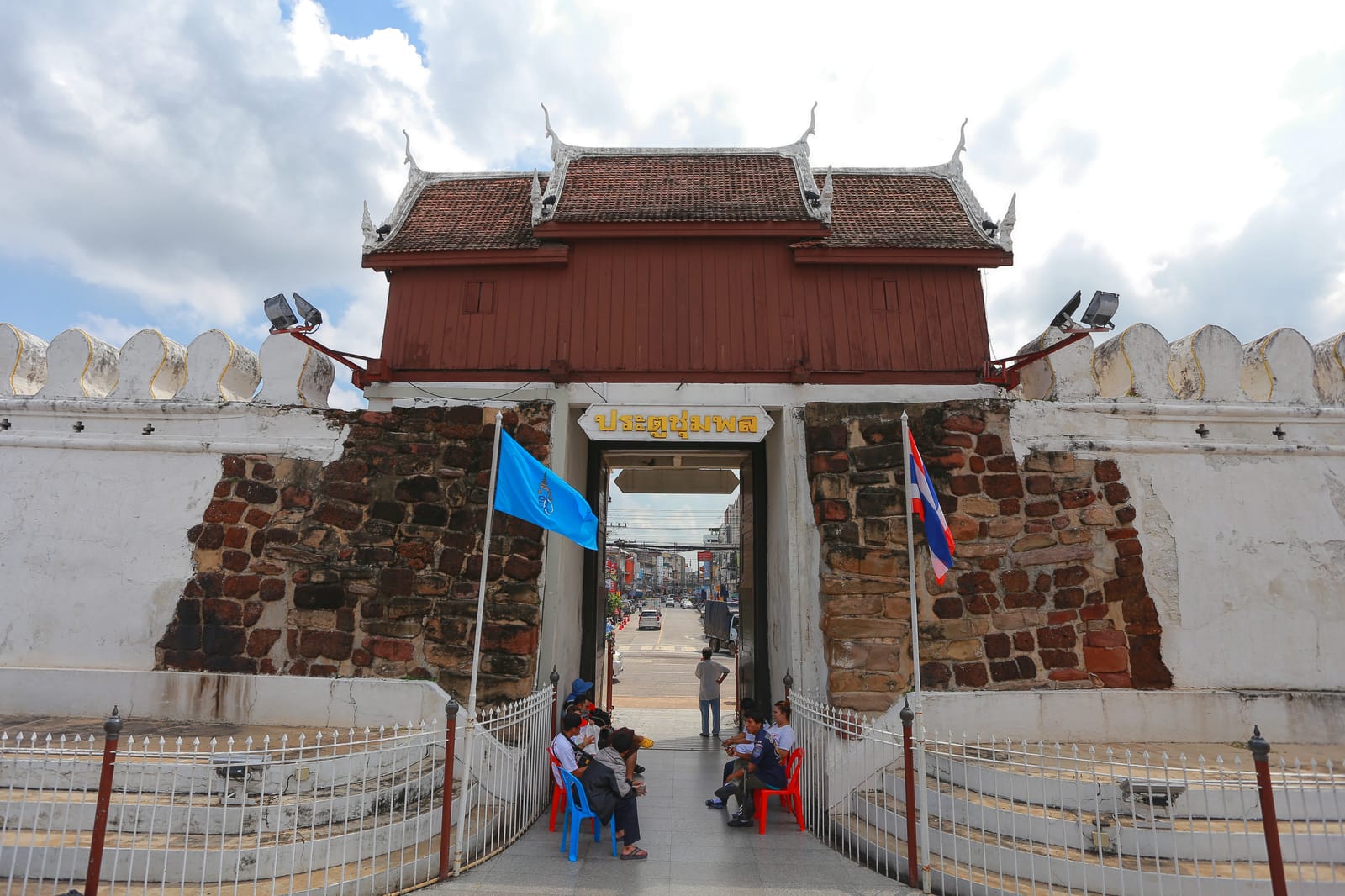
This is the heart of the old town: the wide plaza in front of Chumphon Gate with the Thao Suranari monument — or Ya Mo, as Korat locals affectionately call her — standing and facing the street. People come to pay respects, make wishes, and fulfill vows here every single day. Some hire Korat folk singers to perform as part of fulfilling a vow, which has become part of the plaza's everyday atmosphere. Turn around after paying your respects and you'll see the red-brick Chumphon Gate standing prominently; walk through it and you're inside the inner old town.
- Ya Mo monument — a dark-patinated bronze statue about 185 cm tall. Ya Mo was the heroine who led the townspeople to victory against the army of Prince Anouvong of Vientiane. Open to visit all day, no entry fee.
- Chumphon Gate — the western old-town gate, the genuine one that remains, built of brick and mortar with battlements and crenellations. Photographs well both morning and evening.
- Ya Mo plaza — the wide plaza around the monument and a meeting point for locals, ringed with stalls selling flowers, incense and candles, and snacks.
Etiquette when paying respects to Ya Mo
Ya Mo is deeply revered by Korat locals. Dress modestly, skip the very short shorts, and be mindful when taking photos — don't stand with your back to the monument while people are paying their respects. You can buy flowers and garlands around the plaza, starting from a few tens of baht.
Want more out of Nakhon Ratchasima? Book tours & activities
Booking online ahead on Klook or GetYourGuide is usually cheaper than the gate and skips the queue. Pick only the experiences you actually want — prices and availability are shown live on each site.
Six temples inside the walls that King Narai had built
What makes Korat's old town better to walk than the average city is the cluster of old temples inside the city walls. When this frontier town was founded under King Narai, temples were laid out within the walls with Wat Phra Narai Maharat as the center, and the others positioned by compass direction — six in total. You can walk and visit them one after another in a single morning. You don't have to do all of them; just pick the standouts.
Wat Phra Narai Maharat (Wat Klang Nakhon)
A royal temple central to the city, sitting right in the heart of town next to the city pillar shrine. It's the hub of the in-walls temple cluster, built under King Narai back in the Ayutthaya era. Inside there's an old ordination hall and a shady, peaceful atmosphere. This is the one stop you shouldn't skip in the group.
Nakhon Ratchasima City Pillar Shrine
The city pillar shrine sits right next to Wat Phra Narai Maharat, an easy walk between the two. Locals come to make wishes about the city and for good fortune. It pairs perfectly with the temple — it's within the same compound, so no long walk.
Wat Bueng (royal temple)
One of the old temples that still keeps its Ayutthaya-era structure. The highlight is the old-style ordination hall with a beautifully carved wooden gable — one you shouldn't miss if you love architectural history. It's not far from the central temple, an easy walk onward.
Wat Sala Loi
An old temple by the Lam Takhong river and the resting place of Ya Mo's ashes. The highlight is a junk-shaped ordination hall with a contemporary design that won an architecture award. People who follow faith and fortune like to come here after paying respects to Ya Mo. It sits toward the eastern edge of the old town.
Wat Isan
A temple built when Nakhon Ratchasima was founded under King Narai. The name marks the eastern point of the temple cluster's layout. The atmosphere is quiet and there are fewer people than at the central temple — good for anyone who wants to pay respects without the crowds.
Wat Phayap (royal temple)
The temple for the northwest point of the in-walls cluster, a royal temple still busy and in active use, with an old ordination hall and murals to see. You can walk on from the Chumphon Gate area — good for anyone set on completing the whole cluster.
How many to visit — you don't need all of them
If you've got a half day, just Wat Phra Narai Maharat and the city pillar shrine give you the essence, since they're in the same spot and form the hub of the cluster. If you love architecture, add Wat Bueng next. Wat Sala Loi is a bit farther out — better to drive or grab a ride there than to walk.
The neighborhood and the markets around it
Once you're done with the temples, the neighborhood around the old town still has plenty to drop by — fresh markets, food markets, and spots to stroll and catch the breeze. This zone is real Korat life, not something staged for tourists, so walking it gives you the genuine feel of the city.
Ya Mo Market
A fresh market in the heart of town near the Ya Mo plaza, with fresh produce, seasonal goods, and plenty of curry-over-rice stalls. Open most of the day and busiest in the morning — drop by for breakfast like a local.
Korat Walking Street (Sat–Sun evenings)
A weekend walking street with food, handmade goods, and Isan silk. Easygoing atmosphere where you can graze as you stroll. It's best around 7 p.m.
Save One Market (nighttime)
One of Isan's big night markets — food, shopping, and clothes all in one place. It's just outside the old town, good for dinner, and easier to reach by car or a grab ride.
The moat and restored gate arches
Walk along the old moat in the evening and you'll see stretches of wall and the newly restored gate arches at the city's corners. A chilled-out vibe, good for photos and walking off a meal.
Food worth stopping for along the way
Walking Korat's old town without eating would be a wasted trip. The city's signature dish is pad mee Korat, stir-fried thin rice noodles with a slightly sweet-forward flavor, found all over the area. Beyond that there's Isan food and old-fashioned sweets to try. We picked things you can actually find in the old-town area.
- Pad mee Korat — the city's signature dish, chewy-soft thin rice noodles stir-fried to a balanced, slightly sweet flavor, eaten with som tam or grilled chicken. Old-school shops are scattered around the Ya Mo area, starting from the low tens to low twenties of baht a plate.
- Mee krob Korat — crispy fried noodles glazed in a sweet-sour caramel. Good as a snack and as a gift to take home.
- Som tam & grilled chicken — the classic Isan pairing, found all over the area; there are cart stalls right by the Ya Mo plaza too.
- Khanom jeen Pradok — fresh-noodle khanom jeen famous from Korat's Ban Pradok community, chewy-soft and served with curry sauce or chili dip.
- Old-fashioned sweets — around Ya Mo Market and the walking street you'll find traditional Thai sweets — fried bananas, khanom krok, khanom thuai — all easy on the wallet.
On prices and hunger
Food around here is friendly on the wallet — a meal in the tens to low hundreds of baht will fill you up. Some of the famous pad mee shops sell out fast by mid-afternoon, so if you want the standout spots, going before afternoon is the safer bet. The walking street only runs on Saturday and Sunday evenings — on weekdays, lean on Ya Mo Market and the regular shops instead.
The walking routes we mapped out
Below are two walking routes: a morning half-day focused on temples and food, and a full day that adds markets and the walking street in the evening. Pick based on the time you have. Most of the walking is within easy reach, except Wat Sala Loi and Save One, where you should grab a ride.
Morning half-day, focused on temples and food
Full day, adding markets in the evening
Getting around and parking
Within the old town almost everything is within walking distance, but parking around the Ya Mo plaza is hard to find when it's busy. We'd suggest parking at a mall or a nearby lot and walking in, or using Grab and the local songthaews. Wat Sala Loi and Save One are beyond walking range, so grab a ride. If you come during the Ya Mo festival (late March to early April), the crowds are huge — leave extra time to find parking.
Want a Korat trip planned out day by day — the city, Khao Yai, and Phimai?
See the Korat travel guide →