🔄 Updated 21 Jun 2026
If you've read any Thai literature, the name "Krai Thong" probably rings a bell — a folk drama composed during the reign of King Rama II, telling the story of a young man who takes on the task of slaying the crocodile lord Chalawan. Phichit is the town this legend is genuinely tied to. Locals proudly call their home Chalawan City — not out of fear of crocodiles, but because it's a story that has been passed down for hundreds of years.
The nice thing about doing this Phichit route is that the spots aren't far apart. Both Chalawan Cave in the Old City Park and the giant Chalawan crocodile statue by Bueng Si Fai lake can be covered in half a day. It suits anyone who wants the legend, photo spots, and old temples all in one trip.
The Krai Thong–Chalawan legend in brief
The legend tells of an underwater cave belonging to a clan of crocodiles, with Chalawan as its lord. Chalawan had the power to transform into a human and come ashore. One day he abducted Taphao Thong, the daughter of a Phichit nobleman, and took her down into his cave. Her father then announced a reward for anyone who could defeat him — whoever killed Chalawan would be given his daughter's hand along with the prize.
Krai Thong, a young merchant who had studied the art of subduing crocodiles (some versions say he came from Nonthaburi), took up the challenge with an enchanted seven-metal spear. He dove down to fight Chalawan inside the cave, defeated him, and brought Taphao Thong back up. The tale has memorable characters like Wimala and Lueam Lai Wan, Chalawan's crocodile wives, and the two sisters Taphao Kaew and Taphao Thong — a story of love, jealousy, and combat that Thais know well.
A small note
The character's name is spelled several ways in English and Thai — "Chalawan" and "Chalala wan" among them — because it was an oral story long before it was written down. Even the signs around Phichit use the spellings interchangeably, so don't be confused if you see them differ.
Want more out of Phichit? Book tours & activities
Booking online ahead on Klook or GetYourGuide is usually cheaper than the gate and skips the queue. Pick only the experiences you actually want — prices and availability are shown live on each site.
Chalawan Cave — where the legend begins
Chalawan Cave sits within Phichit Old City Park in Khlong Khachen subdistrict, Mueang district. The actual cave isn't as large as many people imagine — roughly 1 metre wide, 1.5 metres long, and about 4 metres deep. It's believed to be the mouth of the legendary Chalawan's cave. Most people come here to soak up the atmosphere and pay their respects rather than to see some grand cavern.
The highlight everyone photographs is the statue of Krai Thong battling Chalawan at the cave mouth, built by the province to tell the story. The surrounding area is shaded by big trees, with a shrine for offerings, and the mood is fairly atmospheric and quiet. It suits people who prefer attractions with a story over ones loaded with lights and spectacle.
- Location — Phichit Old City Park, Khlong Khachen subdistrict, Mueang district, about 7–8 km from the town centre.
- Hours — roughly 08:00–18:00 daily (it's an open-air area within the park).
- Entry — free, no admission fee.
- Time needed — about 20–30 minutes for photos and paying respects is plenty.
The giant Chalawan crocodile statue by Bueng Si Fai
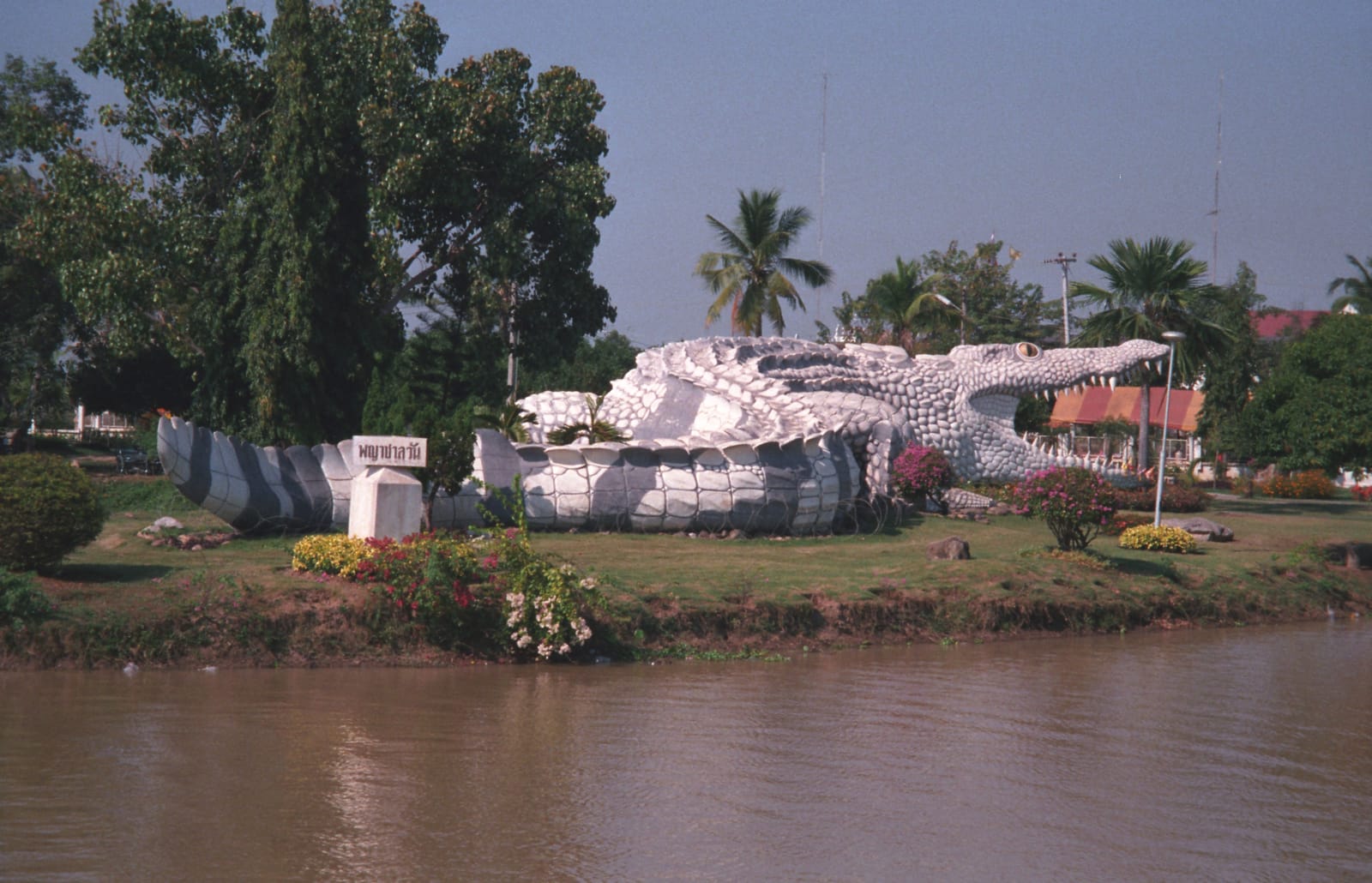
If Chalawan Cave is the small, story-focused real thing, the Chalawan statue at Bueng Si Fai is the all-out spectacle. It's a giant crocodile sculpture said to be the longest in the country — around 38 metres long, 6 metres wide, and 5 metres tall — set right by the water at Bueng Si Fai lake. It has become a landmark that visitors to Phichit have to stop and check in at.
During the New Year holidays or long weekends, the plaza around the statue gets very lively, with crowds coming to take photos. The popular angle is standing in front of the crocodile's open jaws so the teeth show clearly. Around Bueng Si Fai you can also cycle, stroll along the water, and there's a real crocodile pond you can view for free — so you can keep exploring for a good while all in one place.
Chalawan crocodile statue
The giant lakeside crocodile and a popular photo spot. Free to visit and open all day — best photographed in the morning or late afternoon when the sun is softer.
Bueng Si Fai crocodile pond
See real crocodiles in the pond, open roughly 09:00–18:00, free entry. A nice add-on activity that kids tend to love.
Bueng Si Fai lakeside plaza
Cycle, stroll and take in the view, or just sit and catch the breeze. Lovely in the evening — it's the locals' go-to spot to unwind.
Time your visit well
Bueng Si Fai is open-air and the midday sun is harsh. Come before 10am or in the late afternoon, from about 3pm until sunset, and you'll get nicer photos with the statue without overheating.
Nearby temples and legend-linked spots
Once you've done the legend trail, you can easily continue to the old temples nearby, since several of them sit within the same radius as the Old City Park and the town centre.
- Phichit Old City Park — an ancient city more than 800 years old, with city walls, a moat, old chedis and Si Mala island. The grounds are shady and you can stroll straight on from Chalawan Cave.
- Wat Nakhon Chum — an old temple from the late Sukhothai to early Ayutthaya period, within the old city, with a Sukhothai-style Buddha image to pay respects to.
- Wat Tha Luang — in the town of Phichit, home to Luang Pho Phet, the revered Buddha image that locals hold dear. Worth a stop before or after the legend trail.
A half-day route along the legend trail
Following the Chalawan trail at an easy pace
If you have more time, you can move on to the Tha Khoi pomelo orchards or a riverside cafe the next day — but for the Chalawan legend trail alone, half a day to most of a day is enough to cover all the key spots.
Getting there and things to know
- Private car — the most convenient option. The spots are spread a little outside town, and every one has parking.
- Motorbike/bicycle — good if you're staying in town, since the Old City Park and Bueng Si Fai aren't far.
- Dress — there are temples on the route, so dress modestly, and bring a hat, umbrella and drinking water since many spots are out in the open.
- Timing — avoid midday sun; mornings or evenings are more comfortable, and during the rainy season some spots can get slippery.
Want to see all of Phichit — the legends, temples and local food
See the Phichit travel guide →