🔄 Updated 21 Jun 2026
When people think of Khmer stone temples, most picture Phimai or Phanom Rung. But traces of Khmer civilisation are spread all across Isan, Roi Et included, and one of the better-preserved ones you can comfortably walk around is Ku Ka Sing, a sandstone sanctuary out in the fields of Kaset Wisai district, about an hour's drive south of Roi Et town.
The good thing about Ku Ka Sing is that it stays quiet, so you're not jostling anyone for a photo angle. You get to wander among the old sandstone, the carved details and the ancient moat in peace, which suits anyone into history and architecture, or just looking for a side of Roi Et beyond the town itself.
What is Ku Ka Sing, and how old is it?
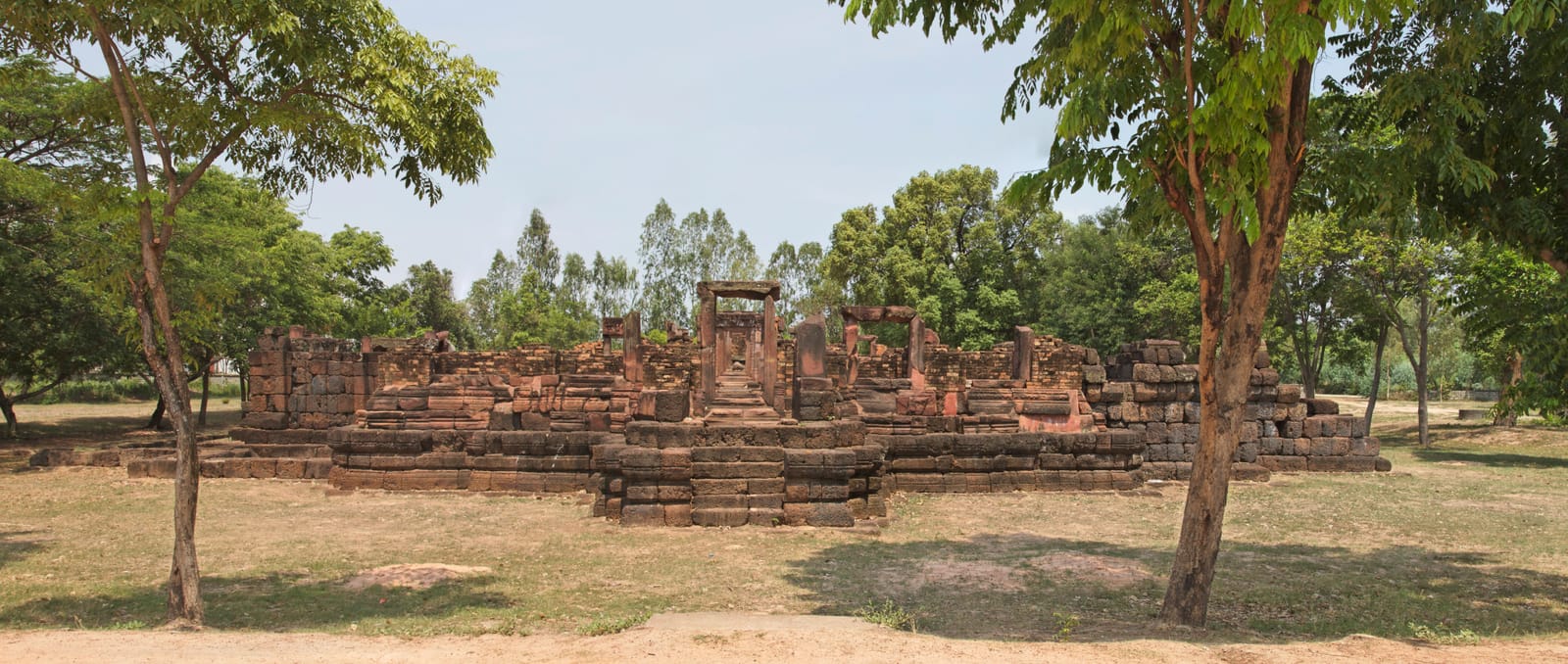
Ku Ka Sing is a Khmer-style religious sanctuary built from sandstone and laterite. Archaeologists date it to around the late 11th century AD, so roughly a thousand-odd years ago. It's Khmer art in the "Baphuon" style, from the period when Khmer influence reached into the Mun–Chi river basin. The sanctuary was once a Hindu shrine before it was abandoned and became the historical site that local people have kept naming through the generations.
The word "Ku" is what Isan people use for Khmer ruins shaped like a tower or stupa. As for "Ka Sing", there are a few theories: some say it comes from the crows (kaa) that once gathered here, others link it to a lion (singha) figure that was once part of the sanctuary. Either way it's a local name that stuck around so long it became the name of the sub-district and community today.
Want more out of Roi Et? Book tours & activities
Booking online ahead on Klook or GetYourGuide is usually cheaper than the gate and skips the queue. Pick only the experiences you actually want — prices and availability are shown live on each site.
The architecture: three towers on one base
The heart of Ku Ka Sing is its three towers, lined up north–south on a single laterite platform. All of them face east, following Khmer religious convention. The central one is the largest, the main tower, with two smaller towers flanking it. This layout represents Mount Meru, the centre of the universe in their belief.
- Main tower (centre) — the largest, built of brick and sandstone, where the original Shiva lingam stood, marking the worship of Shiva
- Two flanking towers — smaller, set in the same line on the single laterite base
- Laterite platform — raises the whole sanctuary up so you can walk up and see the towers close
- Boundary wall and gopura (gateway) — enclosing the sanctuary, with gateways set along the cardinal directions
- U-shaped moat — dug around the site to represent the ocean surrounding Mount Meru; you can still clearly trace its line today
What's interesting is that Ku Ka Sing still shows real carved sandstone detail: lotus motifs, floral patterns and parts of the lintels. It isn't just a bare pile of stone, so as you walk around you can see the work of the old Khmer craftsmen up close.
Where to look first
Start by walking the outer ring to take in the moat and the boundary wall, then step up onto the platform to see all three towers. You'll get the overall plan of the sanctuary much better than if you head straight for the central tower.
Lintels and the artefacts unearthed here
Around 1991–1992, the Fine Arts Department came in to excavate and restore Ku Ka Sing, and found a large number of artefacts that confirm this really was an important shrine. Several of the old pieces tell the story of the beliefs of that era well.
- Lintel of Indra riding the elephant Erawan — Baphuon style, the piece that clearly pins down the age and the craft school of the sanctuary
- Shiva lingam — the symbol of Shiva worship, confirming this was originally a Hindu shrine
- Ganesha sculpture and a miniature stone sanctuary — carved from sandstone
- Pottery shards and iron tools — traces of the ancient community living around the sanctuary
Many of the important pieces have been kept and displayed for safekeeping, while at the sanctuary itself you'll see the sandstone elements and patterns that remain in place. If you want to understand the story better, take a look at the information boards the Fine Arts Department has put up around the site, they make the walk more rewarding.
Ku Ka Sing and the Thung Kula plains
Part of what gives Ku Ka Sing its charm is its setting in the middle of Thung Kula Ronghai, a vast plain stretching across five provinces (Roi Et, Surin, Sisaket, Maha Sarakham and Yasothon). It was once salty, dry land so harsh it earned the name "Ronghai" (the weeping field), but today it's a source of quality jasmine rice with GI registration. Drive through when the rice is green or ripening golden and the views over the fields are gorgeous.
The fact that a Khmer sanctuary sits out in the middle of these fields tells us that a thousand years ago this wasn't empty plain at all, but a place with communities and Khmer cultural routes passing through. Ku Ka Sing is like one piece of evidence of the old civilisation hidden in the Thung Kula, not just a stray ruin but something tied to the history of the whole Isan land.
Opening hours, fees and when to go
The good news is that Ku Ka Sing is free to visit and open daily, with no entry fee. It's a historical site under the care of the Fine Arts Department within a temple compound, so you can walk in and look around at your own pace. Still, there are a few things worth knowing before you go.
- Morning or late afternoon — good light and not too hot; the midday sun is fierce when you're walking the open stone yard, since there's little shade
- Rainy season into early winter — the surrounding fields are green and the views are lovely, with rice fields to drive past
- Dress modestly — it's a historical site within a temple area, so dress neatly
- Bring water and a hat — there's no big shop inside the site, so it's easier to bring your own
Leave enough time
Walking the sanctuary itself takes about 30–45 minutes to cover. But once you factor in the drive from town and stopping for photos of the fields, set aside half a day for this route and you'll be more relaxed.
More to do around Kaset Wisai
Since you've come all the way to Kaset Wisai, there's more than just Ku Ka Sing. The Thung Kula area has other Khmer sanctuaries and a few farm-themed stops to add on, easily making a half- to full-day trip.
Prasat Ku Phon Rakhang
Another Khmer stone sanctuary in Kaset Wisai, built around the same period, often paired with Ku Ka Sing on a ruins-focused trip.
Thung Kula Ronghai
Vast GI jasmine rice fields stretching as far as you can see. Drive through for lovely field views; the green or golden-ripe rice seasons make for great photos.
Kaset Wisai jasmine rice souvenirs
Pick up genuine Thung Kula jasmine rice to take home from community shops around Kaset Wisai, a souvenir Roi Et locals are proud of.
Getting to Ku Ka Sing
Ku Ka Sing is in Ku Ka Sing sub-district, Kaset Wisai district, Roi Et province, inside the grounds of Wat Burapha Ku Ka Sing. From Roi Et town, take Highway 214 heading toward Kaset Wisai district, a distance of about 40–50 km, roughly a 1-hour drive. Just pin "Ku Ka Sing" or "Prasat Ku Ka Sing" on the map; there are signs to follow as you get close.
- Private car — easiest for this route, since it's out of town and the sights are spread across the fields; driving yourself or renting a car in town is far more flexible
- Parking — there's a lot within the temple grounds, and with few crowds it's easy to find a spot
- Public transport — there are songthaews and buses to Kaset Wisai, but from the district centre out to the sanctuary you'll need another ride. Without your own car, it's best to ask locals or hire a vehicle in the area
Plan a full Roi Et trip that ties all the stops together
See the Roi Et travel guide →