🔄 Updated 21 Jun 2026
If you come to Satun thinking the province is all sea and islands, Kuden Mansion will change your mind. It sits right in town and is easy to walk to, and you don't need long to look around — but you'll see that Satun was once a port where Thai, Chinese, Malay, and European cultures met. This building is the most tangible proof of that.
We like it here because it doesn't try to be a fancy museum. It's a genuine old house that has been kept in good shape. Walk up the wooden stairs, look out through an arched window, and try to picture how a Satun governor lived in these rooms a hundred years ago.
What is Kuden Mansion and where did it come from
Kuden Mansion was begun around 1898 and finished around 1916, built by Phraya Phumin Narathaphakdi — originally named Tuanku Baharuddin bin Tammahong (Kuden bin Ku Mae) — who was the governor of Satun during the reign of King Rama V. The name "Kuden" that stuck to the building comes from his own name, so older Satun locals still call it "Ban Chao Khun Phum" out of habit.
What's interesting is that the building was originally meant to host King Chulalongkorn (Rama V) during his tour of the south, but in the end he never stayed overnight. The mansion then passed to the family and was later used as a residence and a seat of local administration.
- During World War II — it was used as a Japanese military headquarters
- After the war — it served as the municipal office, the provincial hall, and a school
- 1989 — the Fine Arts Department registered it as a national historic site
- 9 June 2000 — it officially opened as the Satun National Museum
Want more out of Satun? Book tours & activities
Booking online ahead on Klook or GetYourGuide is usually cheaper than the gate and skips the queue. Pick only the experiences you actually want — prices and availability are shown live on each site.
Where the European-Malay blend actually shows
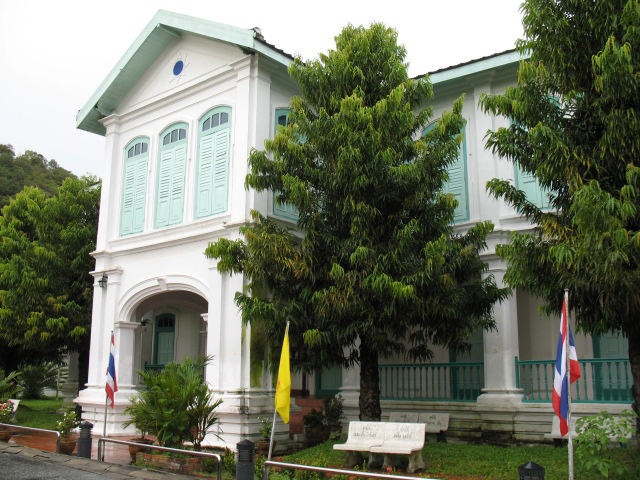
This is where people take the most photos. The building is a two-storey brick-and-plaster structure painted white, laid out in a Western colonial style, with doors and windows formed into arches in the Roman manner — it looks fully European. But look up at the roof and you'll see it's covered with local terracotta tiles shaped like banana sheaths, and many details actually suit the hot, humid climate and the Malay taste of the south.
- White two-storey body — colonial European layout and arches, catching wind and light well
- Arched doors and windows — semicircular Roman arches, the standout feature of the facade
- Banana-sheath tiled roof — local terracotta tiles, unlike a typical European building
- Vents and high ceilings — designed for the hot, humid southern climate
- Interior stairs and wooden floors — still hold the feel of the original governor's home
Photo spot
The best light is in the morning before 11am, when the white building stands out against a clear sky. Shoot from an angle so you catch both the arched windows and the roof in one frame — that's the clearest way to capture the European-Malay mix.
What there is to see inside
The displays run across two floors and tell the story of Satun from start to finish — from the area's geology and fossils, to the history of its governors, the way of life of the local Thai Muslim community, regional traditions, and old everyday objects and dress. It's an easy walk-through; about 45 minutes to an hour covers it.
Ground floor
Covers the history of Satun town, the governor Kuden, and its role as a port where several cultures came together.
Upper floor
Rooms showing the way of life of the local Thai Muslim community — dress, everyday objects, and a room recreating the feel of the original home.
The building itself
Some people come mainly for the building — to walk the arches and wooden stairs, and photograph the white facade.
Opening hours, entry fee, and location
- Opening hours — Wednesday to Sunday, 9:00am–4:00pm (closed Monday–Tuesday and public holidays)
- Entry fee — around 30 THB for adults, 10 THB for children (a different rate applies for foreign visitors)
- Location — Satun Thani Road, Phiman subdistrict, Mueang Satun district, about 800 m from the provincial hall
- Time needed — around 45 minutes to 1 hour
Straight talk
This place is closed Monday and Tuesday, which trips a lot of people up. If you're planning a Satun trip and want to fit it in, keep it to Wednesday–Sunday. Entry rates can change, and since it's a state museum we'd bring a little cash — not everywhere here takes transfers.
Making the most of Kuden Mansion in half a day
Kuden Mansion is right in town, easy to reach on foot or by car, and pairs nicely with other in-town sights for an easy half day. Here's a short plan we put together for both solo travellers and families.
Old building + old town
Eat well in town
Who it suits
Kuden Mansion works well as a morning activity, or on an overcast day when the sea isn't an option. If it's raining or the waves are rough, this is a spot that gives you both something to learn and good photos. Families with kids can do it easily too — the space isn't large, and the fossils give children something to get excited about.
Want a well-located hotel in Satun town, within easy walking distance of the old building and local eateries?
See well-reviewed Satun hotels →