🔄 Updated 21 Jun 2026
Say Phetchaburi and most people picture Khao Wang, old temples, and sweet desserts. Few think of the mudflats and mangroves over on the Ban Laem side — even though this is one of the best shorebird-watching spots in Thailand, and home to a royal initiative that turns the town's wastewater into a living ecosystem. We'll walk you from the boardwalk in the mangroves all the way out to the salt fields and the tip of the cape, the spot known as the first grain of sand in the upper Gulf of Thailand.
What is the Laem Phak Bia project?
Its full name is the Laem Phak Bia Environmental Research and Development Project under the Royal Initiative, in Laem Phak Bia subdistrict, Ban Laem. The idea came from His Majesty King Rama IX: use nature to treat the wastewater from Phetchaburi town before it flows out to sea. The principle is "nature helping nature" — oxidation ponds that let sun and oxygen do the work, plots of filtering plants like sedge and cattail, and mangroves that use the rise and fall of the tide to keep water circulating. The byproduct is a large mangrove forest that has become home to many species of birds and aquatic life.
The nice part is that it's free to enter, and it's a genuine learning site rather than a manicured garden. Bring the kids and they'll see coastal ecology with their own eyes. Come to take photos and you've got a boardwalk through the forest for a lovely backdrop.
Before you go
If you're coming as a big group or want a guide to walk you through, call the project office ahead on 0-3244-1264-5. You'll get far more out of it than wandering in on your own.
Want more out of Phetchaburi? Book tours & activities
Booking online ahead on Klook or GetYourGuide is usually cheaper than the gate and skips the queue. Pick only the experiences you actually want — prices and availability are shown live on each site.
Walking the boardwalk through the mangroves
The most photographed highlight is the wooden boardwalk that runs deep into the mangroves — about 850 metres of nature trail in total. Both sides are thick with mangrove and Avicennia trees, dense enough that some stretches feel like a tree tunnel. The walking is easy on flat boards, and a stroller can manage parts of it.
- Fiddler crabs — tiny crabs with bright claws waving in their thousands across the mud at low tide
- Mudskippers — small and large alike, hopping around the bases of the mangroves; kids love them
- Shorebirds — early morning and late afternoon are when you'll see the most birds feeding on the mud
- Observation tower — a high point to climb and look out over the mangrove canopy from above, taking in the whole forest
Best time to come
Come early (it opens 08:30) or late afternoon for nice light and cooler air. Midday is glaring and you won't see many birds — they're all sheltering from the sun. Bring a hat and water; the mangroves give shade in patches, not the whole way.
Migratory birds — why this place matters
Laem Phak Bia and neighbouring areas like Ban Pak Thale are part of Thailand's migratory bird network. More than 240 species have been recorded here, both resident and migratory. Among them are rarities that birders travel from around the world to see, such as the Spoon-billed Sandpiper, of which very few remain in the wild, the Asian Dowitcher, and the Great Knot.
The best birding window is October to April, the season when migratory birds escaping the cold come down from Mongolia, China, and Siberia to rest and feed here. You'll see flocks of gulls and shorebirds covering the mudflats and salt fields. In the rainy season (May–Sep) the migrants have gone and only resident birds remain — still a fun mangrove walk, but if you're specifically here for the birds, choose the cool season.
Birding gear
Bring binoculars or a zoom lens to really enjoy it. Shorebirds are small and far off — to the naked eye they're just dots. Wear muted, natural colours rather than anything bright, and walk softly so the birds don't startle and fly off.
Ban Laem salt fields
A short way out from the project, along the coastal road, are the Ban Laem salt fields — sea-salt farms that have been part of Phetchaburi for a long time. The salt from this area is known for its quality. The dry season, roughly February to May, is salt-harvesting time, when you see white mounds of salt lined up to the horizon, set against the water in the pans, which on some days turns pink-red from algae and microorganisms. It's a photo spot people haven't quite worn out yet.
Around the salt fields there are cafés converted from old salt barns, like Yung Kluea, open roughly 7:30am–5:00pm. Sip a coffee while looking out over the salt pans from the deck, with a boardwalk, a windmill, and a swing for photos. A good place to rest after a full morning walking the mangroves.
What are the salt fields like in the rainy season?
In the rains (Jun–Oct) the pans fill with water and you won't see any salt mounds. If you want the white salt heaps, come in the dry season, Feb–May — that's the perfect window.
The cape tip — the first grain of sand in the Gulf
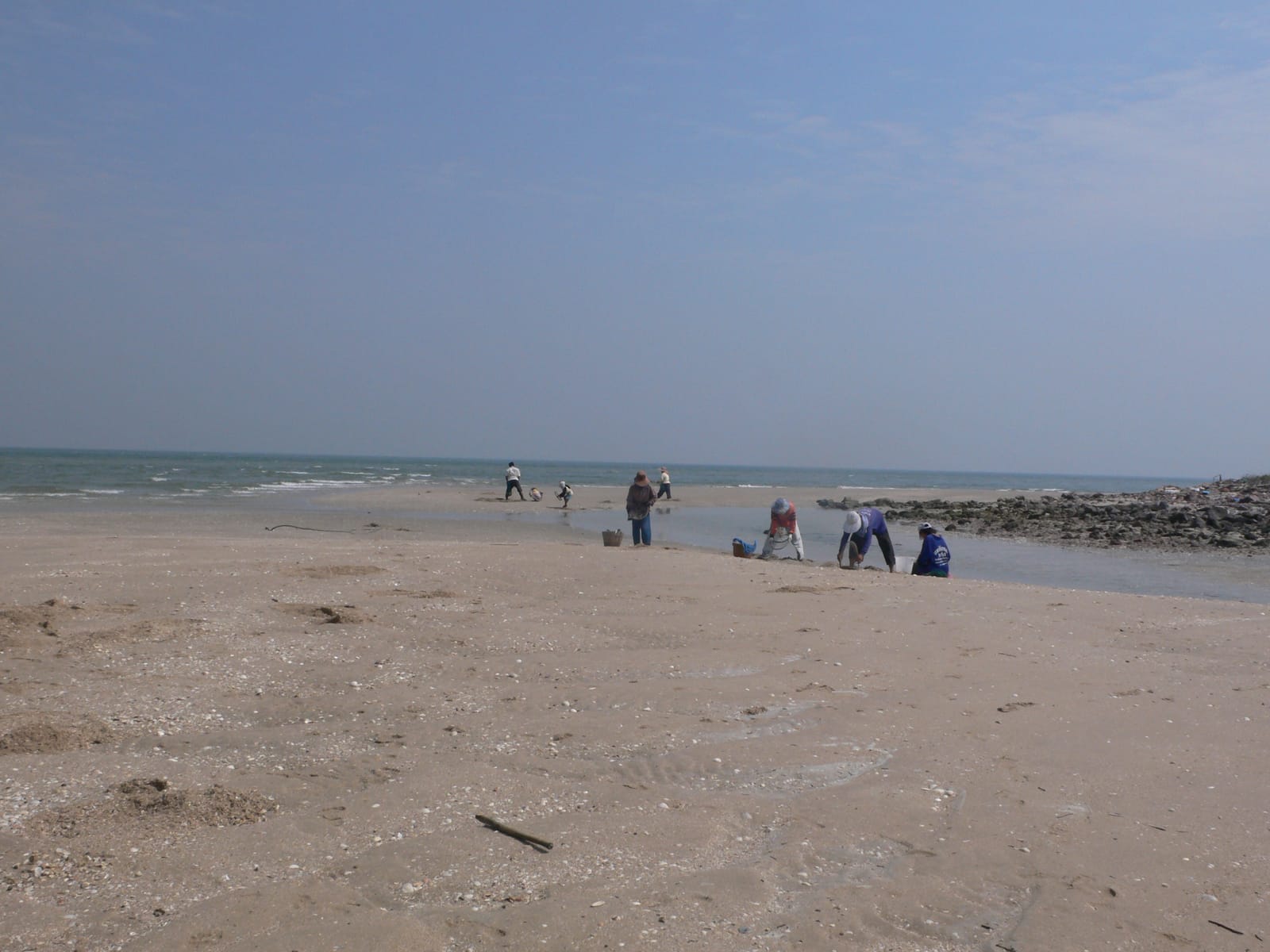
At the very end of Laem Phak Bia is a spot naturalists call "the first grain of sand in the upper Gulf of Thailand," because it's the meeting point between the mudflats to the north and the sandy beaches to the south. One side is soft mud, the other starts to be real sand. This area is First Grain of Sand Beach — a quiet beach with no shops or facilities, suited to people who like peace and a stroll along an empty shore. It's not a swimming beach.
- Quiet beach, few people — good for photos and an evening walk
- No restaurants or toilets; bring your own water and snacks
- Some stretches are mud, so wear shoes you don't mind getting wet — don't bring your nice sneakers
Hours, entry fee, and getting there
- Opening hours: Mon–Fri 08:30–16:30 · Sat–Sun 08:30–12:00
- Entry: Free, no admission fee. There's a free tram service running on rounds (about every 1 hour)
- Location: Laem Phak Bia subdistrict, Ban Laem district, Phetchaburi province
- Contact: Project office 0-3244-1264-5
- Getting there: From Phetchaburi town, drive toward Ban Laem, about 30–40 min. There's parking inside the project. Driving yourself is easiest — there's no public transport that goes all the way there
Planning your day
On weekends the project closes at noon, so if you come on a day off, arrive early to walk the boardwalk before it shuts, then move on to the salt fields and café in the afternoon when they stay open longer.
A half-day at Laem Phak Bia — how to make it flow
Mangroves + birds
Salt fields + café + food
Want a full-day Phetchaburi plan covering the old town, temples, and the sea?
See the Phetchaburi travel guide →Who is Laem Phak Bia for?
Families with kids
Walk the boardwalk to watch crabs and mudskippers and learn real coastal ecology. Free entry — great for an out-of-classroom learning trip.
Birders / nature lovers
In the cool season there are rare migratory birds to spot — this is one of the best shorebird sites in Thailand.
Photographers / slow travellers
A boardwalk through the forest, white salt mounds, and quiet beaches make for photo spots people haven't worn out yet.