🔄 Updated 21 Jun 2026
If you want to get a feel for Lamphun fast, get up early and walk the market. The town isn't big, so the good food clusters in just a few markets. Locals buy ingredients for breakfast, grab bags of northern Thai dishes to eat at home, stop for a bowl of khanom jeen nam ngiao, then pick up seasonal fruit on the way out. We've walked these markets a few times and sorted out which one to go to, what to eat, and what's worth taking home.
The main morning markets to visit
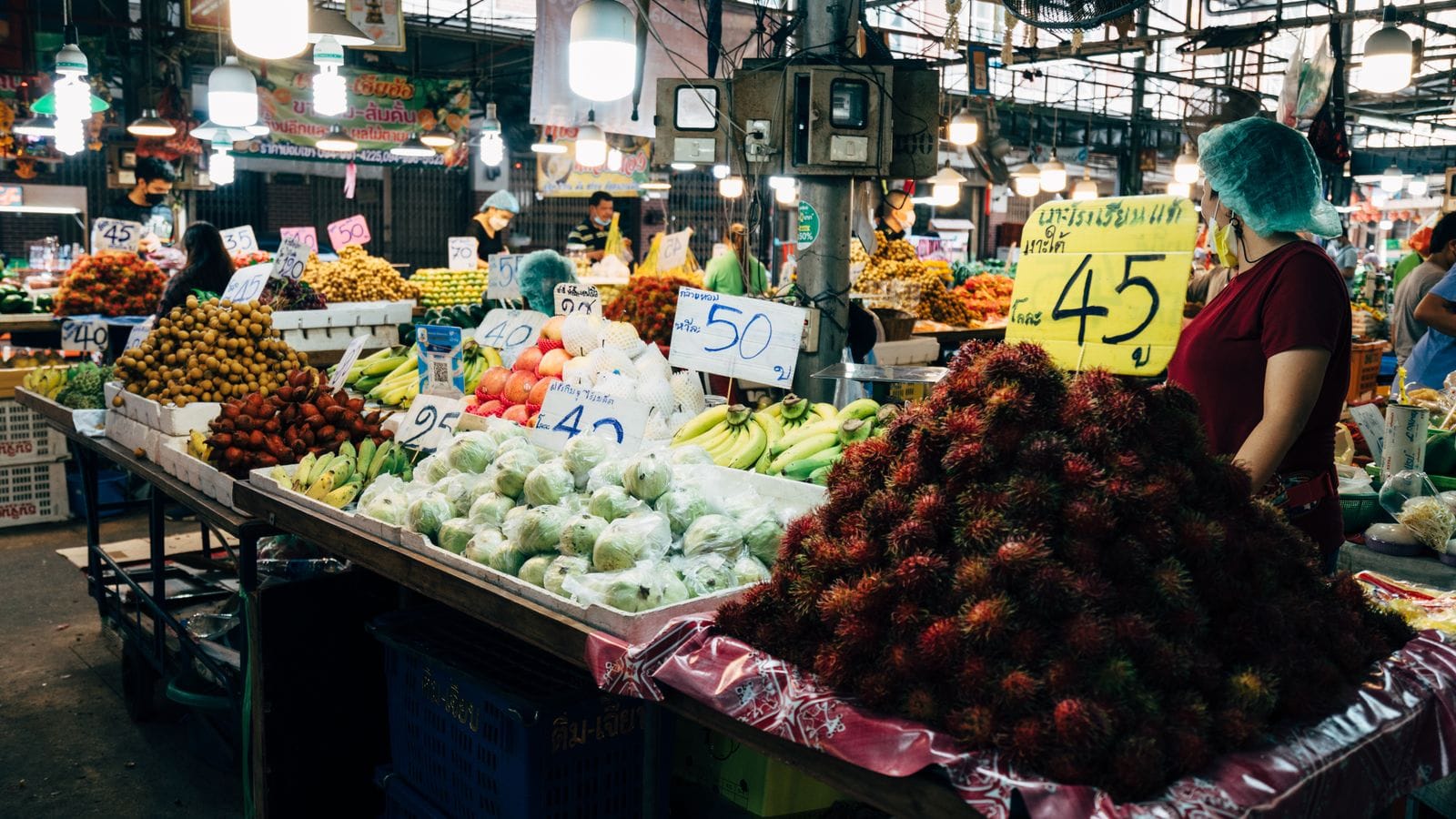
The heart of morning food in Lamphun town is Kad Nong Dok, an old market in the town centre, not far from the Queen Chamthewi Monument. It's both a fresh market and a food market, busiest in the early morning, with stalls for vegetables, fruit, foraged goods, fresh pork and fish, and a long row of ready-cooked food. One loop and you've got a full meal sorted.
- Kad Nong Dok (Nong Dok Market) — the town's main market, near the Queen Chamthewi Monument. Mornings lean toward fresh produce and ready-cooked food; by evening it turns into a night market, so you can come at two different times of day.
- Markets around Wat Phra That Hariphunchai — food and souvenir stalls scattered around the temple. Pay your respects, then pick up local sweets and snacks right there.
- Pa Sang morning market — out of town toward Pa Sang district, a homey atmosphere with proper northern food at easy prices. Worth a stop if you're driving through in the morning.
What time should you go
Lamphun's morning markets are busiest around 6:00–9:00 a.m. The fresh produce and most popular ready-cooked dishes sell out fast, so if you want the full spread, going before 8 a.m. is best. Souvenir items like dried longan and other dry goods are sold all day, so there's no rush on those.
Want to taste deeper? Try a Lamphun food tour or cooking class
Half a day with a local who knows the lanes — or cooking a dish yourself — teaches you more than just eating. Book ahead on Klook or GetYourGuide.
Ready-cooked northern dishes — the stuff to bag up and take
The charm of a northern morning market is the ready-cooked stalls — dishes scooped hot into bags, sold at 15–30 THB a bag. Lamphun locals buy several bags to eat with sticky rice at home, and if you're visiting you can sample several dishes for just a few baht. Here's what you'll see often and should try.
Khanom jeen nam ngiao
Lamphun's signature dish: a well-rounded, orange-hued broth coloured by red kapok flowers, with blood cubes and pork ribs, ladled over fresh rice noodles and eaten with raw vegetables and crispy pork rinds. A famous spot like Khanom Jeen Pa Sai in town has been open for years and really does draw a queue.
Khanom sen mor din
Rice noodles served northern-style with nam ngiao or curry broth simmered in a clay pot, fragrant with curry paste, eaten with a big plate of local vegetables. Some places in town offer it as a set with a choice of several broths.
Gaeng hang lay
A northern-style pork belly curry, balanced sweet and salty, fragrant with ginger and hang lay spice. The ready-cooked stalls almost always have it every morning. Scoop it into a bag and it goes perfectly with sticky rice.
Nam prik num + nam prik ong
A pair of northern chilli dips: num is mildly spicy from roasted green chillies, ong is sweet-and-sour from tomato and minced pork. Buy a bag of each with steamed vegetables and crispy pork rinds for a light meal that still fills you up.
Sai ua + crispy pork rinds
A grilled herb sausage fragrant with lemongrass and kaffir lime, sliced and sold at the stalls. Eat it with sticky rice and crispy pork rinds. It's both a snack and a souvenir you'll find easily at every market.
Larb moo khua
Northern larb, stir-fried and fully cooked, fragrant with larb spice and not as fiery as Isan larb. Some stalls bag up the khua larb with sticky rice, so you can grab it for an easy breakfast.
Khao soi
Egg noodles in a coconut-curry broth made with northern curry paste, topped with crispy fried noodles, with chicken or beef. Lamphun has several long-running khao soi shops in town. Eat it with pickled greens and shallots, northern-style.
Khao kaep & kao kriap wow
Local snacks: thin rice-flour sheets sun-dried then toasted over a flame until they puff up, crisp and fragrant. They're a homey nibble and souvenir, found at the dry-goods stalls in the morning market.
Fresh produce — browse the stalls like a local
The fresh-produce side is the fun part if you like looking at ingredients. Lamphun's morning market has foraged goods and local vegetables you rarely see in big cities, at prices clearly cheaper than the supermarket. Even if you're not cooking, it's a pleasant browse and a good way to get to know more northern foods.
- Local vegetables and foraged goods — fiddlehead ferns, chiang da leaves, bamboo shoots, seasonal mushrooms, sold in small bundles for a handful of baht.
- Fresh curry pastes — northern curry paste, freshly pounded chilli dips, fermented soybean discs — the things that give northern food its real flavour.
- Pork, fish and free-range chicken — fresh meat straight from nearby, with friendly vendors you can haggle with.
- Seasonal mushrooms and red ant eggs — at the start of the rains you'll find hed thob, hed phao, and red ant eggs — seasonal goods that only come around for a short window.
Bring a cloth bag
Stalls at the morning market still tend to use plastic bags. If you bring your own cloth bag or container, you'll cut down a lot of waste, and plenty of vendors are happy to fill it for you — some will even knock a little off the price.
Seasonal fruit — Lamphun is longan country
Mention Lamphun and northerners think of longan before anything else — there's even a saying, "for longan, go to Lamphun." Lamphun longan has thick flesh, a small seed, and is sweet and fragrant. The peak is July–August, lining up with the Longan and Agriculture Fair held in early August every year. Come during this window and you'll eat the freshest longan at the lowest prices — but Lamphun's seasonal fruit isn't only longan.
Longan (Jul–Aug)
The town's most famous product, thick-fleshed with a small seed, sweet and fragrant. At peak, fresh longan by the kilo is very cheap. Off-season there's dried longan and whole-shell dried longan sold all year round.
Mango (Mar–May)
Lamphun is a major mango-growing area. In the hot season several varieties show up at the market, both ripe to eat and green to dip in chilli-salt.
Rambutan & lychee (May–Jun)
Early-rains fruit of the north. Lychee has crisp, sweet flesh, sold in bunches at the morning market early in the season.
Dry goods & dried longan
If you come outside fresh-fruit season, you can still buy dried longan, dried longan flesh, and processed fruit as souvenirs, sold at both the markets and souvenir shops.
Stalls Lamphun locals actually eat at
Beyond the ready-cooked stalls, the area around Nong Dok Market also has old sit-down eateries that have been part of the market for years — the spots where locals meet up for breakfast.
- Kuaytiao Phi Nong (beside Wat Chai Mongkhon) — behind Nong Dok Market, clear-broth and tom yum noodles, well-balanced, a fixture of the market for years.
- The old yen ta fo stall in front of Nong Dok night market — a regular that Lamphun locals know, running steadily through market hours.
- Khanom Jeen Nam Ngiao Pa Sai — a shop down a lane in town, with a rich, well-rounded nam ngiao broth, open long enough that it's become the name Lamphun locals pass along.
- Old northern restaurants in town — Lamphun has northern restaurants open for decades, serving traditional sets of chilli dip, gaeng hang lay, and khua larb.
Straight talk
Lamphun's morning market is a local market, not set up for tourists. There's almost no English signage and things can sell out fast. The charm is exactly that realness. Just point and ask the vendors — northerners are kind and love recommending food.
Plan a full day of eating in Lamphun
See the Lamphun travel guide →