🔄 Updated 21 Jun 2026
Lopburi is a town that's "old but still alive" — people still live and trade in the old buildings around the ruins, rather than the whole place turning into a museum. The charm of the old-town quarter is that everything clusters close together: walk from the palace to the prang, on to the Western envoy's house, then loop back to the market. It takes anywhere from half a day to a full day, depending on how many cafes you stop at.
One thing we should say straight off: the monkeys. The area around Phra Prang Sam Yot and San Phra Kan has plenty of monkeys that aren't afraid of people. Anything in your hand, a plastic bag, glasses, your phone — all of it can get snatched. If you come prepared, it's a fun visit. We've put a how-to-handle-it section below.
Start at King Narai's Palace (Phra Narai Ratchaniwet)
The best place to start is Phra Narai Ratchaniwet, the palace most people just call King Narai's Palace. King Narai the Great had it built in 1666 on roughly 41 rai of land, to serve as his residence and seat of government back when Lopburi was the kingdom's second capital. The palace walls are tall and solid, the gateways pointed arches, and rows of boundary niches line the walls. Inside the grounds you'll see both the ruins of throne halls and buildings from King Rama IV's reign layered on top.
Inside is the Somdet Phra Narai National Museum, which displays antiquities excavated around Lopburi. If you like history, it's a good primer on the town before you head out to see the real thing outside. Around 1–1.5 hours wandering the palace is about right.
The combo ticket is better value
At Wat Phra Si Rattana Mahathat you can buy a combo ticket — 30 THB for Thais, 150 THB for foreigners — that covers Wat Phra Si Rattana Mahathat, Phra Thinang Kraison Siharat, Phra Prang Sam Yot and Vichayen House. If you plan to walk the full circuit, the combo works out cheaper than paying at each site separately.
Want more out of Lopburi? Book tours & activities
Booking online ahead on Klook or GetYourGuide is usually cheaper than the gate and skips the queue. Pick only the experiences you actually want — prices and availability are shown live on each site.
Phra Prang Sam Yot — a Khmer temple in the middle of town
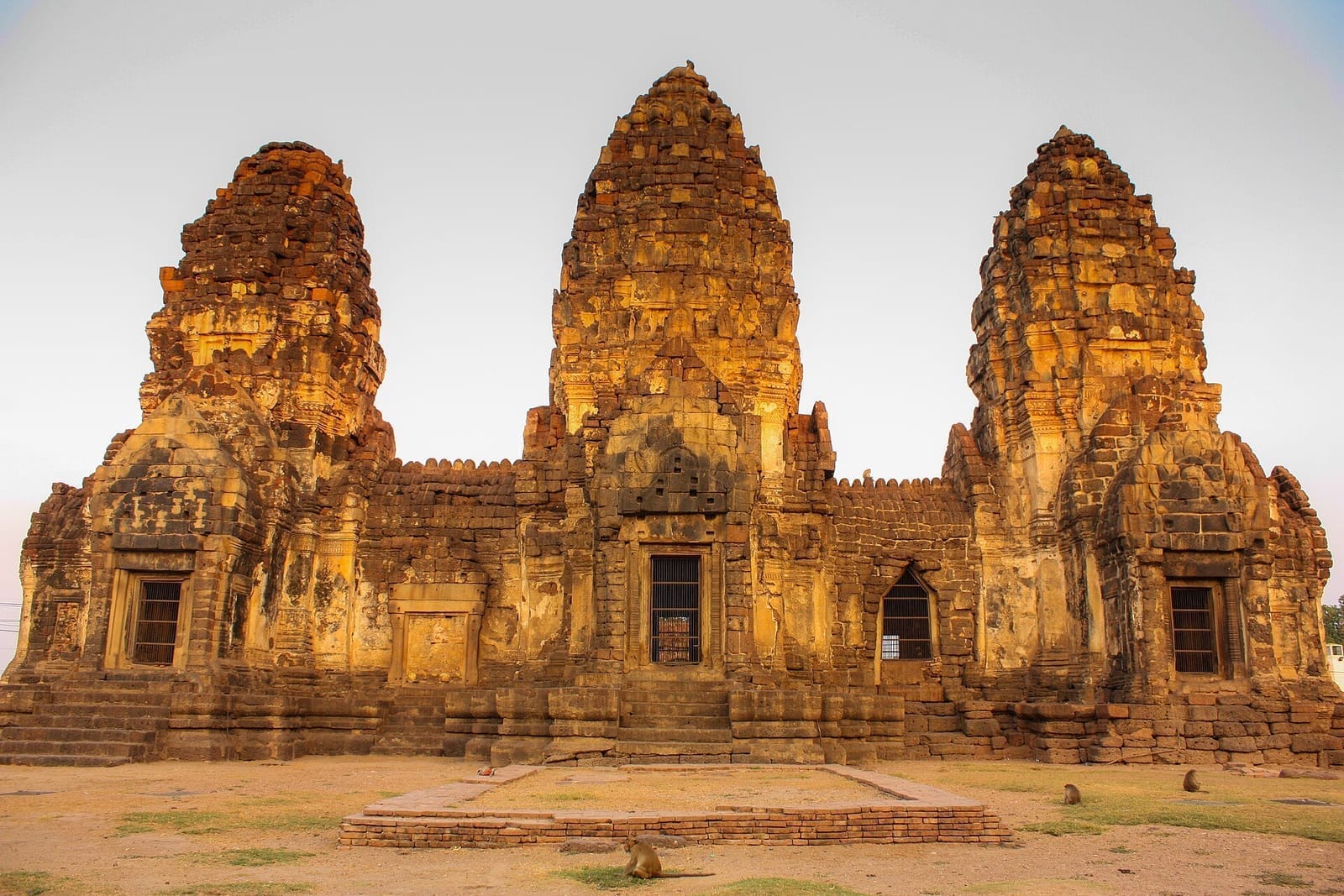
Phra Prang Sam Yot is the image people picture when they think of Lopburi: three connected laterite towers, a Khmer temple in the Bayon style. It began as a Hindu shrine before being converted into a Buddhist site later on. The towers are rendered in stucco, and you can still see fragments of old stucco reliefs. It sits on a low mound near Lopburi railway station, an easy walk from the town centre.
This is the real home turf of the monkey troops. From mid-morning into the afternoon the monkeys come out in force — crossing the road, climbing the lamp posts, sitting on the temple walls. It's a sight you won't easily find elsewhere, but keep a close eye on your belongings.
- Don't walk in carrying a plastic bag or food — monkeys link bags to snacks instantly.
- Keep glasses, hats and phones secure — small loose items are easy targets to grab.
- Don't hold eye contact or bare your teeth at the big males — they read it as a challenge.
- If you want to feed them — only at the designated spots, and watch out for a whole group rushing in at once.
Vichayen House and San Phra Kan
Walk north from the prang and you'll reach Vichayen House, also known as the Ambassadors' Reception Residence — a cluster of brick buildings that was once the home of Constantine Phaulkon (Chao Phraya Vichayen), the Greek courtier in King Narai's service, and the place where the French diplomatic missions were received. The ruins blend European and Thai architecture, with an old Christian church on the grounds, giving you a photo spot with a very different feel from the usual Thai temple.
Right nearby is San Phra Kan, an old shrine that Lopburi locals revere, with a lintel and Lopburi-era deity images enshrined inside. This area also has plenty of monkeys, and many people stop to pay respects and ask for blessings before continuing on.
Vichayen House
Open 08:00–18:00, closed Mon–Tue. Entry 10 THB for Thais, 30 THB for foreigners (covered by the combo ticket).
Wat Phra Si Rattana Mahathat
Open 07:00–17:00, closed Mon–Tue. Entry 10 THB for Thais, 50 THB for foreigners. The large central prang photographs beautifully.
Wat Nakhon Kosa
Ruins of prangs and chedis layered across several eras, from Dvaravati to Ayutthaya, right by the railway station.
Photographing old shophouses and the lower market
Another layer of Lopburi old town's charm is the old shophouses around the ruins. Many are commercial buildings from the reign of Rama V through the Phibun years — aged plaster walls, hand-painted shop signs, folding wooden doors. Walk slowly along Vichayen Road and the lanes around the palace and you'll find plenty of corners that tell the town's story.
The lower market community (Talat Lang) is an old trading quarter beside the railway, with local snacks, sweet shops, and old-school coffee shops mixed in with newer spots. It feels like a market where people still go about their daily lives, not one staged for tourists. Wander through in the morning for the liveliest atmosphere.
About the railway cutting through town
The railway really does run right through the old-town quarter — in some stretches the tracks sit right next to the market and the ruins. It makes for great photos, but always watch the train timing and listen for the signals.
Cafes in the old town and facing the palace
Over the past few years a lot more new-wave cafes have opened in Lopburi's old town. Many have set up inside old buildings or facing the palace walls, so you can sip your coffee while looking at the ruins in one spot. These are the places people talk about that are still open.
Nom-Cup-D
A cafe right in front of King Narai's Palace, with a full view of the palace walls. The highlight is old-style Thai sweets to go with your coffee — a good stop after you've finished walking the palace.
ART DECO Cafe' & Gallery
Set in the old army hotel building from the Phibun era in the town centre, renovated into an art-deco cafe-gallery with plenty of vintage photo corners.
Saneha Café
A calm cafe in the old-town quarter, good for a break between sights. Warm decor and a varied coffee and drinks menu.
The Mellow
A cafe in a lane near the palace, minimalist in style with coffee taken seriously — good for anyone who likes a quiet, uncrowded spot.
ONEPERCENT
A coffee shop in the area facing the palace with a varied drinks menu — another option to wander and sample in the same neighbourhood as Nom-Cup-D.
SIERRA & CO.
A two-storey loft-style cafe near Robinson, comfortable and air-conditioned — a good place to escape the afternoon heat before heading back to walk the old town.
If you have time and a car, the nature cafes with mountain views just outside town — around the Khao Chin Lae and Phatthana Nikhom areas — are worth driving out to in the morning. But if you're only doing the old town on foot, the cluster of palace-facing cafes above covers you well enough.
A real walking route through the old town
If you want to see it all without doubling back, here's the order we'd put it in — about half a day to a full day, depending on how long you linger over coffee.
Palace–Prang–Envoy's House
Vichayen House–Old Shophouses–Market
Things to know before you go
- Many ruins close Mon–Tue — both Wat Phra Si and Vichayen House. If you want to see everything, go Wednesday to Sunday.
- The train is an easy way in — Lopburi station is right in the old town, walking distance to Phra Prang Sam Yot and Wat Nakhon Kosa, so no car rental needed.
- Wear comfortable walking shoes — the route is mostly on foot, over a mix of stone and old paving.
- Avoid carrying open food — especially in the prang and San Phra Kan zones where the monkeys are.
Want a full-day Lopburi plan with places to stay
See the Lopburi travel guide →