🔄 Updated 21 Jun 2026
Tai Yai food is noticeably different from the Northern Thai cooking most people know. The giveaway that you're eating Shan food is tua nao — fermented soybean pounded into dried discs or ground fresh, used in place of shrimp paste in almost every dish. It gives a deep, savory umami a bit like Japanese natto. The other tell is the flavor: not fiery like Southern Thai food, but lightly sour, gently salty and a touch sweet from the vegetables. Shan locals actually eat far less spicy than many people assume.
If you're visiting from elsewhere, there are four key dishes worth trying: khao sen nam ngiao (the Shan version of nam ngiao noodles, with a light sourness from tomato and dried kapok flower), khao ram fuen (a soft, springy tofu made from chickpeas or peas, eaten with fermented vinegar), nam prik ong tai (rounder and less sweet than the Chiang Mai version, with tua nao added) and Shan hang lay (Shan-State-style hang lay curry — less sweet, with bolder spice).
10 Tai Yai eateries locals actually go to
Pa Sribua Tai Restaurant
A local Shan home-cooking spot that Mae Hong Son locals consider the real deal, near Sai Yut Market and open from morning to afternoon. Standout dishes are jin lung (minced pork seasoned Shan-style), oop gai and Shan-style hang lay — not overly sweet, with clear spicing. This is the one we'd point a first-time visitor to.
Pi Pin — Nam Ngiao, Khao Fuen & Tai Yai Food
A small place where locals come for khao sen nam ngiao and khao ram fuen in the morning. The nam ngiao here has a balanced, gentle sourness, while the khao fuen (khao ram fuen) is soft and springy, doused with fermented vinegar and chili powder. A genuine Shan spot that doesn't tone down the flavors for tourists.
Bai Fern Restaurant
A town institution of over 25 years on Khunlum Praphat Road, near the walking street, open late. Standouts are nam prik ong, tom phak kat jor and oop gai, all cooked the traditional way. It's a larger, comfortable room — good for a proper sit-down dinner.
Mae Hong Son Morning Market (Sai Yut Market)
The heart of Shan eating is right here. Come early and you'll find khao sen nam ngiao, fried khao ram fuen, tua nao discs, gaeng hoh and hard-to-find local vegetables. Many of the vendors are Shan who've been cooking and selling for years — cheap, and the real flavor.
Market by Chao Pho Khor Mue Lek Shrine (Pa Lek's stall)
A tiny stall in the market along Singhanat Bamrung Road, selling traditional Shan snacks that locals genuinely buy and eat — khao som gai oop, sweet miang and fried tua nao snacks, just a few baht a portion. Great for sampling a bit of everything.
Evening Fresh Market (Sai Yut Market area)
In the evening the same area has another set of Shan food stalls — khang pong (Shan-style battered fried vegetables), fried tofu, and Shan sweets like peng mong and suay thamin. Easy to grab and take back to your room.
Lee Wine Rak Thai (Yunnanese food, Ban Rak Thai)
If you drive out to Ban Rak Thai and fancy Yunnanese-Chinese food by the lake, this is the spot most people head for. Standouts are tea-leaf salad, pork knuckle with mantou and stir-fried bamboo shoots. Not strictly Shan food, but part of the same borderland food culture — and the view is great.
Leg-Dangling Noodles, Ban Ja Bo
A legendary Mae Hong Son spot where you sit with your legs dangling over the cliff edge at Ban Ja Bo, eating hot clear-broth noodles with a 180-degree sea-of-mist view. A completely different vibe from the in-town food, but if your route passes through Pang Mapha it's worth the stop. Go early for the full mist.
Ban Pai Restaurant (Pai town)
If your trip stops in Pai, this place does a good range of Northern–Shan dishes to try: nam prik ong, nam prik num, kua hoh and sai ua. Reasonable prices, relaxed atmosphere — handy if you want a taste of both Northern and Shan flavors in one meal.
Pi Nong Khao Soi (Pai town)
A small khao soi shop in Pai that reviewers praise for its rich curry broth and fall-apart tender braised meat. Khao soi is more Northern Thai than Shan, but it's on the same local-food trail — a good way to cap off lunch before carrying on sightseeing.
How to catch the real Shan flavors
The best Shan food usually sells in the morning and goes fast — both khao sen nam ngiao and khao ram fuen. If you want the traditional spots, get up and walk the morning market before 8am to find everything fresh and in stock. On Buddhist holy days many local eateries close, so check before you go.
Want to taste deeper? Try a Mae Hong Son food tour or cooking class
Half a day with a local who knows the lanes — or cooking a dish yourself — teaches you more than just eating. Book ahead on Klook or GetYourGuide.
Meet the core dishes of Shan cooking
- Tua nao — fermented soybean pounded into sun-dried discs, or ground fresh, used in place of shrimp paste in the Shan kitchen. It adds deep umami and goes into chili dips, curries and fried snacks alike — the single ingredient that tells you you're eating Shan food.
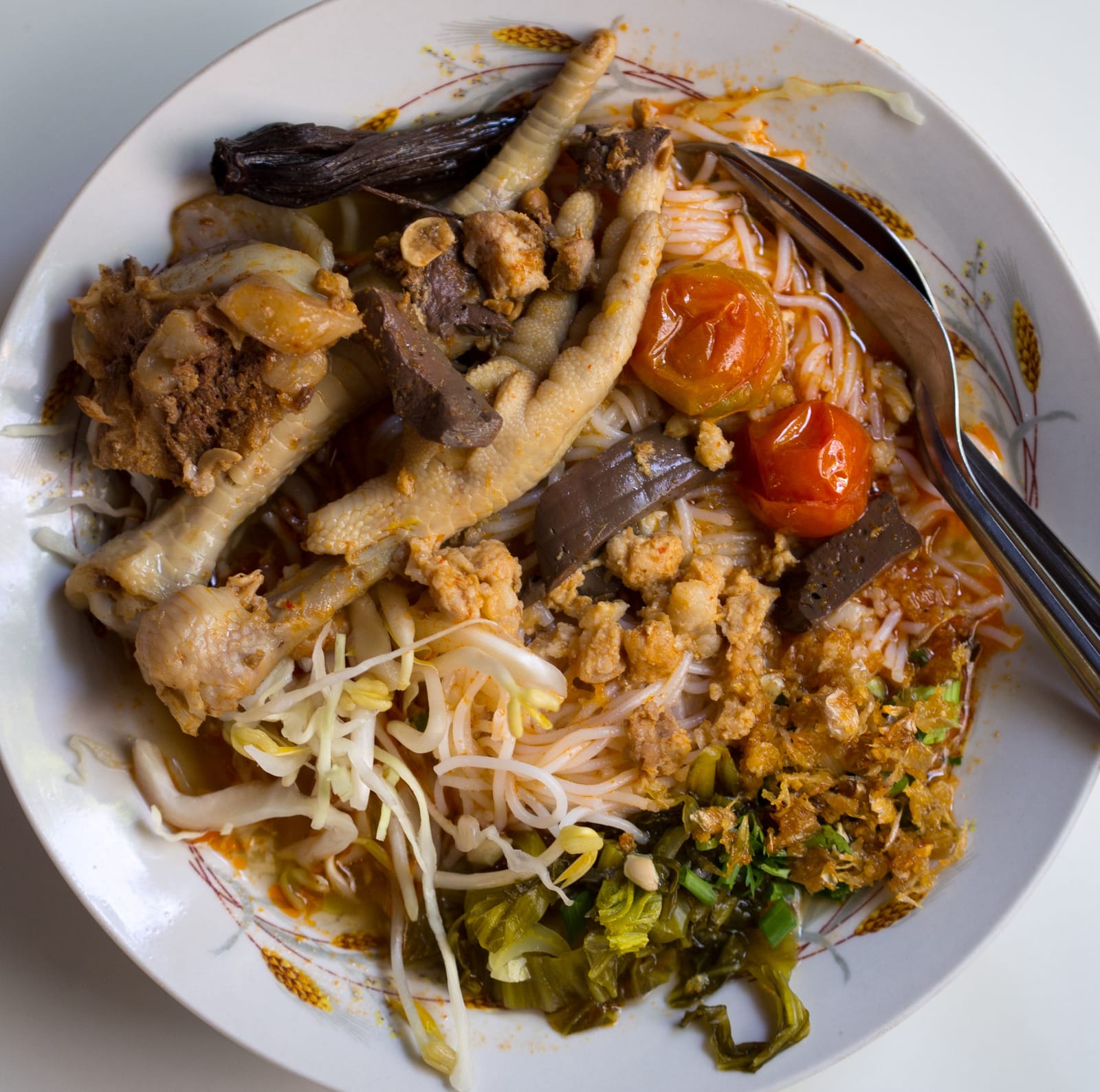
- Khao sen nam ngiao — the Shan take on nam ngiao noodles, with a pale-orange broth colored by tomato and dried kapok flower, lightly sour and not too spicy, eaten with fresh vegetables and crispy pork crackling. A popular breakfast.
- Khao ram fuen — a tofu made from chickpeas or peas, soft and springy, sliced into strips or cubes and topped with fermented vinegar, chili powder and fried garlic. Some places fry it into a crisp-outside, soft-inside version.
- Nam prik ong tai — a tomato-and-minced-pork chili dip, the Shan version with tua nao added, rounder and less sweet than the Chiang Mai version, eaten with steamed vegetables and sticky rice.
- Shan hang lay — Shan-State-style hang lay curry, with clear spicing and less sweetness than the Chiang Mai version, the pork braised until tender. It's a dish traditional Shan eateries make differently from a typical Northern Thai restaurant.
Shan snacks and sweets worth trying
Khang pong
Shan-style battered, fried vegetables or pumpkin, eaten hot — crisp outside, soft inside. Found at the evening markets.
Peng mong / Suay thamin
Chewy, sticky Shan sweets made from sticky rice and cane sugar, mildly sweet. Easy to find around the markets.
Alawa
A Shan sweet a bit like a rice-flour cake, dense and chewy with a rich sweetness — a nice edible souvenir to take home.
How to eat it all in 2 days
Morning market to dinner in town
Local food out of town
Plan a full eat-and-explore trip to Mae Hong Son
See the Mae Hong Son guide →