🔄 Updated 21 Jun 2026
If you only know coconut sugar from the bagged stuff at the supermarket, watching it made at a Mae Klong stove changes everything. Real coconut sugar here comes from the sweet sap inside the coconut flower stalk, which the orchard keepers climb up to tap and collect twice a day — morning and afternoon — before bringing it down to simmer over a wood fire until it thickens into fragrant cakes. No cane sugar mixed in. The whole process happens in a small canal-side grove that's still very much alive and working.
How a sugar stove works, and why three woks
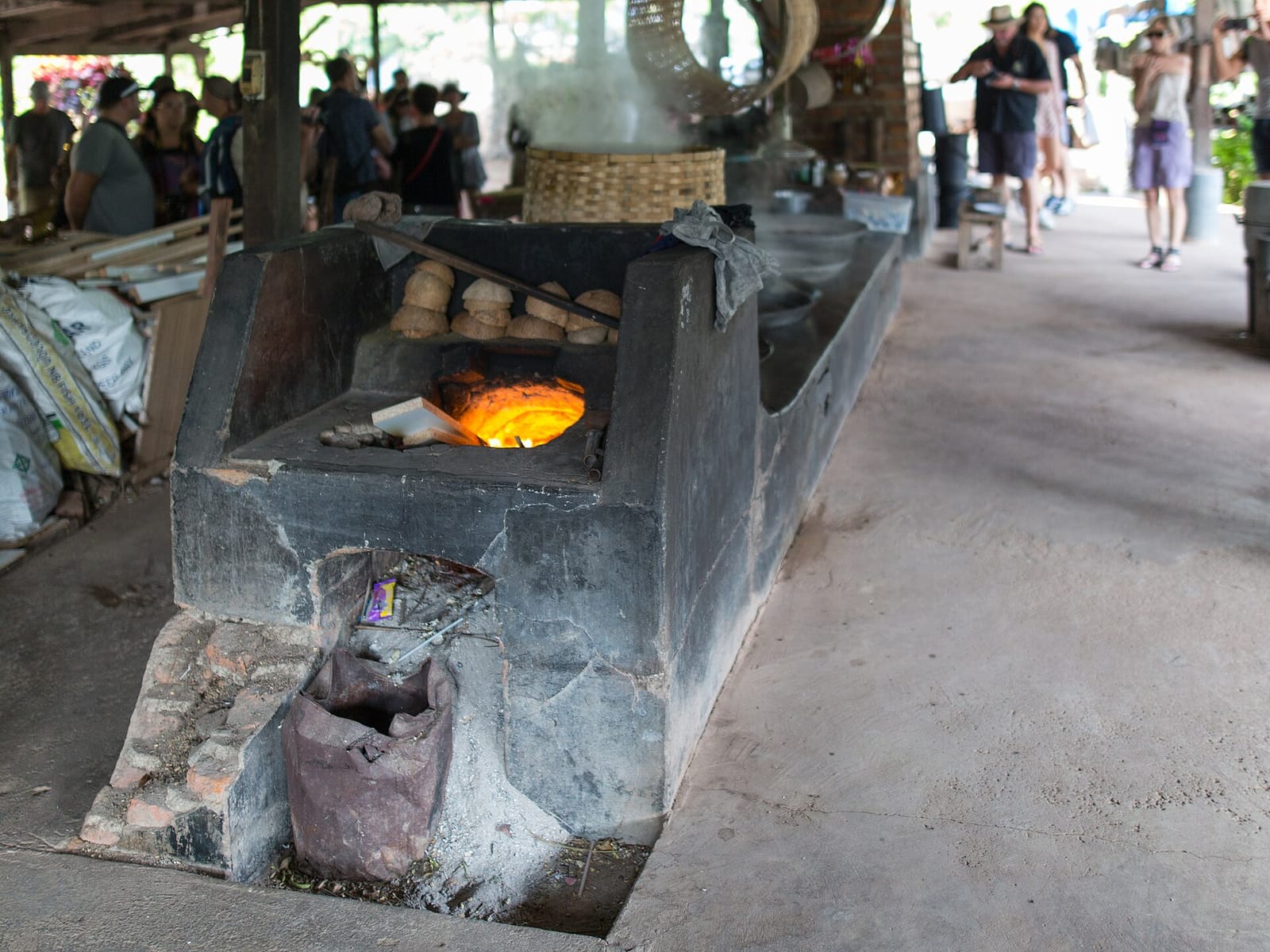
The heart of coconut-sugar making is the "tao tan" — a long clay stove that holds three wide woks in a row over a single wood fire. The heat isn't the same at each spot, so the person tending the stove keeps ladling the raw sap forward, from the hottest wok to the cooler ones, driving off the water in stages until it reaches just the right thickness — never burnt, never bitter.
- Wok 1 (hottest) — strained raw sap goes in here to boil, bubbling hard with sweet steam filling the whole shed. This is where the water boils off fastest.
- Wok 2 (middle) — the sugar starts to thicken and deepen to a golden brown; the cook keeps stirring so it doesn't catch on the bottom.
- Wok 3 (lowest heat) — once it's reduced just right, it's lifted off and beaten smooth, then poured into moulds or cups to set into solid sugar cakes.
When it tastes best
Ask to taste the sugar right when it comes off the wok, still warm — you'll get a caramel aroma the bagged stuff never has. Many stoves are happy to let you try a piece for free if you're buying some to take home.
Want more out of Samut Songkhram? Book tours & activities
Booking online ahead on Klook or GetYourGuide is usually cheaper than the gate and skips the queue. Pick only the experiences you actually want — prices and availability are shown live on each site.
Where you can actually see a working stove
Most of these stoves are family orchards, not full-blown tourist attractions, but a handful welcome outsiders to come watch and taste without any fuss. Here are the ones locals point you to.
Amphawa Chaipattananurak sugar stove
Set inside the Amphawa Chaipattananurak project right in the middle of Amphawa market, this has a demonstration centre where you can watch real coconut sugar boiled up close, plus a shop selling sugar cakes and fresh sugar — and you can walk straight on to the floating market. Good if you'd rather not stray off the beaten path. Call ahead to check demo times at 0-3475-2199.
Riam Arun orchard (Mae Klong)
Pi Nok's palm orchard, where she came back to make coconut sugar herself the traditional way. It opens for scheduled visits through the The Monrak Mae Klong network, and you'll see everything from the tappers climbing the palms to the final boil. Best for anyone who wants the full, in-depth look — message ahead to book via Facebook.
Stoves in the Tha Kha–Bang Phrom orchards
The Tha Kha and Bang Phrom area is old coconut-growing country, with sugar stoves scattered through the orchards. Several growers will take you in by boat to see them right at the source. Ask around at Tha Kha Floating Market or at the resorts nearby.
Pair it with Tha Kha Floating Market and a row through the groves
If you want the full canal-country atmosphere, Tha Kha Floating Market is the perfect match. It only runs in the morning on Saturdays and Sundays, plus the 2nd, 7th and 12th days of the waxing and waning moon, roughly 6am to noon. Most of what's sold is genuine orchard produce — coconuts, pomelos, rose apples — and coconut sugar from stoves in the area. The highlight is taking a paddle boat down the narrow orchard canals, gliding through the coconut palms, with some growers boiling sugar to watch along the way.
The season when the sugar's best
From late rainy season into early cool season — roughly November to February — the weather's cooler and the sap from the coconut flowers is at its sweetest and most fragrant. The stoves are busiest then too. Come in the height of the hot season and you may get less sap and a thinner flavour.
What to take home, and how to spot the real thing
- Sugar cakes (nam tan puek) — round golden-brown discs with a firm texture, around ฿60–90 a kilo. Buying straight from the stove is cheaper than at the market.
- Soft palm sugar (nam tan sot) — soft and spoonable, great for desserts and curries, and more fragrant than the solid cakes.
- Pure coconut sugar vs. blended — the real thing has a natural caramel aroma and isn't sharply sweet; after a while it may crystallise a little, which is perfectly normal. If it's oddly over-sweet and too pale, it's usually been cut with cane sugar.
- Ask for a small piece to taste first — a stove that's confident in its sugar will gladly let you try. If you're buying at the floating market, ask which stove it came from.
Before you go
- Go early, around 8–10am, while the stoves are on their morning boil — that's when you'll see the whole process and the sweet smoke is still rising.
- Wear shoes you don't mind getting wet; the orchard rows and canal-side paths are slippery and muddy.
- Call or message ahead for private orchards like Riam Arun — it's a real working farm, not open every day.
- Bring cash. Most stoves and orchard shops still don't take cards.
- Respect the workspace. The fires are scorching hot, so ask before you get close or take photos.
Plan a full day of eating and exploring around Samut Songkhram
See the Samut Songkhram guide →