🔄 Updated 21 Jun 2026
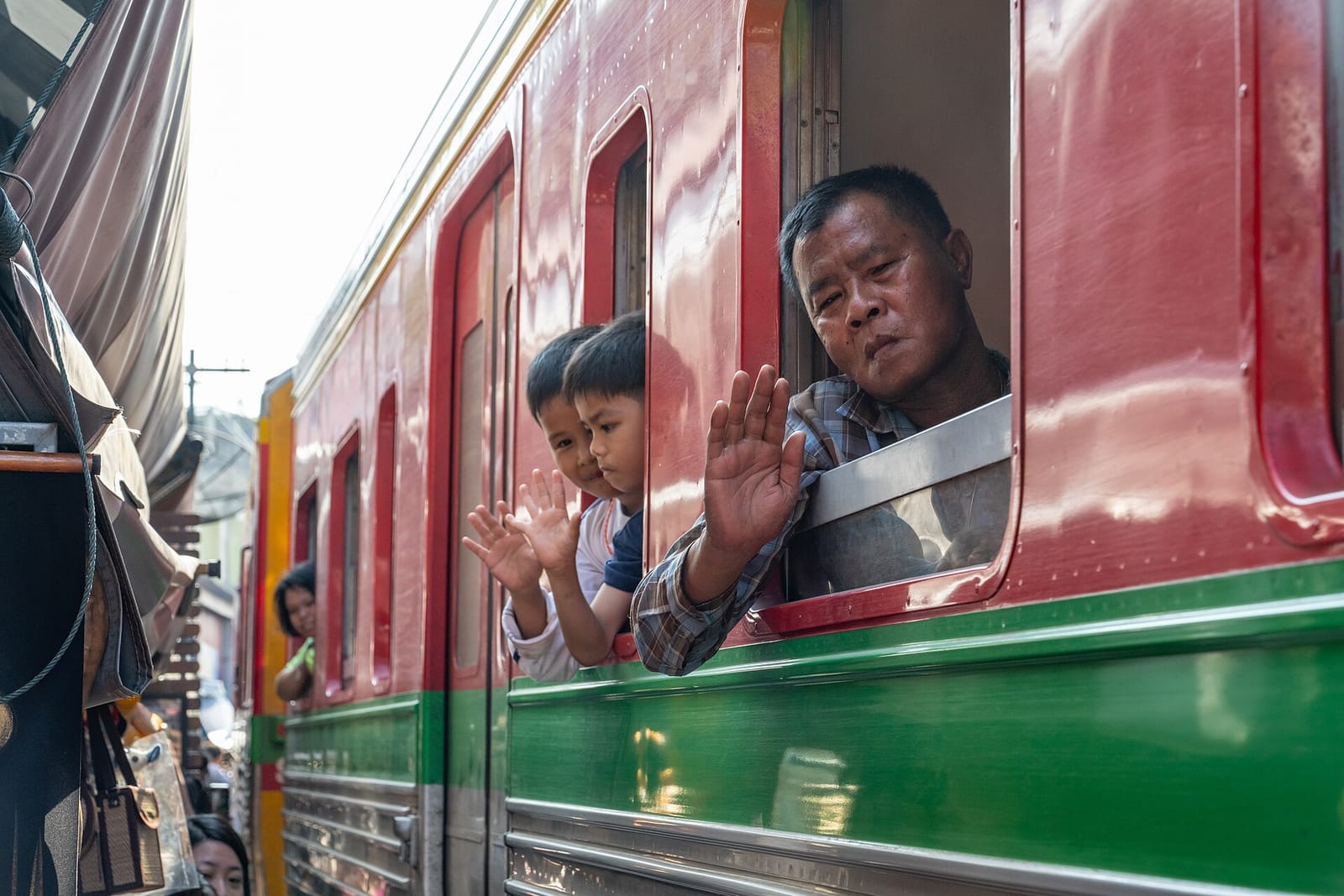
If there's one place that put Samut Songkhram on the map, it's this. The Maeklong Railway Market is a genuine local fresh market where people sell their goods directly on the Ban Laem–Maeklong railway line. Vendors line both sides of the track for more than 100 metres, and when a train draws near, an announcement sounds and everyone folds their awnings and pulls their goods back within seconds. The train inches past just a few dozen centimetres from the stalls, then everything snaps back to how it was. That's exactly why visitors call it the Umbrella Pulldown Market.
Train schedule — know the times so you don't miss it
The whole point of coming here is the "train moment," because the awning-folding only happens as a train pulls in or out. Trains pass eight times a day on the Ban Laem–Maeklong commuter line. The times below can shift a little, so plan to arrive 20–30 minutes early to claim a spot to stand.
- Trains arriving at Maeklong station (heading into the market) — roughly 08:30 · 11:10 · 14:30 · 17:40
- Trains departing Maeklong station (heading out of the market) — roughly 06:20 · 09:00 · 11:30 · 15:30
- The most popular runs are 11:10 and 14:30, thanks to the nice light and not having to wake up too early
- The early 08:30 run draws fewer people and is easier for photos, if you don't mind an early start
Always check the times first
The schedule can drift from the posted times — track maintenance, long holidays, or unexpected delays all play a part. Before you set out, try calling Maeklong railway station or asking someone at the market to confirm, so you don't end up waiting around for nothing.
Want more out of Samut Songkhram? Book tours & activities
Booking online ahead on Klook or GetYourGuide is usually cheaper than the gate and skips the queue. Pick only the experiences you actually want — prices and availability are shown live on each site.
The awning-folding — what's actually happening
As train time nears, an announcement and warning signal go out about 5–10 minutes ahead. Vendors start pulling in their canopies, folding awnings, and sliding their stalls back to a safe distance. It's a system they've run for decades, and they've got it down to a science. The train crawls through the market, passing just inches from the goods laid out on the ground, and the moment the last carriage clears, the vendors pop their awnings back open and push the stalls into place as if nothing happened.
- Don't cross the line — the market paints a red line as a safety boundary; always stay behind it when a train comes
- Keep your valuables close — it's crowded and tight, so wearing your bag in front is safer
- Listen to the staff and vendors — they'll tell you when to step back, and following them keeps you safe every time
- Mind your head and anything sticking out — some spots have low roofs, so don't reach out a hand or a selfie stick as the train passes
The best photo spots
The shot everyone wants is the train rolling straight through the middle of the stalls with colourful awnings on both sides. Getting a good angle comes down to standing in the right place at the right time. Here's how to plan it.
The station end of the tracks
Stand at the end of the rail and you'll see the front of the train slowly emerge toward your camera — a head-on shot of the train coming straight at you. It's the most popular angle, so expect a crowd jostling for it.
The middle of the market over the rails
Stand beside a central stall to capture the awnings on both sides with the train squeezing past. This is the angle that best tells the story of the market.
A trackside café
Plenty of cafés along the market let you sip a coffee while you wait for the train. You get a slightly raised, safe vantage point without elbowing through the crowd — good if you're with older relatives or kids.
Photo tips
If you want a video of the awning-folding, start recording the moment you hear the announcement — the beat when all the awnings come down at once is the money shot. And don't forget to turn the camera back when they reopen the awnings; it's just as good.
What's for sale in the market
Remember, this is a real fresh market where Maeklong locals actually shop — not something set up for tourists. That means the produce is fresh and the prices are local. It's an easy, pleasant wander while you wait for the train.
- Maeklong mackerel (pla tu) — the town's signature catch: short-bodied with a bent face and firm flesh; you can take some home
- Fresh seafood — shrimp, shellfish, crab, and fish straight from the mouth of the Maeklong estuary, cheaper than in the city
- Seasonal fruit — lychees, big white pomelos, and fragrant young coconuts, all local specialties
- Snacks and Thai sweets — Maeklong's local desserts, fried bites, and dried goods to grab and eat as you stroll
Getting there
The Maeklong Railway Market sits right next to Maeklong station, in the town centre of Mueang Samut Songkhram, near Wat Ban Laem. There are several ways to reach it, so pick whatever suits your trip.
- Driving from Bangkok — take Rama II Road, around 1.5–2 hours; most people park near Wat Ban Laem and walk through the lanes into the market
- Van or bus — from the Southern Bus Terminal (Sai Tai Mai) there are services into Maeklong town, then a motorbike taxi or short walk into the market
- The Maha Chai–Maeklong railway — an experience a lot of people enjoy: ride from Ban Laem all the way to the final stop inside the railway market itself, so you get the journey and the photos in one go, with tickets costing just a few tens of THB
Make a day of it
The Maeklong Railway Market is very close to Amphawa — only about a 15-minute drive. Most people catch a late-morning or afternoon train run here, then head to the Amphawa floating market in the evening and finish with a firefly boat tour. It all comes together nicely as a single day trip.
Plan a full day in Samut Songkhram
See the Samut Songkhram travel guide →