🔄 Updated 21 Jun 2026
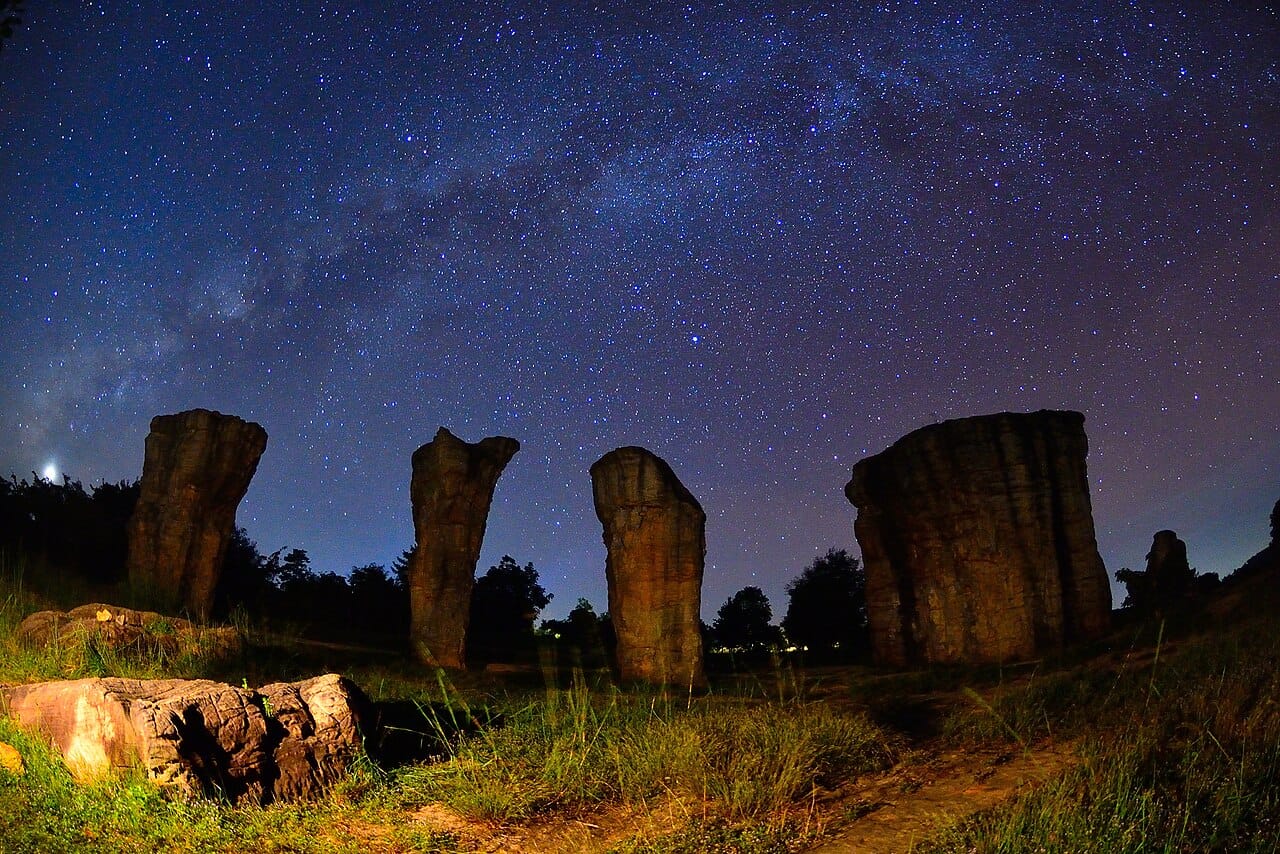
Mo Hin Khao sits inside Phu Laenkha National Park, in Tha Hin Ngom subdistrict, Mueang district, Chaiyaphum, about 40 kilometres west of the city. The site itself is a wide grassy plateau where clusters of stone pillars and sandstone slabs rise straight out of the ground. The most photographed spot is the group of five pillars lined up like the standing stones of England's Stonehenge, and beyond them rock formations in all sorts of shapes scatter off into the distance. What makes the place easy to enjoy is that you can stroll around the whole thing on flat grassland with no climbing, then continue up to the Pha Hua Nak viewpoint, which gets so pretty in winter that many visitors can hardly believe it is in Chaiyaphum.
The five sandstone pillars — why they call it Thailand's Stonehenge
The icon of Mo Hin Khao is the group of five white sandstone pillars lined up in the open field, the tallest standing about 12 metres high. These rocks are Jurassic to Cretaceous sandstone, roughly 175–195 million years old. They formed as wind, water, and sun slowly wore away the softer layers of sandstone, leaving only the hard cores standing as pillars. Lined up like this in an open meadow, they remind people of the Stonehenge standing stones, and the nickname Thailand's Stonehenge stuck. Around the main pillars you will also find smaller and larger rocks in odd shapes to wander past and guess what they look like.
- Walk all the way around — there are paths through the rock field so you can loop past the pillars and surrounding boulders. The ground is grass and dirt with no climbing involved, and it takes about 30–45 minutes to see it all.
- The rock formations keep going — beyond the five main pillars, more clusters scatter on for roughly 500 metres and 1,500 metres further. Keep walking if you have the time and energy.
- Don't climb on or carve into the pillars — rock that is a hundred million years old is more fragile than it looks. Pose for photos beside them, but don't climb, and keep this place intact for the next generation to see.
Photo tip
The pillars look their best in the early morning when the light is low, and in the late afternoon before sunset, when the long shadows give the stones real depth. Around noon the overhead light is harsh and hot. If you want green grass set against the pillars, come from the rainy season into early winter, when the fields are greener than in the dry months.
Want more out of Chaiyaphum? Book tours & activities
Booking online ahead on Klook or GetYourGuide is usually cheaper than the gate and skips the queue. Pick only the experiences you actually want — prices and availability are shown live on each site.
Pha Hua Nak viewpoint — the winter sea of mist
After Mo Hin Khao, most visitors carry on up to the Pha Hua Nak viewpoint deeper inside the park. It is a cliff edge along the rim of Phu Laenkha looking down over valleys and a wide plain in a sweeping 180-degree view. From late rainy season into early winter, roughly October to February, the air is cold, the wind is strong, and a sea of mist often fills the valley in the morning. Locals rate it one of the best sunrise and sunset spots in all of Isan, and many people hike up to camp overnight so they can catch the morning view and watch the stars, because the sky here is pitch dark with almost no city light to interfere.
Straight talk about the road up to Pha Hua Nak
From the Mo Hin Khao field up to Pha Hua Nak it is dirt road climbing the whole way. Sedans struggle on it, especially in the rainy season when the ground is slick. The park recommends parking at the Mo Hin Khao ranger station and taking one of the locals' six-wheel songthaew trucks up instead. You pay per head or charter the whole vehicle, and it is safer and less stressful than driving it yourself. Ask the staff on site about the fare, since the rate changes with the season.
Camping and stargazing on Phu Laenkha
One of the real charms here is spending the night on the mountain. Pha Hua Nak has a camping field that takes dozens of tents, with toilets, staff on hand for safety, and a stargazing spot under a very clear sky. In winter the overnight temperature can drop into the low twenties Celsius, with strong wind all night long, so if you plan to stay, pack a warm jacket and a sleeping bag.
Pha Hua Nak camping field
The popular camping field right on the viewpoint, so you wake up to the sea of mist. It has toilets and staff on hand. It gets busy in winter, so contact the park ahead of time.
Tent and gear rental
If you don't have your own gear, the park rents out tents and bedding. Ask the staff about the queue and prices before heading up the mountain.
Stargazing field
Pitch-dark skies with almost no city light, so on clear nights the sky fills with stars. Great for Milky Way photos in winter.
When is the best time to visit Mo Hin Khao
The Mo Hin Khao pillars themselves are worth visiting year-round, since the rocks don't depend on the season. But for the full atmosphere, the best window is late rainy season into early winter, roughly October to February, when the grassland is still green, the air is cool, and you have a chance at the morning sea of mist over Pha Hua Nak. During the rainy season from June to September the fields turn deep green, but the dirt road up to Pha Hua Nak gets slippery and hard to drive yourself. In the dry season from March to May you can still see the pillars, but the grass dries to brown and the days get hot.
- Oct–Feb (recommended): cool air, green fields, and a chance at the morning sea of mist over Pha Hua Nak. This is the high season here, and it gets busy over long holiday weekends.
- Jun–Sep (rainy season): the fields are deep green and lovely, but the dirt road is slick, so take the park truck up to Pha Hua Nak and check the weather before you go.
- Mar–May (dry season): you can still visit the pillars as usual, but the fields are dry and the days are hot. Skip the midday sun and go in the early morning or late afternoon instead.
Entry fees, opening hours, and what you need to know
- Opening hours: daily, roughly 8:00 AM–6:00 PM (overnight stays only for those who have arranged camping)
- Entry fee: Thai adults around 20 THB, children around 10 THB, seniors 60 and over free · foreign visitors are charged at the National Park Department's rate
- Vehicle fee: cars around 30 THB, motorbikes around 20 THB per vehicle
- Songthaew up to Pha Hua Nak: park at the Mo Hin Khao ranger station, then take a local six-wheel songthaew up. Ask about the fare on site.
- There are food and drink stalls around the parking area and service points, but it gets crowded in winter, so allow extra time
- What to bring: comfortable walking shoes, water, a hat, sunscreen, and a warm jacket if you're staying overnight · to contact the park, call 044 810 902–3
Getting to Mo Hin Khao
Mo Hin Khao is in Mueang Chaiyaphum district, about 40 kilometres from the city, roughly 1 to 1.5 hours by car. The final stretch climbs the mountain, but the road is paved all the way to the Mo Hin Khao field, so a sedan handles it fine. The onward route up to Pha Hua Nak is dirt, where you should take the park truck. Because it's close to the city, many people make it a day trip out in the morning and back in the evening, though you can also stay overnight on the mountain.
- From the city of Chaiyaphum: take Highway 2051 (Chaiyaphum–Tat Ton) for about 6 kilometres, then turn onto Highway 2159 (Chaiyaphum–Nong Bua Daeng) and continue to kilometre marker 26, where a left turn leads to the park headquarters and Mo Hin Khao. Signs guide you the whole way.
- From Bangkok: drive about 330 kilometres to the city of Chaiyaphum, then another 40 kilometres or so to Mo Hin Khao. It works well to spend a night in the city first, then head up the mountain.
- From Nakhon Ratchasima (Korat): about 160 kilometres to the city of Chaiyaphum, easy to add on after a Korat trip.
- There is no public transport directly to Mo Hin Khao — driving yourself or renting a car is best. If you don't have a vehicle, try asking about a chartered ride from the city of Chaiyaphum.
Mo Hin Khao as a day trip and an overnight stay
Out in the morning, back in the evening from the city
Camp out for the morning sea of mist
Want to see all of Chaiyaphum? Check out other places to stay and visit
See the Chaiyaphum travel guide →