🔄 Updated 21 Jun 2026
Mukdahan sits directly across from Savannakhet province in Laos, with a bridge over the Mekong linking the two, so it's a town that mixes a lot of things together: wide Mekong views, unusual sandstone hills, an Indochina market selling Lao and Vietnamese goods, and the Phu Thai ethnic group who still hold tight to their culture. The sights aren't clustered in one spot but spread around the town within a 15-40 minute drive. Having your own car or a rented motorbike is by far the easiest way to get around, because public transport in town is thin.
We've split the sights into four easy angles: the riverfront (Ho Kaeo, the walking street, the Indochina market, Kaeng Kabao), the rock hills (Phu Pha Thoep, Phu Manorom), the border crossing (Friendship Bridge 2 to Savannakhet), and Phu Thai culture (Nong Sung, Wat Song Khon). Cover every angle in one trip, or just pick the ones you like.
The Mekong riverfront — the heart of town
Mukdahan's main draw is the Mekong itself. The whole town runs along the river, with a viewing tower, a walking street, a cross-border market, and rocky rapids out in the water. These spots are all close together and easy to cover in a single day.
Ho Kaeo Mukdahan
A 65-metre tower that's the province's main landmark. Take the lift to the 6th-floor deck for a 360-degree view over Mukdahan town, the Mekong, and the Savannakhet side in Laos. The top floor enshrines the Phra Phuttha Nawaming Mongkhon Buddha image, and there's an ethnic-cultures museum downstairs to walk through. The view is at its best in the late afternoon, just before sunset.
Kaeng Kabao (Wan Yai district)
A long stretch of rocky rapids along the Mekong, 35 km from town, with broad rock terraces to stroll along while you take in the river bend. In the dry season the water drops and the islets and sandbars come out clearly. The thing to eat here is grilled suckling pig by the river — Sirichai Moo Han is the old original, crispy skin and tender meat, eaten in the cool breeze at the water's edge.
Indochina Market
A riverside market in the middle of town selling imported goods from Laos, Vietnam, and China — cloth, household items, dried snacks, and sweets. It's the go-to spot for souvenirs, and an easy wander from morning to afternoon. Savannakhet sits right across the water.
Mukdahan Riverside Walking Street
A walking street along the river, open Friday to Sunday evenings, with Isan street food, sweets, handmade goods, and buskers playing for tips. The mood is relaxed in the river breeze — a good place to stroll and find dinner.
Riverfront tips
Ho Kaeo is loveliest in the late afternoon, but the riverside levee in front of the Indochina Market is a free sunset spot that locals like to sit at. If you come on a weekday when the walking street isn't open, look for food around the municipal market or the levee restaurants instead.
Want more out of Mukdahan? Book tours & activities
Booking online ahead on Klook or GetYourGuide is usually cheaper than the gate and skips the queue. Pick only the experiences you actually want — prices and availability are shown live on each site.
The rock hills — a million-year rock garden and a big Buddha on the hill
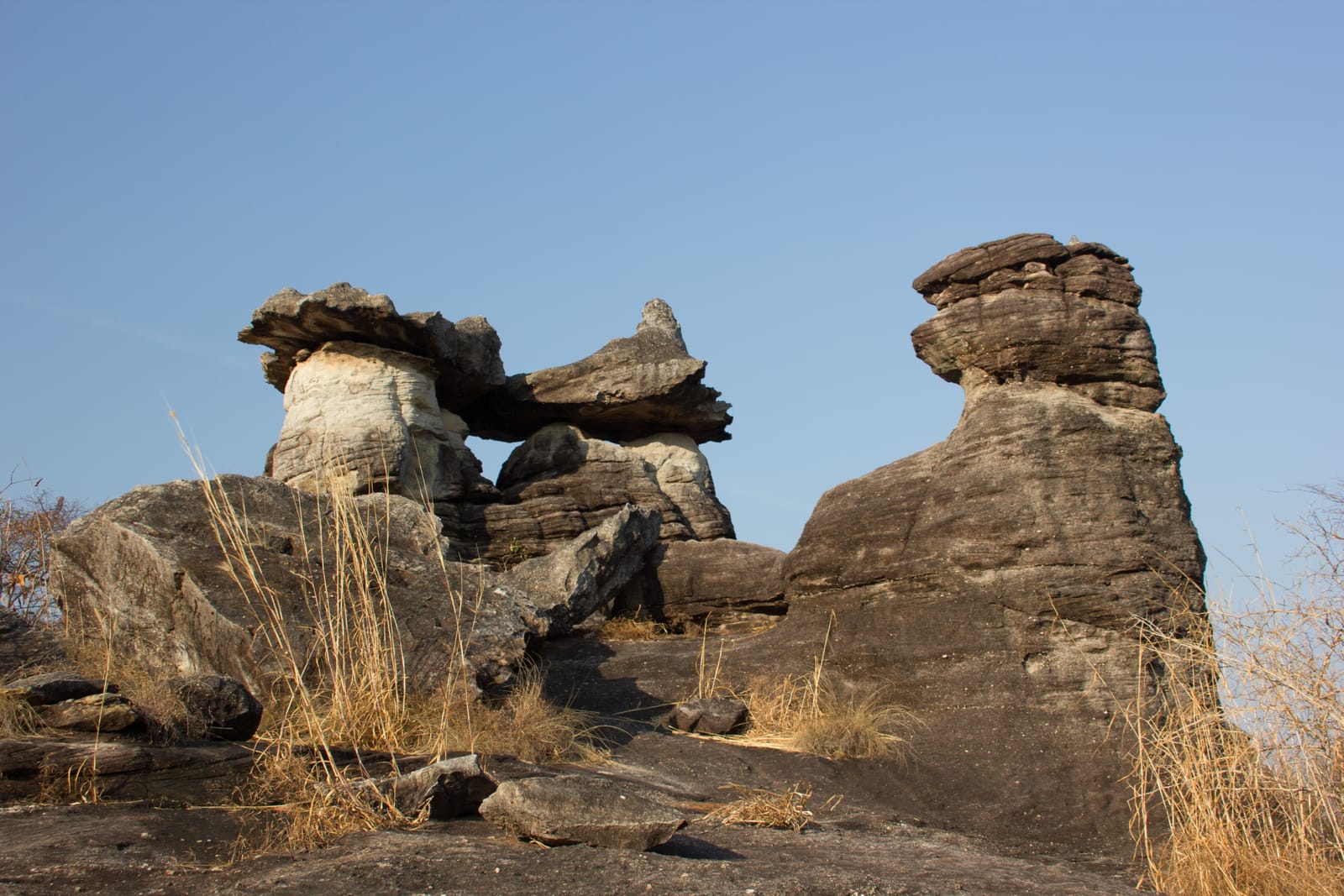
About 15-17 km west of town runs a line of sandstone hills. The highlights are the oddly shaped rock formations carved by wind and water over millions of years, and a hilltop temple that looks down over the whole sweep of the Mekong.
Phu Pha Thoep (Mukdahan National Park)
The highlight is a cluster of remarkable rocks — large boulders in all sorts of shapes stacked on broad stone terraces, like a natural sculpture garden you can walk all the way around. There's a small waterfall in the rainy season and the Pha Thoep viewpoint looking out over open plains. Early morning, before the sun gets harsh, is the most comfortable time to walk.
Wat Roi Phra Phutthabat Phu Manorom
A hilltop temple that looks down over all of Mukdahan town, the Mekong, and Savannakhet. It has the large Phra Chao Yai Kaeo Mukda Sri Trai Rat Buddha image and the blue naga Pu Sri Mukda Maha Muni, more than 120 metres long — a favourite for photos and for the lucky-charm crowd. You park at the bottom and take one of the temple's songthaews up.
Both hills in one day
Phu Pha Thoep and Wat Phu Manorom are on opposite sides of town but easy to pair in half a day. We'd climb Phu Pha Thoep in the morning while the air is still cool, then save Wat Phu Manorom for the late afternoon, when the Mekong view is best in the soft evening light.
Crossing the border — Savannakhet in a day
What sets Mukdahan apart from other Mekong towns is how easy it is to cross into Laos. The Thai-Lao Friendship Bridge 2 is just 7 km from town and runs straight over to Savannakhet province. Thai travellers can cross on either a passport or a border pass.
- Thai-Lao Friendship Bridge 2 — a Mekong crossing over 1,600 metres long. The bridge itself photographs well, but you have to cross by vehicle — you can't walk across. There are scheduled buses running Mukdahan–Savannakhet.
- Crossing to Savannakhet — the Lao town on the far bank, with markets, temples, old French-era buildings, and Vietnamese restaurants. People usually go over in the morning and come back in the evening; Thai travellers use a passport and need no visa.
- Border pass vs passport — a border pass lets you stay within Savannakhet province for up to 3 days, while a passport lets you travel anywhere in Laos. Check the border post's opening hours before you go — it's usually open around 06:00–22:00.
Before you cross
Carry a passport with more than 6 months left, bring Lao kip or Thai baht (many shops on the Lao side take baht), and allow extra time for queues at the checkpoint on long weekends. Always check the latest notices for the Mukdahan border post before you travel, since crossing conditions can change.
Phu Thai — a culture that's still alive
Another angle many people overlook is Phu Thai culture — an ethnic group settled around Nong Sung and Khamcha-i who still speak the Phu Thai language, wear their own distinctive woven cloth, and cook their own home-style food. They're about 40-50 km west of town, which makes for a good half-day to full-day trip.
Phu Thai Village, Nong Sung
A Phu Thai community that holds tight to its way of life, with houses weaving cotton and silk in Phu Thai patterns, local food like bamboo-shoot curry and sticky rice, and Phu Thai dance performances at temple fairs. Good for anyone who likes unhurried cultural travel.
Wat Song Khon (Shrine of the Mother of the Martyrs)
A riverside Catholic church in Wan Yai district whose modern architecture once won a Siam Architect award. It's a memorial to the seven martyrs, set on a wide stretch of ground right by the Mekong — quiet, and photogenic.
Khamcha-i — wild-produce market
The district you pass through on the way to Nong Sung, with a morning market selling wild produce, mushrooms, bamboo shoots, and woven cloth. A worthwhile stop along the way that gives you a real look at Phu Thai life.
Sample trips — build your own to your pace
If you're not sure where to start, here are three versions to use as a guide. Having your own car is by far the easiest. The times are approximate, with room to stop for food and photos.
Riverfront + rock hills
Cross to Savannakhet
Phu Thai culture
Know before you go — when to come, how to get around
- Best time to visit — November to February, when the air is cool and pleasant and the Mekong drops to reveal the rocky rapids clearly. In the rainy season Phu Pha Thoep is lush and green with a waterfall, but the paths get slippery.
- Getting to Mukdahan — there's no airport in the province; most people fly into Nakhon Phanom or Ubon Ratchathani and continue by road, or take a direct coach from Bangkok, around 10-11 hours.
- Getting around the province — sights are spread out and public transport is scarce, so we'd rent a car or a motorbike. Without your own wheels, hire a private car/taxi by the spot.
- Daily budget — an easygoing day runs around ฿600–1,000 per person, including entry fees, food, and fuel, not counting accommodation.
Want a Mukdahan plan with the hotels sorted out too? See our full Mukdahan travel guide.
See the Mukdahan travel guide →