🔄 Updated 21 Jun 2026
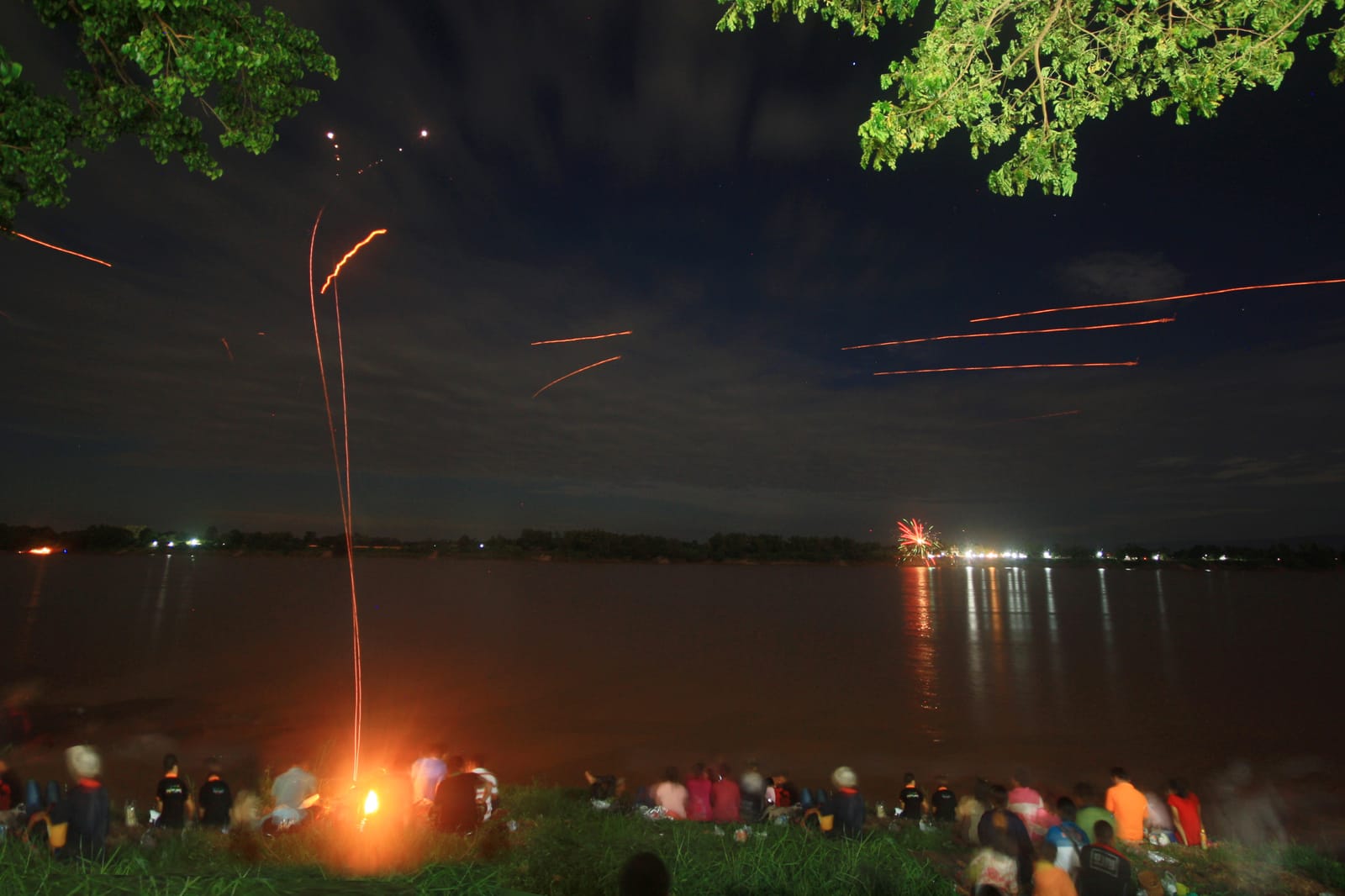
Naga Fireballs are round, reddish-pink balls of light that rise straight up off the surface of the Mekong to about 50–150 meters, then fade out mid-air — no explosion, no smoke, no smell. Sometimes they come up one at a time, sometimes in quick bursts. Some spots see only a handful; others see dozens in a single night. They appear only on the full-moon night of the 11th lunar month, which falls exactly on the end of Buddhist Lent, and only along the stretch of the Mekong around Nong Khai and Bueng Kan.
What they actually are is still up for debate. Believers say the Naga living beneath the river launches the fireballs to honor the Buddha on the day he descended from heaven. Scientists have proposed they're methane gas from riverbed sediment that ignites on its own, but no one has reproduced it cleanly in a lab. For anyone going to watch, the most honest takeaway is simple: go see it with your own eyes and make up your own mind.
When does it fall this year
The fireballs appear on the night that ends Buddhist Lent — the full moon of the 11th lunar month. In 2026 that's the night of Monday, October 26, 2026. This is the main night, the most crowded, and the one with the most fireballs. Many spots also see scattered fireballs on the night before and 1–2 nights after. If you can skip the peak night, the crowds thin out a lot, though the number of fireballs becomes more of a gamble.
Check the date before booking tickets
The end of Buddhist Lent shifts every year with the lunar calendar, so if you're planning for a different year, go by the full moon of the 11th lunar month rather than a fixed date. Nong Khai province announces the dates for its End-of-Lent Naga Fireball Festival well in advance each year.
Want more out of Nong Khai? Book tours & activities
Booking online ahead on Klook or GetYourGuide is usually cheaper than the gate and skips the queue. Pick only the experiences you actually want — prices and availability are shown live on each site.
Viewing spots in Phon Phisai
Phon Phisai district is the best-known area and the center of the festival, about 45 km from Nong Khai town. This is where the crowds are thickest — there's a stage, a night market, and decorative lights, with the feel of a big temple fair. Come here if you want both the fireballs and the buzz.
Lan Naga Boek Fa
A riverside plaza in central Phon Phisai with a giant Naga statue as its landmark. This is the main stage and activity hub run by the province, and the most crowded spot of all. Arrive before early afternoon to get a riverside seat.
International Buddhist Park
A spacious, well-organized riverside Buddhist park with plenty of seating and an open view across a wide stretch of the river. Good for anyone who wants a more comfortable seat than Lan Naga Boek Fa.
Riverside temple (Wat Thai)
An old riverside temple long tied to the Naga Fireball legend, with a nine-headed Naga statue and a strong sense of faith in the air. Good for anyone who wants to combine the fireballs with making merit.
Ban Nong Kung riverside
A riverside community upstream of the town center, less crowded than the main spots. Locals set up their own food stalls, so you get a genuine local feel. Good for anyone who'd rather not be packed in.
Viewing spots in Rattanawapi
Rattanawapi district is upstream of Phon Phisai toward Bueng Kan, about 80 km from Nong Khai town. In many years it actually sees more fireballs than Phon Phisai. Viewing spots are spread across several riverside villages, the crowds are smaller, and the atmosphere is quieter. It's a better fit if you're here purely for the fireballs and not the festival scene.
Ban Tha Muang
One of Rattanawapi's most popular spots, with lots of fireballs many years. Locals set up their own seating and food stalls.
Ban Tan Chum
A riverside spot favored by locals, with an open view of the river and far less of a crush than the Phon Phisai side.
Ban Peng Chan
A riverside community that sees fireballs reliably almost every year. Good for anyone wanting to dodge the crowds.
Ban Nam Pe–Ban Aya
A cluster of villages at the far north of Rattanawapi, very quiet, with a raw, unpolished riverside feel.
Pick your spot by vibe
Want the lively festival, a stage, a market, and bright lights → Phon Phisai (Lan Naga Boek Fa). Want quiet fireball-watching with small crowds → Rattanawapi, or a small community spot like Ban Nong Kung.
When do the fireballs rise, and what time to go
The fireballs start rising after sunset, from around 6:00 PM onward, and keep coming until about 10:00–11:00 PM, with some spots stretching to midnight. The most frequent stretch is usually just after full dark, roughly 7:00–9:00 PM. Each one rises fast and fades within a few seconds, so you have to keep your eyes on the water — glance down at your phone and you can miss one.
- Before 3–4 PM — arrive at the viewing spot to claim a riverside seat, especially on the peak end-of-Lent night when it's packed. Show up late and you may be in the back rows or standing.
- Late afternoon to early evening — wander the night market, eat, make merit, and wait for dark. This stretch is just as fun as the fireballs themselves.
- After 6 PM — start watching the water; the first fireballs usually begin around now.
- 7 PM to 9 PM — the peak, when fireballs come most frequently. Stick around and don't rush off.
Getting there and parking
Most people stay in Nong Khai town and head to the viewing spots in the afternoon. It's about 45 km from town to Phon Phisai via Highway 212 — roughly 50 minutes to 1 hour driving yourself. But on the peak night the traffic in and out of the area is brutal, so budget at least double the time. Rattanawapi is farther, about 80 km, adding roughly 30–40 minutes of driving.
- Self-drive — the most flexible option, but parking fills up fast on the peak night. The province sets up parking lots and shuttle buses to the viewing areas, so park at the designated lots and take the shuttle in.
- Day tour / overnight tour — several operators run packages from Bangkok and Udon Thani that include seating and transfers. Good if you'd rather not deal with parking and traffic.
- Private car / taxi from town — splitting it among a few people works out cheaper, but agree clearly on a pickup time, because cars are hard to find late at night.
- River cruise — some years there are boats to watch the fireballs from the middle of the Mekong, giving you a close-to-the-water angle. Seats are limited and need to be booked ahead.
Book your stay months ahead
On the peak night, hotels in Nong Khai town, Phon Phisai, and Udon Thani fill up fast and prices climb. If you're going on the peak night, book at least 2–3 months out, or eye hotels in Udon Thani (about 1 hour away) as a backup.
What to bring and viewing etiquette
- A mat or folding chair — you'll be sitting by the river for a long stretch, so bring a mat, a towel, or a folding chair. Much more comfortable.
- Mosquito repellent and an umbrella — the riverside is full of mosquitoes, and early October still gets late-season rain, so pack a rain jacket or a small umbrella.
- Cash — most stalls at the festival take cash only, and the mobile signal that night is usually slow because of the crowds.
- Flashlight / power bank — the walk back is dark and long, and your battery drains fast from shooting photos all night.
- Take your trash with you — the riverside is sacred ground for locals, so help keep it clean and respect the merit-making rituals.
Straight talk on photos
The fireballs rise fast in the dark, so they're very hard to capture on an ordinary phone. If you want good shots you'll need a camera on a tripod with a long exposure. Honestly, though, watching with your own eyes feels better than staring at a screen — watch first, then try a photo as a bonus.
More to do nearby
If you're making the trip to Nong Khai for the end of Lent, leave some daytime to see other spots too. In town there's Sala Kaew Ku, packed with giant concrete sculptures; Wat Pho Chai, home to the revered Luang Pho Phra Sai Buddha image; and Tha Sadet riverside market for souvenir shopping. In the evening, the riverside road is a good place to sit at a cafe and watch the sunset before heading out to see the fireballs.
Plan a full Naga Fireball trip
See the Nong Khai end-of-Lent itinerary →