🔄 Updated 21 Jun 2026
To understand Nakhon Pathom, start with the word Dvaravati. More than a thousand years ago this city was an early center of Buddhism in the Chao Phraya basin, and you can still see traces of it in the ancient chedis, old shrines and local legends. By the Rattanakosin era it gained both a restored great chedi and a new royal palace. So a cultural trip here gives you faith and history in one go.
Phra Pathom Chedi — the heart of the city
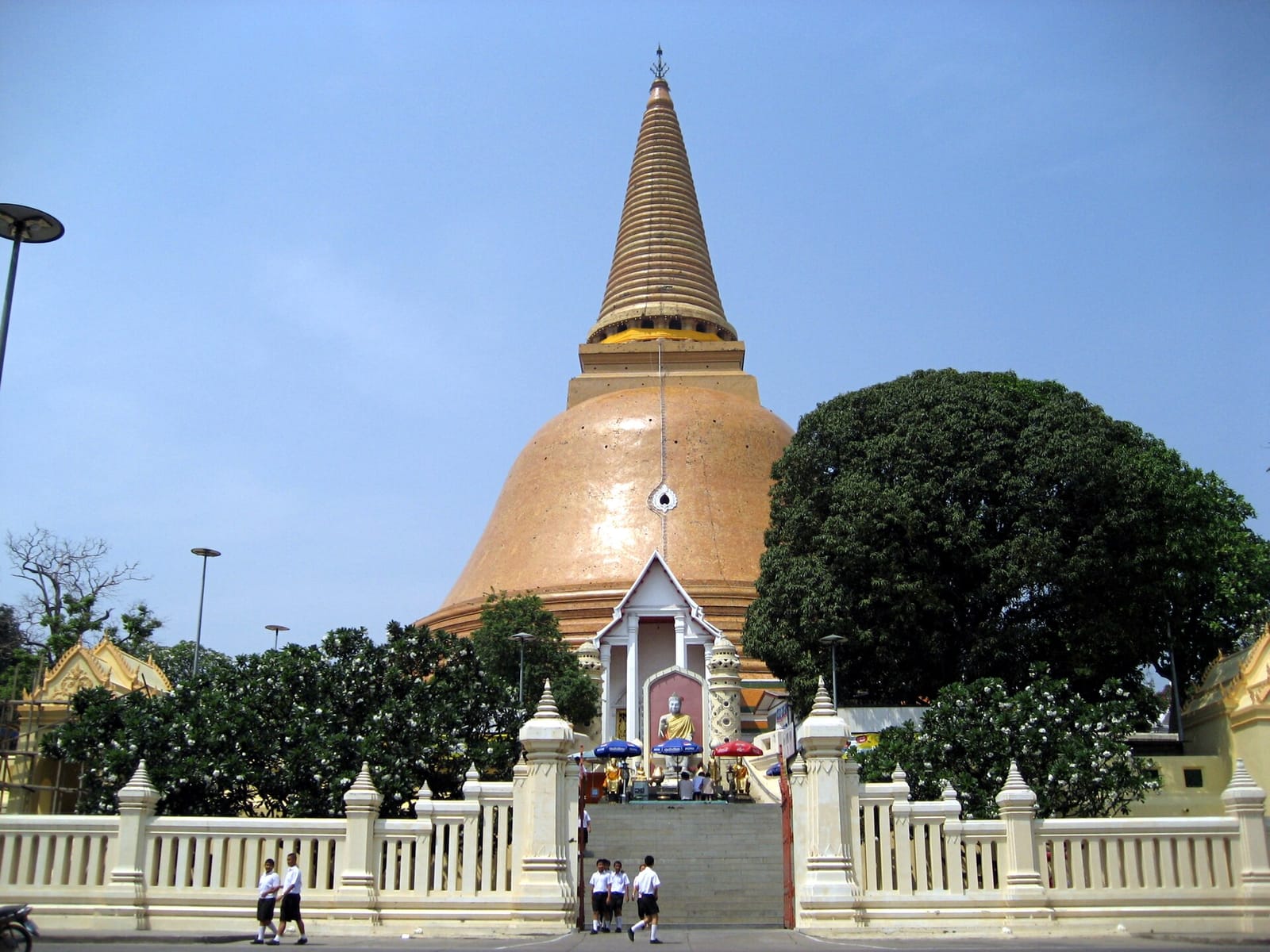
Phra Pathom Chedi is the tallest chedi in Thailand. The one you see today was built to enclose the original Dvaravati-era stupa inside it, a golden-brown inverted-bell shape you can spot from far away. Drive into town and you'll always see the chedi's spire first. This is the religious and emotional center for the whole province.
The spot people come to pay respects to most is Phra Ruang Rojanarit, a standing Buddha image in the abhaya (granting forgiveness) posture, around 7.4 meters tall, enshrined in the viharn on the north side of the chedi. King Rama VI had the head and hand fragments brought from Sukhothai and the rest cast to complete the image. Locals treat it as the guardian Buddha of the city, and many come to ask for blessings on work and success.
- Opening hours — the chedi grounds open very early until evening, roughly 05:00–19:00. You can walk up and pay respects around the chedi all day.
- Entry fee — free for Thais; foreign visitors pay a maintenance fee of around 60 THB.
- Dress code — this is a royal temple, so dressing modestly with shoulders and knees covered will feel more comfortable.
- Around the chedi — there are markets and food stalls ringing the chedi, and in the evening a night market opens up so you can keep eating right there.
Quick tip
Going early morning or late afternoon is more pleasant than midday when the sun is harsh. The area around the chedi is an open plaza with little shade, so bring a hat and water.
Want more out of Nakhon Pathom? Book tours & activities
Booking online ahead on Klook or GetYourGuide is usually cheaper than the gate and skips the queue. Pick only the experiences you actually want — prices and availability are shown live on each site.
Wat Rai Khing — blessings by the Tha Chin River
Wat Rai Khing, a royal temple in Sam Phran district, sits right on the Tha Chin River, and people from Bangkok and the surrounding provinces drive out here to make merit non-stop. Luang Pho Wat Rai Khing is a revered Buddha image people come to for blessings on health and good fortune. The riverside setting brings a cool breeze, you can release fish and turtles, and there's a food market in front of the temple to wander through afterward.
- Opening hours — open daily, roughly 08:00–16:00 for paying respects inside the viharn.
- Entry fee — no entry fee; donate as you wish.
- Sunday market — there's an early Sunday morning market in front of the temple, around 04:00–10:00, with plenty of food. Go early for the freshest, tastiest picks.
- Boat trip to Don Wai — from the Wat Rai Khing pier you can take a boat to Don Wai floating market; the round-trip fare is around 60 THB, with boats stopping service around 4 pm.
Straight talk
Long weekends and major Buddhist holidays get very crowded and parking fills up fast. If you can dodge the chaos, a weekday morning is far quieter.
Phutthamonthon — a huge Buddhist park
Phutthamonthon sits in Salaya, a sprawling area of about 2,500 rai built to mark 2,500 years of Buddhism. It isn't a temple in the usual sense but more like a leafy Buddhist park full of big trees and wide lawns. Locals come here to walk, exercise, cycle and sit quietly in the evening.
At the center stands Phra Sri Sakyathotsaphonlayan Prathan Phutthamonthon Suthat, a large walking Buddha image around 15.8 meters tall, standing prominently in the middle of an open plaza. It's a great landmark for photos, especially in the soft evening light, and the grounds also include replica pilgrimage sites and other Buddhist structures to walk among.
- Opening hours — open daily, roughly 05:00–19:00.
- Entry fee — free, and you can drive in and park inside.
- Good for — easygoing walkers, cyclists, families letting the kids run around, and anyone who likes wide-open photo spots.
- Location — on the Salaya side near Mahidol, easy to reach from western Bangkok.
Sanam Chandra Palace — Rama VI's old palace
Sanam Chandra Palace sits in the town of Nakhon Pathom, not far from Phra Pathom Chedi. King Rama VI had it built as a residence, and it's now over a hundred years old. The standout is its well-preserved blend of Thai and European architecture, with several royal residences scattered across shady gardens — a pleasant stroll that feels like a public park with history.
A favorite highlight is Chali Mongkhon At Residence, a soft-pink European-style building that photographs beautifully, along with the Ya Le monument, King Rama VI's royal dog, which has become a symbol of this palace. Walk the gardens and you'll also pass other royal residences and a number of very old, large trees.
- Opening hours — the interiors are open for viewing around 09:00–16:00, while the surrounding gardens stay open until the evening, roughly 20:00.
- Entry fee — walking in the gardens is free; to go inside the residences it's around 30 THB for adults, 10 THB for children, and 50 THB for foreigners.
- Good for — history buffs, fans of old-building photography, and anyone who wants a shady garden stroll.
- What's nearby — it's in town, just a few minutes by bike or car on to Phra Pathom Chedi.
Other temples and spots worth a stop
Wat Phra Pathon Chedi
An old Dvaravati-era temple in town with an ancient chedi and the Ya Hom shrine tied to local legend. Good for history lovers.
Wat Don Yai Hom
A temple popular with locals, where people come to honor Luang Pho Ngern and the Ya Hom statue. A genuine rural-temple feel outside town.
Don Wai Floating Market
An old market on the Tha Chin River for tasty food and souvenirs, linked by boat to Wat Rai Khing — a neat pairing.
If you have time to spare, try pairing the in-town temples (Phra Pathom Chedi + Sanam Chandra Palace + Wat Phra Pathon Chedi) for the first half-day, then save the Sam Phran–Salaya side (Wat Rai Khing + Don Wai + Phutthamonthon) for the second half, so you're not crisscrossing back and forth.
A one-day temple and culture loop
Town side + Sam Phran side, all in one day
Planning tip
Everything in this plan is about an hour from Bangkok, and driving yourself works best since the spots are spread out. If you don't have a car, you can take a van or train to Nakhon Pathom and hop in a local taxi in town — though the Sam Phran–Salaya side is a bit more of a hassle that way.
Want to stay overnight and explore Nakhon Pathom's temples without rushing? Line up a good place to stay.
See the Top 10 Nakhon Pathom hotels →