🔄 Updated 21 Jun 2026
A lot of people see Nakhon Sawan as just a stop on the way north, but if you make a point of stopping, you'll find a real range of nature within a short radius: the widest freshwater lake in the country, a limestone hill in the middle of town you can climb for the view, and the spot where four rivers meet to form the Chao Phraya. We've grouped it into four zones — the lake, the in-town hills, the out-of-town hills, and the riverside — so you can drop whichever fits the time you have.
Bung Boraphet — Thailand's largest freshwater lake
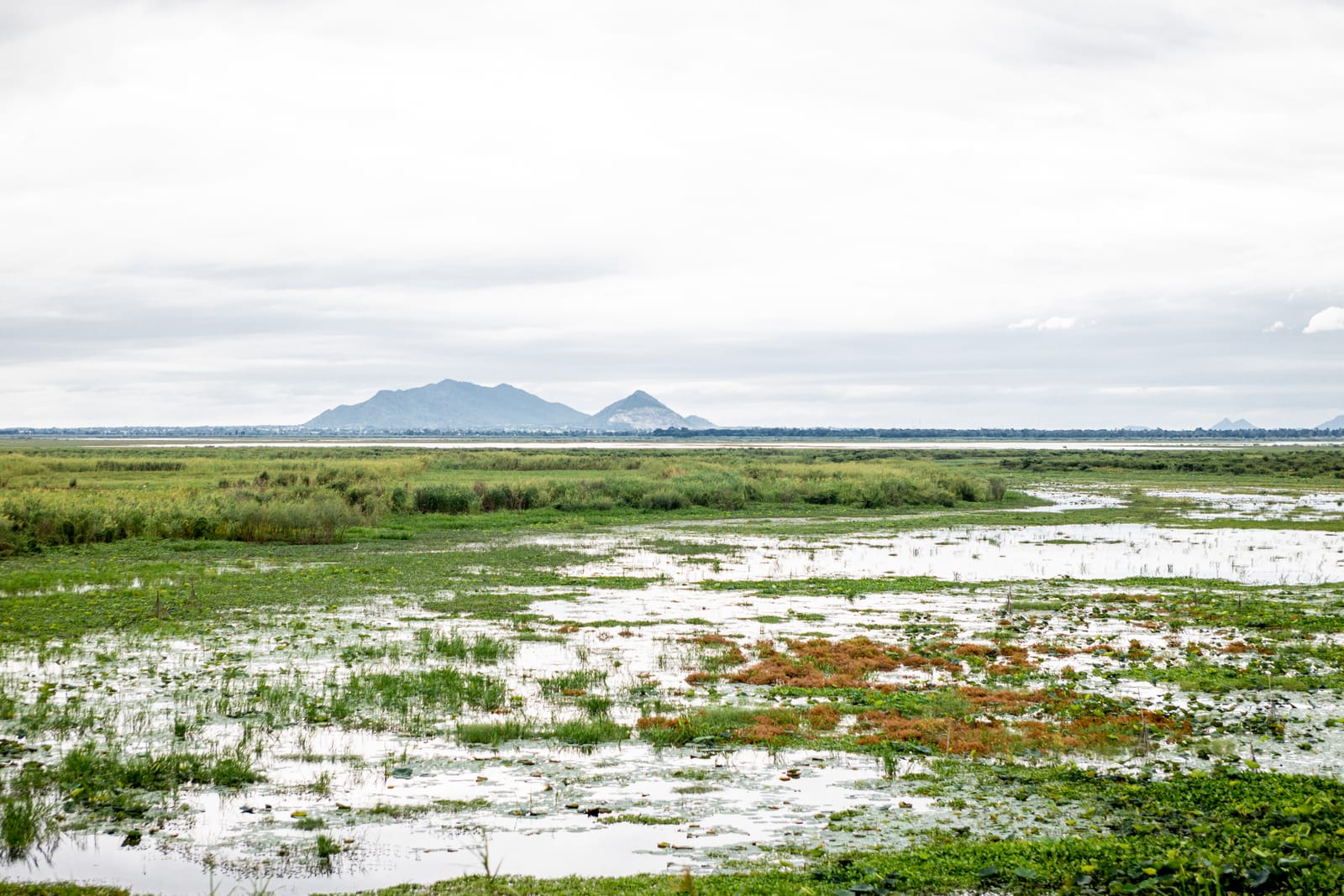
Bung Boraphet is a freshwater lake spanning more than 100,000 rai across three districts of Nakhon Sawan, and it's the province's best-known spot for bird-watching and nature boat rides. The lake holds both resident birds and migratory species in the cool season, red lotus fields that bloom in season, and an aquarium building with a fish tunnel you can walk through without even getting on a boat.
- Boat rides for birds and red lotus — local community boats run trips out, roughly 100 THB per person (kids usually free). The ride takes around an hour or so depending on the route.
- Ban Rang Bua red lotus viewing point — over on the Tha Tako district side, where the red lotus carpets the water in the cool season. You can take a boat out for a close look.
- Bung Boraphet Aquarium — a freshwater fish tunnel and tanks to walk through, good for kids and anyone who'd rather not sit in the sun on a boat.
- Bung Boraphet Non-Hunting Area — the main bird-watching zone, with viewing towers and nature trails. Liveliest during the migration season.
When to go
The red lotus looks best in the morning, roughly 06:00–09:30. Migratory birds are best from November through February. If you're coming specifically for these two, head out early and come in the right season — by mid-morning the sun gets strong and the lotus starts to close up.
Straight talk
The red lotus fields and the birding both depend on the season and the water level. Come at the wrong time and you may find the lotus not in bloom or few birds about. Before you go, check the latest conditions with a tour-boat page or the Bung Boraphet Non-Hunting Area so you're not disappointed.
Want more out of Nakhon Sawan? Book tours & activities
Booking online ahead on Klook or GetYourGuide is usually cheaper than the gate and skips the queue. Pick only the experiences you actually want — prices and availability are shown live on each site.
In-town view hills — Khao Kop and Khao Khiriwong
One of the nice things about Nakhon Sawan is that the view hills are right in town — no need to drive far out. The two people climb most are Khao Kop and Khao Khiriwong. Both have a temple on top, so you go up to pay your respects and get the city view as a bonus.
Khao Kop (Wat Woranat Banphot)
A low hill in the middle of town with an old temple on top. Walk up the stairs or drive up — either works. From the top you get the whole city of Nakhon Sawan and the line of the river in every direction. It's the easiest city viewpoint to reach.
Khao Khiriwong (Wat Khiriwong)
Another in-town hill, with the white Chulamani Chedi standing out on top. Go up for the city view and photos with the chedi. The mood is quiet and calm — best in the morning or evening when the sun isn't harsh.
Chulamani Chedi photo spot
On Khao Khiriwong there's a wide plaza around the chedi, looking down over the city and the lake. It's a popular photo angle at sunset, when the light goes soft.
A tip
Climb Khao Kop in the morning before the sun gets strong, when the city view is clear and the air is good. Save Khao Khiriwong for the evening near sunset, when the light is lovely for photos with the chedi. You can easily fit both hills into a single day at different times.
Khao No–Khao Kaeo — limestone hills and the evening bats
Khao No–Khao Kaeo is a cluster of oddly shaped limestone peaks in Ban Daen subdistrict, Banphot Phisai district, clearly visible from Phahonyothin Road along the Nakhon Sawan–Kamphaeng Phet stretch. Khao No has stairs up to a cave shrine and views over the surrounding rice fields, but the real draw people come for is the millions of bats that stream out of the cave in one long ribbon at dusk.
- Bat-watching time — the bats start pouring out around 17:00–18:00. Get there early to find a spot to stand and wait.
- Climbing Khao No — there are stairs up to a cave that houses a Buddha image. You'll meet a fair number of monkeys along the way, so watch your snacks and bag.
- Bat-viewing platform — a spot where you can stand and watch the bats stream out of the cave mouth in a long line, with rice fields and evening light as the backdrop.
- Distance — it's out of town, about 45–60 min by car from Nakhon Sawan city. Leave buffer time so you don't miss the bats.
Straight talk
Khao No–Khao Kaeo is a fair way out of town and easiest reached by your own car. If you're coming for the bats, work out your drive time to arrive before dusk — otherwise you may miss the exodus, which doesn't last long. Bring insect repellent too, since it's all rice fields around there.
Chao Phraya riverside — Pasan and the headwaters
Nakhon Sawan is where the Chao Phraya River is born, at Laem Ko Yom in Pak Nam Pho, where the Ping, Wang, Yom and Nan rivers come together. In some stretches you can still see the two colors of water clearly before they blend into the Chao Phraya. The prettiest and easiest riverside viewpoint to reach is Pasan, a landmark building with a long curved design stretching along the water.
- Pasan, the Chao Phraya headwaters landmark — walk up to look out over the confluence of the rivers. The riverside plaza around the building is open all the time and free; the interior of the building opens roughly 09:00–17:00, closed Mondays.
- Sunset angle over the Chao Phraya — in the evening the light reflects beautifully off the water. It's the best time of day to photograph Pasan.
- Stone-faced riverside embankment — a walkway along the river in the Pak Nam Pho area, good for a stroll in the cool breeze and a look at riverside life.
- Pak Nam Pho riverside market and shrines — near Pasan. Walk on to sample the food and soak up the old Chinatown atmosphere.
A tip
Pasan is at its best in the evening near sunset. Get there a bit before the sun softens and you'll catch both the nice light and cooler air. Weekdays are quiet and easy for photos; weekend evenings draw more people but the atmosphere is livelier.
Forest and waterfalls — Mae Wong (if you have more time)
If you've got more than a day and you're genuinely into forest, Mae Wong National Park is the province's deepest nature zone, sitting on the Kamphaeng Phet–Nakhon Sawan border. There's the Chong Yen viewpoint, where the air is cool and pleasant in late rainy season into early cool season, plus rapids and Mae Rewa Waterfall. The Mokoju peak is a multi-day trek for serious campers.
Straight talk
Mae Wong is a long way from the city and the access road runs deep in, so it suits people with their own car who plan to stay overnight in the forest — not a quick stop. If your trip is short, stick with Bung Boraphet, Khao Kop, Pasan and Khao No and you'll still get plenty of variety.
How to plan a nature and viewpoint trip
Nakhon Sawan's nature spots split into two zones: in town (Khao Kop, Khao Khiriwong, Pasan, the Chao Phraya riverside) and out of town (Bung Boraphet, Khao No–Khao Kaeo, Mae Wong). Try laying it out like this to get the lake, the hills and the riverside all in one trip.
Lake + in-town hills + Chao Phraya riverside
Out-of-town limestone hills + bats
Add a forest day (if you have time)
Getting around
Most of Nakhon Sawan's nature is easiest with your own car, since Bung Boraphet, Khao No and Mae Wong are all out of town and hard to reach by public transport. If you don't have a car, stick to the in-town zone (Khao Kop, Khao Khiriwong, Pasan, the Chao Phraya riverside) and you'll still get both hills and riverside in a single day.
Plan a full Nakhon Sawan trip — where to stay, eat and go
See the Nakhon Sawan guide →