🔄 Updated 21 Jun 2026
First, set your expectations: Nong Bua Lamphu is a quiet town, not a tourist hub with something to do on every corner. Its charm is the slow pace and the genuine, down-to-earth feel — friendly people, cheap prices, and nature that hasn't been dressed up into a check-in spot. Come with that frame of mind and you'll really enjoy it. But if you're after a buzzing nightlife or a big mall, you'll need to adjust your hopes a little.
The easiest way to get here
Nong Bua Lamphu has no airport and no train line. For most people the main gateway is Udon Thani. Fly into Udon Thani Airport (UTH) first, then carry on into Nong Bua Lamphu town — about 45 km, roughly an hour by road. It's the most convenient and fastest route for travellers coming from Bangkok or other regions.
- Fly to Udon Thani, then connect by road — there are several Bangkok–Udon Thani flights daily, then a minivan or bus from Udon Thani bus terminal into Nong Bua Lamphu, around 55 minutes to an hour. The fare is just a few tens of baht.
- Direct coach from Bangkok — buses run from Mo Chit straight to Nong Bua Lamphu, a distance of about 595 km and roughly 8 hours. Most are overnight services, with tickets starting around 450 THB.
- Drive yourself — this is the best option for getting around here, since the sights are spread out and public transport within the province is limited. If you didn't drive in, renting a car at Udon Thani Airport and driving over is a good move.
First-timer tip
In town there are almost no metered taxis or city buses like you'd find in a big city. Without your own wheels, getting between sights is a hassle. The smoothest approach is to rent a car in Udon Thani, or arrange a private driver by the day through your accommodation.
Book the activities in your Nong Bua Lamphu trip ahead
Booking online ahead on Klook or GetYourGuide is usually cheaper than the gate and skips the queue. Pick only the experiences you actually want — prices and availability are shown live on each site.
The best time of year to visit
Nong Bua Lamphu is fine to visit year-round, but the most comfortable stretch is November to February — cool air, gentler sun, ideal for temple walks, hiking, and reservoir views. The rainy season (June–October) brings green rice fields and full waterfalls, but some of the paths up to viewpoints get slippery, so take care. April is full-on Isan heat — bearable if you can handle it, but skip walking around in the midday and afternoon sun.
Top sights a first-timer shouldn't miss
Wat Tham Klong Phen
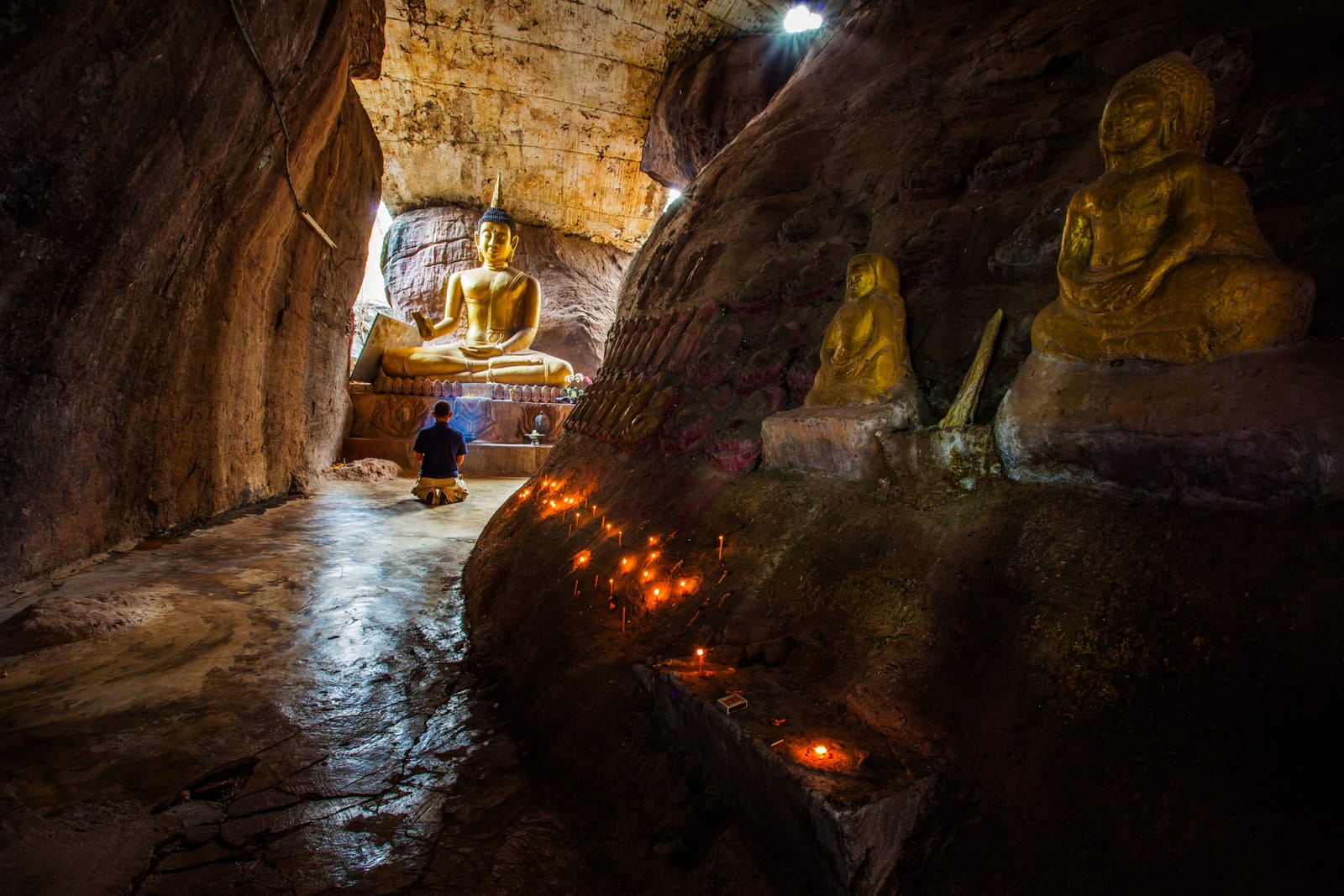
A forest-meditation temple where the revered monk Luang Pu Khao Analayo once stayed. Shaded by huge boulders and old trees, it's genuinely calm, with a Luang Pu Khao museum to visit. A peaceful way to start the trip.
King Naresuan Shrine
Right in the town centre in front of the district office, deeply respected by locals. It was built to commemorate King Naresuan's march through here. Easy to stop in for a prayer, and central.
Phu Kao–Phu Phan Kham National Park
A wide stretch of forest along the Ubolratana Reservoir, with viewpoints, hiking trails, and prehistoric rock paintings at Phu Phra Bat. Great for nature lovers who want those wide-open views.
Ubolratana Reservoir (Phu Phan Kham side)
A large freshwater lake marking the line between Nong Bua Lamphu and Khon Kaen. Lovely sunset views, with riverside fish restaurants to relax at. A favourite spot for locals to close out the day.
There's also Tham Erawan (a large limestone cave up on a hill with far-reaching views), Tao To Waterfall near town, and Tham Pha Cho in Na Wang district, an up-and-coming rice-field viewpoint. Save those for if you've got several days — for a first visit, three or four main spots already make for a full trip.
What to eat in Nong Bua Lamphu
Nong Bua Lamphu is a true Isan food town with friendly prices. Here are the spots and dishes locals actually go for, picked to give you an easy starting point so you don't have to hunt around.
Nai Nuat Boat Noodles
A long-standing boat-noodle shop in town with a rich, deep broth, tender pork, and good noodles, plus crispy wontons and self-serve veggies. It's the first name locals mention when you ask where to get noodles.
Larb Pet Non Sombun
The province's famous duck larb spot, set in a comfortable two-storey house. Punchy duck larb, duck noodles, and a full Isan made-to-order menu. Good for a group dinner.
Belief Cafe' & Garden
A pretty garden cafe locals share often, with both indoor and garden seating, drinks, fresh-baked croissants, and Isan dishes to order. Perfect for a coffee break and a few photos during the day.
Tree Bar & Restaurant
A restaurant-cum-bar that's nice for a relaxed evening, with both air-conditioned rooms and an outdoor zone. There's live music at night — a good low-key way to end the day without staying out too late.
Fish restaurants by Phu Phan Kham reservoir
Along the Ubolratana Reservoir there are several restaurants serving fresh freshwater fish — grilled fish, fish tom yum, fish larb — eaten with the sunset view. This is the meal locals bring guests to.
Evening market in town
For cheap and varied eats, walk the evening market in the town centre — som tam, grilled chicken, khao jee, local sweets, and seasonal fruit. It's where you get the real Isan flavours at easy-on-the-wallet prices.
Eat smart
Many local shops close early and some take days off unpredictably. If you want to hit a popular spot, go before evening and always have a backup in mind. Evening-market food is the easy, can't-go-wrong option.
Where to stay
Most accommodation is clustered in Nong Bua Lamphu town, ranging from mid-size hotels and small resorts to budget guesthouses. Prices are generally far cheaper than your typical tourist town. Staying in town is the smart pick since you're close to the restaurants and the King Naresuan Shrine, then you can drive out to the temples and reservoir in loops. If you really want a natural setting, look at places near the reservoir instead.
A 2-day, 1-night plan for first-timers
This plan is built for people who fly into Udon Thani and connect by road, or who drive in themselves. It leans into quiet temples, nature, and local food, paced so you're not rushing — easy to follow without hurrying.
Into town, temple visit, sunset by the reservoir
Nature, a cave, rice-field views, then home
If you've only got one day, trim Day 1 down to the King Naresuan Shrine, Wat Tham Klong Phen, and a sunset by the reservoir — that's enough to get the feel of the town. With three days, add Tham Pha Cho, Tao To Waterfall, and link your trip on to Udon Thani or Loei.
Things to know before you go
- Bring cash — local shops and markets mostly take cash. Even though many now have QR payment, having cash on you is the safer bet.
- Dress modestly at temples — Wat Tham Klong Phen is a practising forest temple, so skip the tank tops and short shorts, and keep your voice down.
- Allow travel time between sights — the attractions are spread out, some in different districts. Driving between points takes 30–60 minutes, so map your route ahead.
- Internet and convenience stores are fine in town — but once you head out to the temples or forest, signal can get weak. Have an offline map ready.
- Locals are kind and helpful — if you get lost or have a question, just ask. Most people are happy to point the way.
Want the full Nong Bua Lamphu travel guide, with stays and restaurants?
See the Nong Bua Lamphu guide →