🔄 Updated 21 Jun 2026
Nong Bua Lamphu is a small province backed by Phu Phan Kham and the Phu Kao–Phu Phan ranges. Districts like Mueang, Non Sang, Suwannakhuha and Na Klang still have real dry forest, dipterocarp woodland and hill slopes right up against the villages. Once the rainy season sets in, roughly May through October, the damp and the leaf litter push wild mushrooms up and bamboo shoots out along the clumps. Villagers treat this as extra income while they wait for the rice to grow: they head out early, then bring the haul straight to market, so it's about as fresh as it gets — gathered in the morning, sold the same morning, nothing held overnight.
In a year with steady, back-to-back rain, the mushroom stalls in Nong Bua Lamphu get especially busy and whatever comes in sells out, because the whole province is waiting to eat the season's wild food. If you swing by during this stretch and walk a morning market, you'll notice the difference from a big-city market straight away: this stuff isn't farmed, it really did come off the woodland behind someone's house and the lower slopes of the hills.
Huay Dueam Market — the province's real wild-food market
If you're talking wild food in Nong Bua Lamphu, you start at the Huay Dueam Community Market (Talat Huay Dueam) in Ban Huay Dueam, Non Than subdistrict, Mueang district. It sits on Highway 210, the Udon Thani–Nong Bua Lamphu road, about 11 km from town. It's a roadside market at the foot of the hills with several buildings and plenty of parking, selling seasonal wild food and nothing else — what's on the tables changes with whatever the forest is giving that month. Isan-restaurant cooks from Udon Thani still drive over to buy ingredients here, because this kind of produce is hard to find elsewhere.
- Open daily, roughly 07:00–18:00, but the wild food is freshest in the morning and the good stuff is often gone before noon.
- Location — on Highway 210 (Udon Thani–Nong Bua Lamphu), Ban Huay Dueam, Non Than subdistrict, Mueang district. It's right on the route if you're driving from Udon into Nong Bua Lamphu town.
- What you'll find — wild mushrooms, bamboo shoots, red-ant eggs, foraged greens, herbs, medicinal roots, wild fruit like mak mao, edible insects, wild honey — all depending on the season.
- Market tip — ask the vendors straight out 'what's in season right now' rather than going in set on one specific item, because the wild food doesn't all come out at the same time.
Driving from Udon? It's a natural stop
Huay Dueam Market sits right on the Udon Thani–Nong Bua Lamphu road. If you fly into Udon and drive across to Nong Bua Lamphu town, you can stop here before you even reach town. It doesn't take long to walk, but you'll see a fuller spread of Isan wild food than at the in-town markets.
Want to taste deeper? Try a Nong Bua Lamphu food tour or cooking class
Half a day with a local who knows the lanes — or cooking a dish yourself — teaches you more than just eating. Book ahead on Klook or GetYourGuide.
Rainy-season wild mushrooms you'll see most often
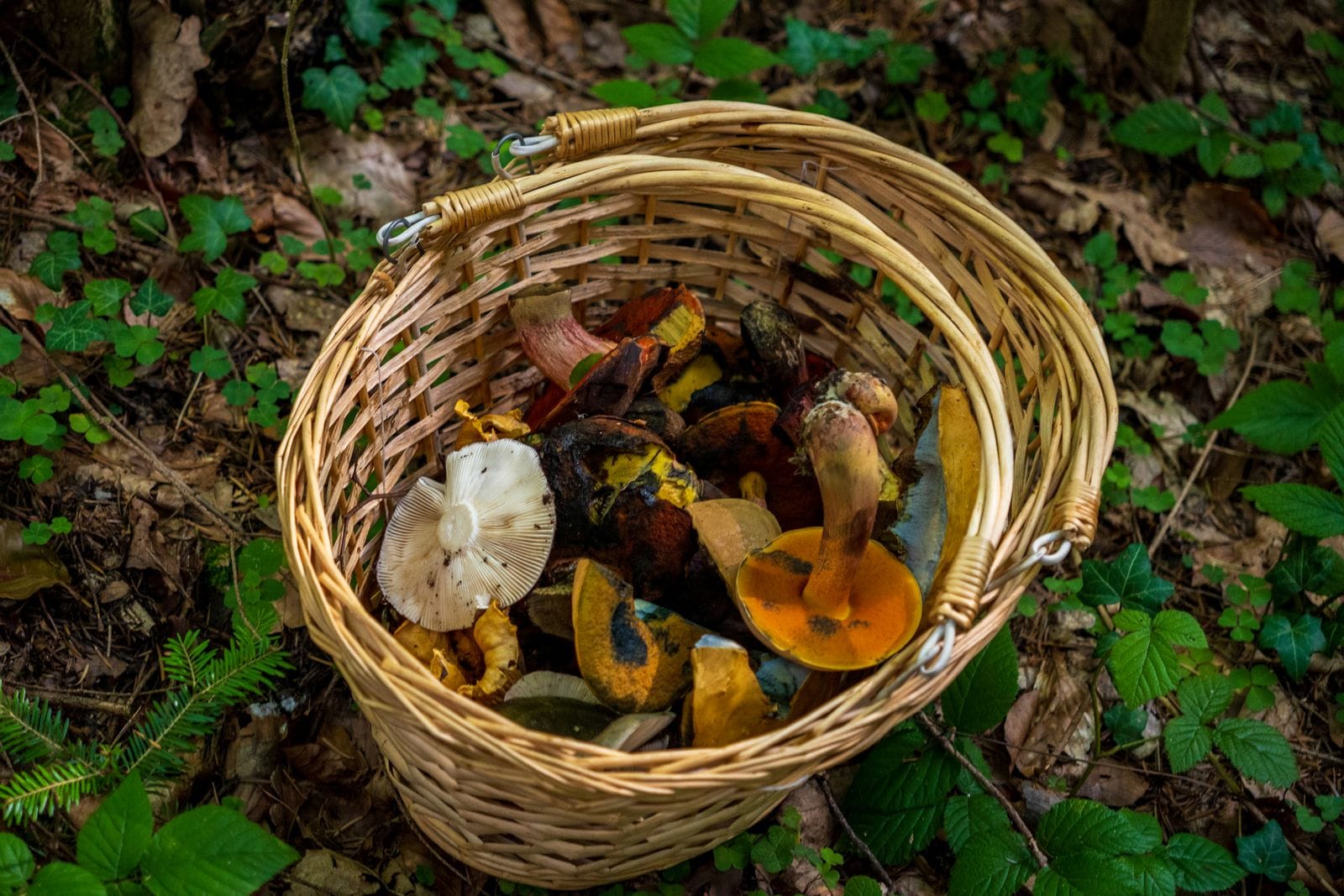
Isan has many kinds of wild mushroom, and each comes out at a different point — some at the start of the rains, some mid-season. Prices swing depending on whether the rains have been good that year and how much is reaching the market. In Nong Bua Lamphu the big favourites are het pho (barometer earthstar), het phueng (bolete) and het rangok (Caesar's mushroom). The prices below are the ranges we've seen at the market and in local reports — useful as a guide, but the day's actual price may move.
Het Rangok (Caesar's mushroom)
Egg-shaped white, yellow and red caps with soft, silky flesh — the star of the Isan rainy season. The most popular of the lot, because in a curry with hoary basil or young tamarind leaf it turns sweet. Early in the rains supply is thin and the price runs high.
Het Pho (barometer earthstar)
Small round balls buried just under the soil that you have to dig out, with a springy snap in the mouth. Nong Bua Lamphu locals wait for these every rainy season. Early in the season supply is scarce and the price is steep, then it eases off. Good in tom yam or curried with greens.
Het Phueng (bolete)
Dark brown on top with firm, chewy flesh — a real local favourite. Early in the rains it's scarce and used to sell by the 100-gram khit. Curried or boiled it gives a deep flavour.
Het Khon (termite mushroom)
Grows on termite mounds in the dry forest, with sweet, crisp flesh and its own distinctive aroma. Many people pay a premium because it's hard to come by. Lovely in a clear soup or a curry. Comes out after heavy rain.
Het Din / Het Nam Mak
Small-capped mushrooms that grow on the forest floor, cheaper than the rest. A humble, everyday mushroom that villagers gather to curry at home and sell mixed in among the piles.
Safety you need to know
Wild mushrooms include both edible kinds and poisonous ones that look very similar. If you're buying to eat, buy from vendors who regularly gather and sell at the market, and don't forage yourself if you're not sure. The white het rangok has a poisonous lookalike called het khai tai sak, and novice foragers get caught out by it every year. Mushrooms sold by the regulars at market are safer than what you'd pick blind, and every kind of wild mushroom must always be cooked through before eating.
Bamboo shoots and foraged greens that come out alongside
Rainy-season wild food isn't just mushrooms. Once the soil is soaked, bamboo shoots push up thick along the clumps, and foraged greens from the dry forest and the rice-field bunds come out at the same time. Isan people gather them to eat as dipping vegetables with jaew and pon, or drop them into the curry pot to round out the flavour. At the Nong Bua Lamphu morning market these greens start at just a few baht a bunch — some are five baht and you're set.
- Bamboo shoots — they come up everywhere in the rains. Boil them for bamboo-shoot soup, add them to a mushroom curry, or pickle them as sour bamboo to eat for ages. The easiest and cheapest wild food of the season.
- Wild pak wan (melinjo) — soft yellow-green young shoots, sweet and tender, curried with mushrooms or added to a red-ant-egg curry. A classic Isan rainy-season pairing.
- Pak tiu / yot makok / pak kradon — young shoots with an astringent, slightly sour edge, top-notch eaten alongside chilli dips and jaew, foraged from the dry forest at the village edge.
- Krachiao flowers / shoots (Siam tulip) — they come out right in the rainy season; blanch them for chilli dips or add to a curry, with their own sweet, crisp bite.
- Hoary basil / pak i-tu (wild basil) — its distinctive aroma is essential in a mushroom curry; add it right at the end before you take the pot off the heat so it perfumes the whole thing.
- Red-ant eggs — a rainy-season wild food people wait for, used in koi with red-ant eggs, a pak wan curry, or stirred into an omelette, with a naturally rich, slightly sour taste.
Which markets are actually worth walking
Beyond Huay Dueam, which is the real wild-food market, the rainy-season haul also spreads to the morning markets in town and the roadside stalls in the hill-edge village districts. If you want the freshest produce and plenty to choose from, go a bit early — the good stuff sells out fast.
Huay Dueam Community Market (Talat Huay Dueam)
The province's real wild-food market, on Highway 210 about 11 km from town. In the rainy season it has wild mushrooms, bamboo shoots, red-ant eggs and foraged greens, with the spread changing through the season. Go in the morning for the freshest produce.
Nong Bua Lamphu Municipal Fresh Market
A morning market in the centre of town on Wiriyothin Road, near the Night Plaza. It opens very early, around 03:00–09:00, and in the rains there are wild mushrooms and foraged greens mixed in among the fresh produce, with greens starting at just a few baht a bunch.
Roadside stalls in the hill-edge districts
Around Non Sang, Suwannakhuha and the villages at the foot of Phu Kao–Phu Phan Kham, locals often bring baskets of mushrooms and bamboo shoots to sell at the roadside in the morning. This stuff really did come off the woodland behind the house.
When to go
Wild food is gathered in the morning and sold the same morning. The fresh markets in town open from three in the morning until nine, and Huay Dueam is freshest in the morning too. Any later and the good stuff is usually gone. The peak of the season is after two or three days of back-to-back rain, when the mushrooms push up in numbers and prices drop below the early-season high when supply is still thin.
So you bought the wild food — now what do you cook?
The charm of wild food is that simple cooking already tastes good, because the ingredients are sweet to begin with. There are two main ways Nong Bua Lamphu people do it: curry and boil it, or blanch it for chilli dips, seasoning mostly with fermented-fish sauce (nam pla ra) and no need for seasoning powder.
- Mushroom curry with hoary basil — pound a curry paste of chilli, lemongrass and shallot, bring the water to a boil, add het rangok or het phueng, season with nam pla ra, add young tamarind leaf for a gentle sourness, and scatter hoary basil over the top before serving for the aroma.
- Het pho tom yam — snappy het pho made into a tom yam with chilli, lime and kaffir lime leaf for a sharp, fragrant edge that cuts the richness — the dish people wait for when het pho is in season.
- Bamboo-shoot soup with ya nang leaf — boil bamboo shoots in ya-nang-leaf water with pla ra, toasted sesame and hoary basil for a proper Isan bamboo-shoot soup, eaten with sticky rice.
- Koi with red-ant eggs / pak wan curry with red-ant eggs — the rich, slightly sour red-ant eggs go into a koi with chilli powder and toasted-rice powder, or into a wild pak wan curry for a rounded flavour.
- Blanched greens with jaew and chilli dip — blanch pak tiu, yot makok, krachiao flowers and bamboo shoots, plate them up with jaew bong or pla ra chilli dip, and you've got a simple meal that covers all the wild greens.
Clean wild food properly
Wild mushrooms usually come with soil and leaves stuck to them — rinse them through several changes of water gently, and don't scrub hard because the flesh bruises easily. With het pho, cut one open to make sure the inside is still white; if it's black inside, it's too old. Fresh bamboo shoots should be boiled once and the water thrown out first to cut the bitterness and the risk. And every kind of wild food should always be cooked through before eating — never raw.
Can you buy it to take home as a gift?
Fresh wild mushrooms don't keep long. If you want to carry them somewhere far, pick ones that are still tightly closed, put them in a breathable bag, and don't seal them in airtight plastic or they'll go stale and mushy fast. Best to buy them on your last day as you're heading back and cook them quickly. The things that keep longer and travel easily as gifts are pickled bamboo shoots, sour bamboo, and the wild honey that Huay Dueam Market has in season.
Want more good Isan eating in Nong Bua Lamphu? See the full eat-and-explore guide for the town.
See the Nong Bua Lamphu travel guide →