🔄 Updated 21 Jun 2026
Pai sits about 3 hours by road from Chiang Mai, along Route 1095 — the road famous for its 762 curves that wind one after another. If you get carsick easily, take motion-sickness tablets before you set off and grab a front seat if you can. Once you reach town, most of the sights are spread around it within about 10 kilometres. Plenty of people rent a motorbike for the freedom, but the roads around Pai are narrow mountain bends, so beginners should ride extra carefully and wear a helmet every time. This guide runs zone by zone — starting with the spots close to town that are easy to reach, then moving out to the ones further away — with a short sample plan you can adapt yourself.
Pai Canyon (Kong Lan) — the popular sunset spot
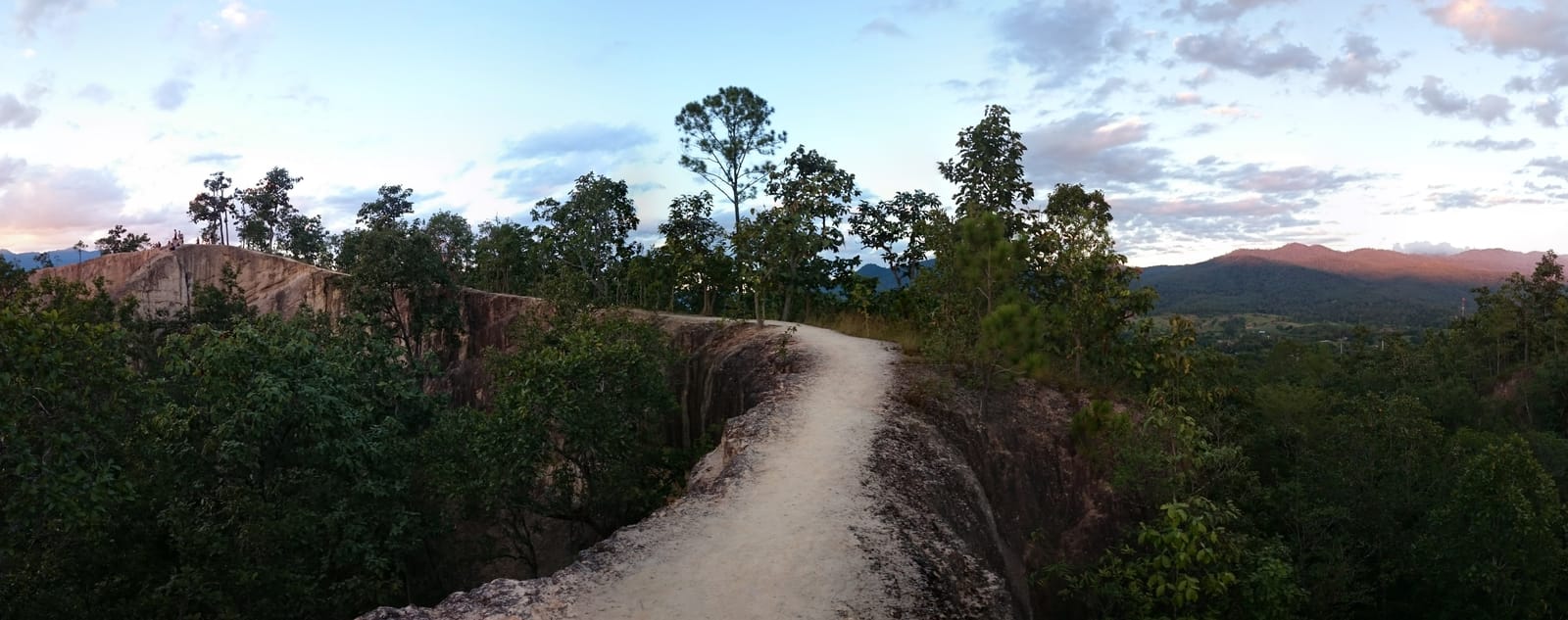
Pai Canyon, or Kong Lan, is about 8 kilometres south of town on Route 1095, near the Memorial Bridge. It's a set of red-clay cliffs that rain has carved into long, narrow ridges, and you can walk along the spines for 360-degree valley views. It's the most popular sunset spot in Pai — in the late afternoon people start drifting in to wait for the last light. Entry is free; there's only a toilet that charges around 5 THB.
- Free entry — no admission, free parking, toilet around 5 THB
- Best timing — arrive about an hour before sunset so you get a good spot and can explore the ridges before the light goes
- Mind the narrow ridges — the paths are thin earthen spines, and in places both sides drop into deep ravines with no railings. The soil is loose and slips easily, especially after rain — wear shoes with grip and don't wander further than you're comfortable with
An honest word on safety
Pai Canyon is genuinely beautiful, but some of those ridges are very narrow with nothing to stop a fall, and people have slipped and been injured here. If you're bringing kids or older travellers, just stay on the upper viewing area — the view from there is already great, and there's no need to head out onto the narrow spines. Try to head back before it's fully dark, too, because the return path gets slippery and hard to see at night.
Want more out of Pai? Book tours & activities
Booking online ahead on Klook or GetYourGuide is usually cheaper than the gate and skips the queue. Pick only the experiences you actually want — prices and availability are shown live on each site.
Pai Memorial Bridge (the WWII bridge)
The Tha Pai Memorial Bridge is a steel bridge across the Pai River, dating to around 1941 during World War II, when Japanese troops built a supply route between Chiang Mai and Mae Hong Son. After the war the Japanese withdrew, and locals restored the bridge to use it as a regular crossing. Today it's a quick photo and history stop, right beside Route 1095 south of town — easy to reach and free to visit.
- Free entry — right on Route 1095, easy to pull over for photos, with coffee shops and souvenir stalls nearby
- Pair it up — it's close to Pai Canyon, so you can do both in the same zone on one loop
- Busy times — midday in the cold season gets crowded with photo-takers; for emptier shots come early morning or late afternoon
Yun Lai fog viewpoint & Santichon village
The Yun Lai viewpoint sits on a hill above Santichon village, about 5–6 kilometres from town. It's the morning fog spot most cold-season visitors don't skip — entry is around 20 THB and comes with a pot of hot Yunnanese tea to sip. On the way up you pass Santichon, a village settled by Yunnanese Chinese who migrated here, decorated in Chinese style throughout, with Yunnanese food, a Chinese swing, and photo spots to stop at.
- Yun Lai viewpoint — around 20 THB (includes a pot of Yunnanese tea) · fog rolls in at first light in the cold season, so go before sunrise
- Santichon village — a Yunnanese Chinese village; there's a small village entry fee at some times. Inside you'll find restaurants, tea, and Chinese outfits to rent for photos
- The climb is steep — the road up to Yun Lai is narrow and steep, so motorbike beginners should take care; in the early dark the road is unlit and can be slippery with dew
Fog depends on the weather
The sea of fog at Yun Lai and the other viewpoints around Pai only forms on mornings when it's cold and the humidity is just right — mostly November through February, and not every morning. If you're up at 5am and the sky is clear with no fog, that's completely normal, so don't set your hopes too high. Bring a warm layer, too, because it's much colder up on the hill at dawn than down in town.
Tha Pai hot springs & Sai Ngam
Pai has two main natural hot springs to soak in. The better-known one is Tha Pai hot spring, about 8 kilometres from town inside a national park. The source water runs close to 80°C — hot enough to boil eggs — then it's piped down and mixed into soaking pools at around 37–42°C. The other is Sai Ngam, set deeper in the forest, more natural in feel and cheaper to enter, good for anyone who wants a quieter soak.
- Tha Pai hot spring — foreigner entry around 300 THB, Thai adults around 50 THB, Thai children around 20 THB · open roughly 07:00–18:00 · several soaking pools and changing rooms
- Sai Ngam — entry around 40 THB, set deeper in the forest, more natural, clearer water, fewer people — good if you like a raw, quiet atmosphere
- What to bring — swimwear, a towel, and non-slip sandals; the pool floors are hot and can be slippery, so ease in slowly to let your body adjust to the temperature
Before you get in
The source water really is very hot — don't get into any pool too close to where the water comes out, especially with small children. The road into Sai Ngam runs through the forest and is narrow and unlit in places, so if you're going, go during the day and allow extra travel time — don't head out late.
Mo Paeng & Pam Bok waterfalls
Pai has several waterfalls, and the two people visit most are Mo Paeng and Pam Bok. Mo Paeng is about 8 kilometres from town — the easiest to reach — a multi-tier waterfall with sloped rock slabs you can slide down into the pool to swim. Pam Bok is in the same area as the Tha Pai hot springs, quieter, with a shady setting that's nice for a cool dip.
- Mo Paeng waterfall — entry around 100 THB · about 15–20 min by motorbike from town · slippery rock slides into the pool, fullest in the late rainy season
- Pam Bok waterfall — in the same zone as the Tha Pai hot springs, a short walk in from the main road, quieter than Mo Paeng, good for a peaceful soak
- Water levels vary by season — Pai's waterfalls run high in the late rainy season (Sep–Nov), while in the dry season they drop a lot, sometimes down to just a small pool
Swim safely
The rocks at Mo Paeng are very slippery from algae — ease in slowly and watch where others slide first; don't slide where the water is shallow or there are boulders. If you're with kids, keep them close, and avoid swimming during high water after heavy rain, because the current is stronger than it looks.
Wat Phra That Mae Yen (the White Buddha) & the Land Split
Wat Phra That Mae Yen sits on a hill east of town, with a large white Buddha image facing west. Walk up the stairs to the top and you look out over the whole Pai valley — it's a popular sunset and photo spot, and it's free. The other, quirkier stop is the Land Split: a farm plot where the ground naturally cracked apart. The farmer opens it free of charge and offers fruit, roselle juice, and sweet potato by donation.
- Phra That Mae Yen — free entry · climb the stairs to the Pai valley viewpoint · the big Buddha faces west, good for sunset · dress modestly, shoulders and knees covered
- The Land Split — entry by donation; the farmer serves fruit and roselle juice from the farm · just off Route 1095, close to town
- A small kindness — the Land Split is free, but if you've enjoyed their food, dropping in a donation as you can is a nice way to support the farmer who keeps the place going
Honest notes before you plan a Pai trip
Pai is a fun place to visit, but there are a few things worth knowing before you decide, so you don't end up disappointed.
- The 762-curve road up to Pai — Route 1095 from Chiang Mai winds nonstop for about 3 hours; if you get carsick easily, take a tablet beforehand and sit up front
- Riding a motorbike in the mountains — the roads around Pai are narrow, steep, and twisting; beginner riders should avoid the steep mountain stretches and always wear a helmet
- Fog isn't guaranteed — it depends on the weather day to day, mostly in the cold season (Nov–Feb), and not every morning
- Haze in Mar–Apr — northern Thailand, Pai included, often has haze problems from crop burning at this time; visibility and air quality can be poor, so anyone sensitive to dust should avoid this window or pack a mask
Try a Pai itinerary like this
If you're not sure where to start, here's a rough plan to adapt around your accommodation and the weather. Pai's sights are close enough together that grouping them by zone is easy.
South zone + in town
Morning fog + waterfall
Catch what you missed
Want a well-placed base to explore around Pai
See 10 great Pai stays →