🔄 Updated 13 Jun 2026
Pai is small enough that you can pretty much eat your way around it on foot. Around the Walking Street (Rangsiyanon Road) you'll find old-school Northern Thai restaurants, noodle shops that open at dawn, and made-to-order spots where people working in town grab lunch. The Pai morning market is where locals come to buy groceries and eat breakfast before the day starts. Prices in Pai overall aren't as scary as a lot of people fear — if you skip the places built purely for tourists and head for where Pai locals actually eat, a plate still starts at a few dollars.
We've split the spots on this page into three broad groups: Northern Thai and local-specialty restaurants that are the town's signature flavors, noodle shops open from morning through lunch, and single-plate made-to-order spots where you can order whatever you want. The prices listed are rough and shift with ingredients and the season — use them as a guide for roughly how much to bring, nothing more.
10 local Pai spots we picked
Khao Soi Song Phi Nong — Walking Street area
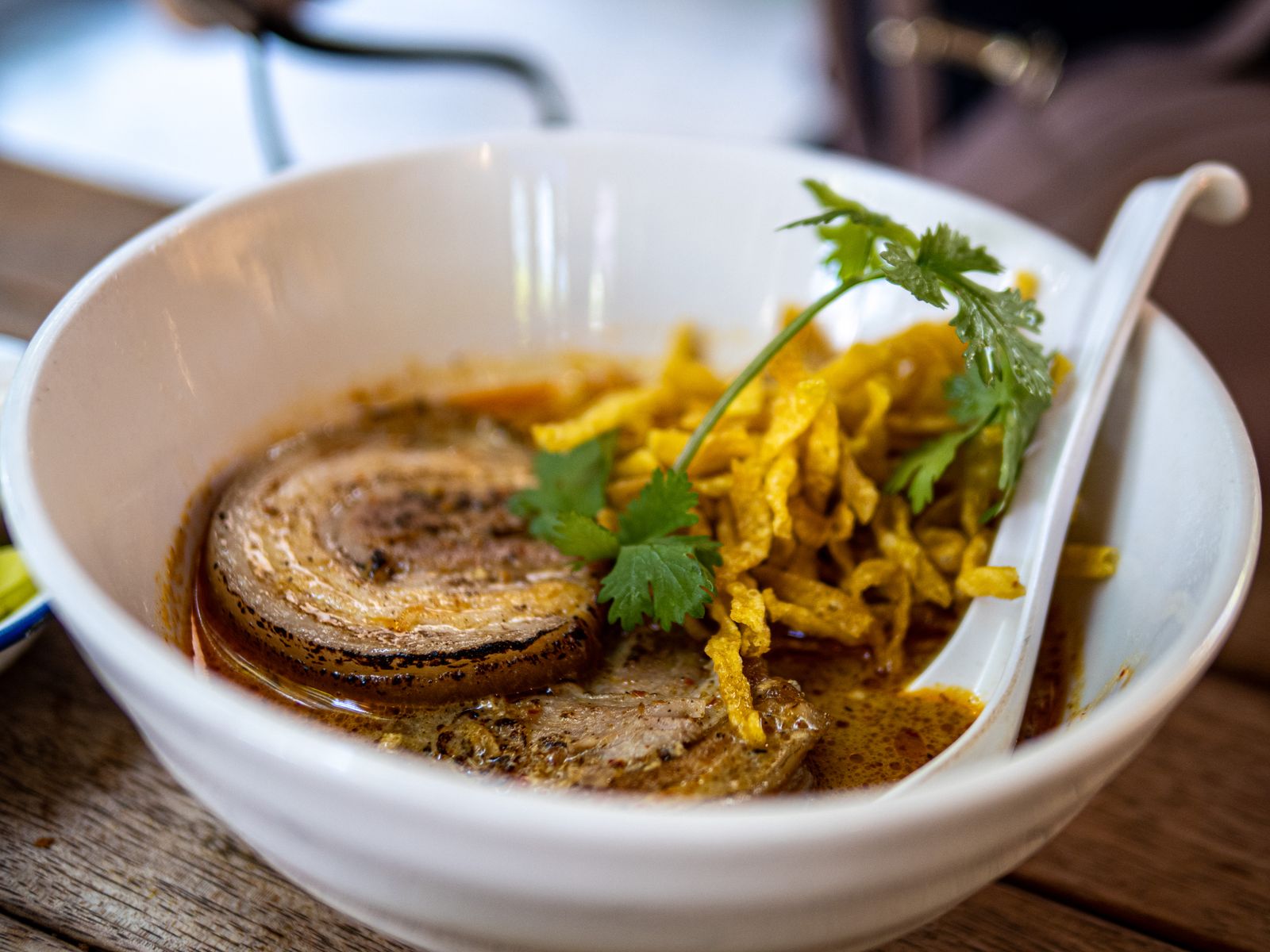
The Tai Yai khao soi spot people in Pai mention most. The broth is well-balanced Northern curry paste, not sweet-forward like the tourist-restaurant versions, topped with crispy fried noodles and eaten with pickled greens and shallots the traditional way. They also do khanom jeen nam ngiao and fried tofu on the side. Open morning to midday — show up late and some things sell out.
Khanom Jeen Nam Ngiao Pa Suk — Soi Lalaisap
A home-style khanom jeen nam ngiao shop Pai locals have eaten at for years. The orange nam ngiao broth gets its color from dried red kapok flowers — mildly sour, savory — ladled over rice noodles and eaten with fresh vegetables and crispy pork rinds. It's a proper Northern Thai breakfast and very easy on the wallet. The shop sits in a small lane locals know well, not on the main drag.
Boat Noodles Por Prateep — Pai branch
A branch of a well-known boat-noodle name that opened in a lane in central Pai. They do both pork and beef, with the rich broth you'd expect from real boat noodles, in small bowls at gentle prices — order several to fill up. It's a quick-meal option that's hard to find in a town as small as Pai, and locals and travelers eat side by side here.
Yen Pho Lui Fai — yen ta fo noodles
A yen ta fo noodle shop people heading to Pai like to recommend. The deep-pink yen ta fo broth is rich and loaded with toppings — a dish you can only get at a handful of places in Pai. Good if you like the punchy sweet-sour profile of yen ta fo, and there are other noodle types and clear-broth options if yen ta fo isn't your thing.
Pai Morning Market — sticky rice, pa thong ko, local bites
The Pai morning market is where locals come to buy groceries and eat breakfast before anyone else is up. There's hot pa thong ko (Thai fried dough) at a few baht a piece to dip in condensed milk, sticky rice with grilled pork, soy milk, and stalls of takeaway curries in bags. It's a cheap breakfast with far more real-town atmosphere than the Walking Street shops — get up a bit early and it's worth it.
Thai Kitchen made-to-order — Pai town
A made-to-order spot run by the owner-chef who cooks punchy Thai food at reasonable prices. Order pad krapao, stir-fried veg, tom yum, hot-wok stir-fries — whatever you feel like. It's a place long-stayers in Pai come back to because the cooking is consistent and cheap. Good for days you just want a simple single-plate meal without overthinking it.
Na's Kitchen — near Walking Street
A Thai restaurant that ranks near the top of Pai in foreign reviews. Fragrant green curry, tom yum with real depth, fried spring rolls, fast service, with seating indoors and out. Around 100–200 baht per meal. It draws plenty of tourists, but the food still tastes properly Thai — a good pick if you want something easygoing near the Walking Street.
Krua Sai Nam Pai — riverside garden restaurant
A garden restaurant focused on fish from the Pai and Salween rivers — grilled fish, fried fish, tom yum fish — eaten riverside in a relaxed setting. Good for groups or families. Prices per dish run higher than single-plate shops because it's fresh fish, but it stays budget-friendly if you share among several people. Open all day.
Stewed pork leg & red pork rice shops — in-town market
Around Pai town there are several cart and shophouse spots doing khao kha moo (stewed pork leg over rice) and khao moo daeng (red pork rice). Soft stewed pork leg over rice, hot pork-blood soup to slurp — a lunch the working crowd in town goes for. Single plates are very cheap, ideal for days you want to fill up fast while wandering the town. Look for the shop with locals sitting and eating to be safe.
Local food stalls on Pai Walking Street — graze for dinner
Come evening, Pai's Walking Street fills with food stalls down its length — grilled sai oua (Northern sausage), sticky rice, Northern-style larb, fried chicken, all the way to local sweets. Graze as you go, paying a little at a time, and you'll fill up. Per-skewer or per-bag prices are low — good for a dinner where you don't want to sit down. Honestly, some stalls are made for tourists, so pick the ones selling genuine local food for the better Northern flavor.
Tip
Northern Thai restaurants and the morning market in Pai open early and sell out fast. The well-known khao soi and khanom jeen nam ngiao spots usually run out before afternoon, so if you want the full spread, go mid-morning before noon to be safe. The Walking Street stalls are an evening thing instead.
Want to taste deeper? Try a Pai food tour or cooking class
Half a day with a local who knows the lanes — or cooking a dish yourself — teaches you more than just eating. Book ahead on Klook or GetYourGuide.
What local Pai dishes are worth trying
Pai is in Mae Hong Son, so the food is Northern Thai blended with Tai Yai (Shan) influence — there's a large Tai Yai community in the area. If you're here and want to eat the way locals do, work through this list.
- Tai Yai khao soi — the broth is less sweet-forward than Chiang Mai khao soi, with a more Tai Yai curry-paste profile, eaten with pickled greens
- Khanom jeen nam ngiao — orange nam ngiao broth colored by dried kapok flowers, mildly sour, a favorite Northern Thai breakfast
- Tua nao & Tai Yai dishes — some shops do Tai Yai-style dishes like khao sen nam moo, hard to find outside Mae Hong Son
- Sai oua & crispy pork rinds — pick them up at the morning market and Walking Street stalls, as a snack or with sticky rice
Can you actually eat in Pai on a budget?
Yes — if you plan your meals right. A lot of people complain Pai is expensive because they only hit the cafes and Western restaurants along the Walking Street, which are priced for tourists. But swap over to the places Pai locals actually eat at and a meal still comes to a few dollars, easily.
Breakfast at the market
Pa thong ko, soy milk, sticky rice with grilled pork at the Pai morning market — fill up for under fifty baht and get the real-town atmosphere.
Single-plate lunch
Noodles, stewed pork leg rice, or a single made-to-order plate, starting from a few dollars up to eighty baht — good for a quick bite while sightseeing in town.
Graze for dinner
Walk the Walking Street buying a skewer and a bag at a time — sai oua, larb, sweets — paying little by little but filling up, no sitting down required.
Special group meal
A riverside garden restaurant like Krua Sai Nam Pai — order fish dishes to share among several people, and the per-head average stays reasonable when there's a group.
What to know before heading up to Pai to eat well
Pai is up in the mountains, and the journey and timing affect a food-and-travel trip more than you'd think. We'll be straight with you so you can plan better.
- The 762-curve road to Pai — Highway 1095 from Chiang Mai is seriously winding. If you get carsick easily, bring motion-sickness tablets and eat light before you set off, then have a proper meal once you reach Pai.
- Ride motorbikes carefully — the mountain roads are twisty and steep in places. If you're not used to it, don't push it — plenty of people rent a bike and crash because they don't know the roads. Ride slow and wear a helmet.
- March–April brings haze — this is the burning season in the North, with murky air and high dust levels. Visibility and the vibe of eating outdoors can't compete with the cool season. If dust affects you, consider avoiding this window.
- Local shops are mostly cash — many market and small shops don't take cards. Some have PromptPay, but not all, so bringing cash makes things easier.
Want to do Pai fully — cafes, local food, and sights? See the full guide.
See the Pai travel guide →