🔄 Updated 21 Jun 2026
When you draw up a list of things to do in Pai, Santichon Village usually turns up as a stop on the way up to Yun Lai Viewpoint, since both sit on the same road west of town. A lot of people assume it's just a China-themed photo spot, but there's a real story behind it. Most villagers are descendants of Yunnanese Chinese who crossed the border and settled in this valley, so the language, food, and way of life still carry a clear Yunnan flavor.
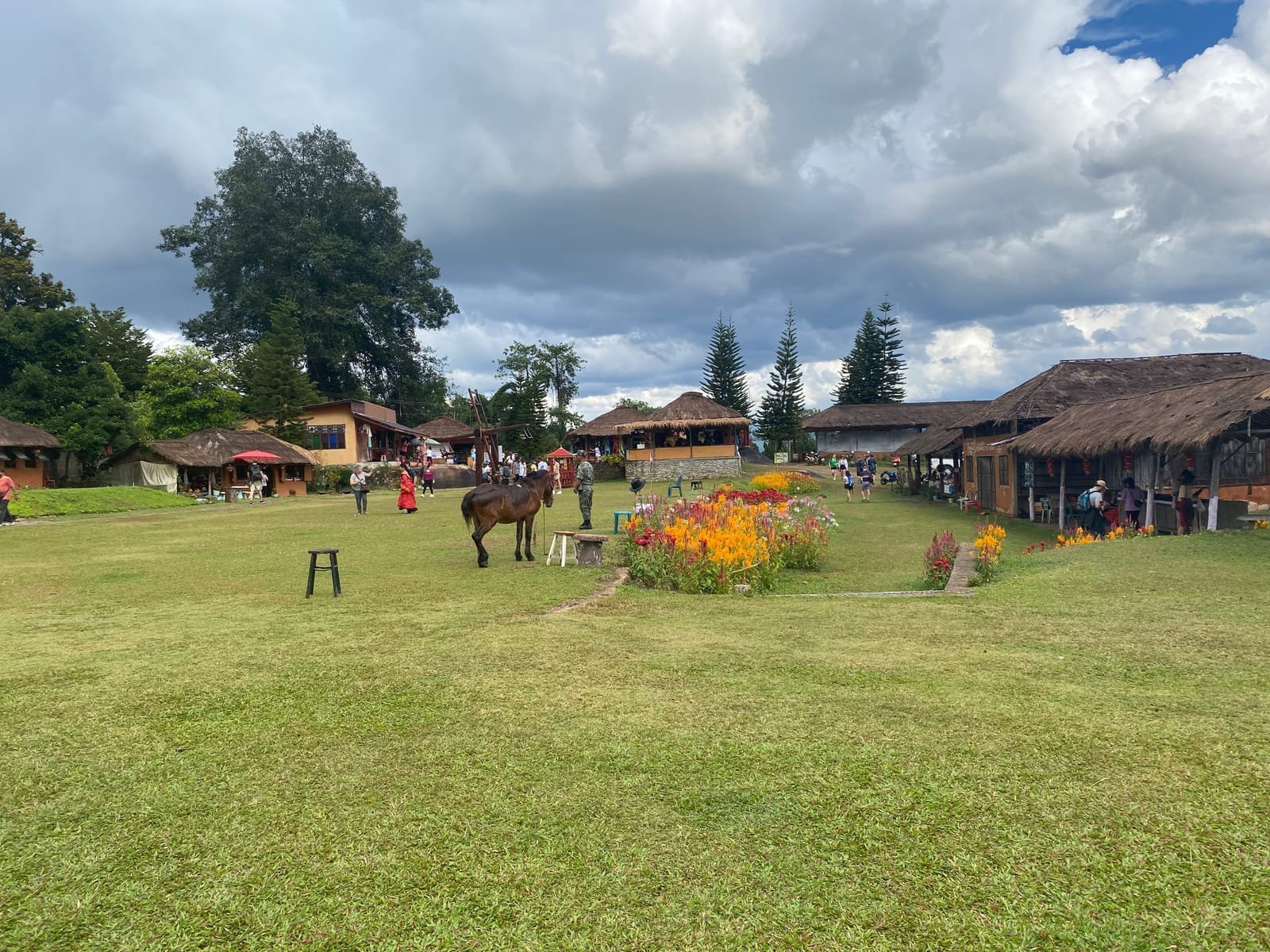
The village itself is built from brown earthen houses with thatched roofs, arranged around a central courtyard with a red Chinese gateway. A few steps in any direction and you hit a tea shop, a restaurant, a souvenir stall, or a photo corner. It feels like you've wandered into a small village in southern China, even though you're still in Pai.
Yunnan earthen houses, the heart of the village
The star of Santichon is the earthen houses, built from soil mixed with straw in the traditional Yunnanese style. The thick walls stay cool in the hot season and warm in winter. Several houses are open to walk into and look at the old household tools inside, while others have been turned into shops or homestays. The brown of the earth set against the red gateway and Chinese lanterns means just about every corner photographs well.
- Central courtyard — with a red Chinese gateway and red lanterns, the first photo spot where everyone stops.
- Earthen display house — walk in to see the old hearth, kitchenware, and Yunnanese everyday items, free.
- Chinese dress rental for photos — qipao and Chinese-princess outfits to rent, around 100–150 THB per outfit, and you can wander the whole village in them.
- Souvenir shops — oolong tea, pickled plums, dried persimmon, nuts, and Yunnan snacks, cheaper than in Pai town.
Want more out of Pai? Book tours & activities
Booking online ahead on Klook or GetYourGuide is usually cheaper than the gate and skips the queue. Pick only the experiences you actually want — prices and availability are shown live on each site.
The big wooden swing, the highlight people queue for
The other thing people post about constantly is the big Yunnanese wooden swing, a timber frame several meters tall standing at the edge of the village. When you ride it, three or four people help push you, swinging you high enough to get the valley as your backdrop. It costs around 25–50 THB per person, depending on the time and who's collecting. If you're afraid of heights, watch first because it swings harder than you'd expect, but if you like a thrill this is a photo spot that gives you both the picture and the fun.
Straight talk about the swing
The swing goes higher and harder than it looks, and the person pushing will ask how strong you want it first, so just tell them if you'd rather take it gentle. Small kids or anyone with back or neck issues should skip it. If you only want a nice photo, you can sit on the swing and shoot without anyone pushing you at all.
Tea shops and Yunnan food, what to order
The charm a lot of people can't miss is the Yunnan food in the village. Step into one of the tea shops and you'll often get free tastings of oolong grown around here before you decide to buy, and you can sip away chatting with the owner. The Yunnan restaurants serve dishes that are hard to find anywhere else, so we've picked out the plates people talk about most to look over before you order.
Pork hock with mantou
Pork hock braised with Chinese herbs until the meat is meltingly soft, drenched in thick gravy and eaten with steamed or fried mantou buns to dip in the sauce. It's the signature Yunnan dish you'll see ordered at nearly every table.
Yunnan noodles
Noodles in a fragrant Chinese-spiced broth with minced pork or beef, bolder than your usual bowl. Eat it warm on one of Pai's pleasantly cool days.
Black chicken herbal soup
Black chicken stewed with Chinese herbs into a well-rounded broth that Yunnanese people consider a nourishing dish. The soup turns sweet from the chicken, best sipped piping hot.
Fried mantou with condensed milk
Mantou fried crisp outside and soft inside, dipped in sweet condensed milk. A popular snack kids love, easy to order and share around the table.
Oolong tea, hot or iced
Oolong grown on the hills around here, fragrant and smooth. Many shops let you taste it free before buying, so order a pot to sip in-shop or take loose-leaf tea home as a souvenir.
Assorted steamed buns
Soft-dough buns filled with minced pork or sweet bean, steamed hot and easy to grab and eat while you stroll the village.
Pickled plums & fruit
Yunnan-style pickled plums and fruit, sweet-sour, sold in small bags that are easy to grab and go. A popular souvenir buy.
Roasted chestnuts & nuts
Hot roasted chestnuts and nuts sold from stalls in and around the village, warm in your hands as you wander and just right for Pai's cool air.
A tip on eating here
Yunnan food in the village is usually cheaper than in Pai town, so if you're coming specifically to eat, stop by before noon while the shops are still fully stocked, since by late afternoon some dishes start to sell out. As for the free tea tastings, don't feel shy, try several before you decide to buy.
Tea terraces and stepped fields
Santichon Village is wrapped in hills, with green tea terraces stepping down the slopes and the villagers' stepped farm plots that look a bit like small rice terraces. The prettiest time is the clear-sky winter, when the green of the fields cuts against the blue. Walk up to the upper part of the village and the valley opens out in front of you, a spot where a lot of people end up standing and shooting photos longer than they planned.
If you want a wide valley view with a sea of fog, the tip is to drive a little past the village up to Yun Lai Viewpoint, which sits on the hill above Santichon. It's one of Pai's most popular spots for sunrise and morning fog, so most people head to Yun Lai before dawn first, then come down to walk Santichon in the late morning, all in one loop.
Honest word on the fog and weather
The sea of fog at Yun Lai and the valley views around Santichon aren't guaranteed every morning, it depends on the weather and humidity that day. Some mornings the fog fills the whole valley, others it's completely clear with no fog at all. The easiest time to catch it is winter (Nov–Feb) after a really cold night. If you come in another season, don't get your hopes too high for the fog.
Costs, opening hours, and what to know
- Village entry: free, no entry fee. You support the community by eating, drinking, and buying souvenirs.
- General opening hours: roughly 07:00–18:00, though each shop opens and closes at different times, and some close early in low season.
- Activity costs: swing about ฿25–50/person · Chinese dress rental about ฿100–150/outfit · short horse ride about ฿50, a 1-hour ride about ฿300 · crossbow/archery has a small fee.
- Time needed: around 45 minutes to 1.5 hours to walk the earthen houses, eat, sip tea, and take photos.
- Pairs well with: Yun Lai Viewpoint and Wat Nam Hu, both on the same road west of town.
How to get there, where it is
Santichon Village is in Wiang Tai sub-district, west of Pai town, about 4–5 km from the center, roughly a 10–15 minute drive by car or motorbike. The route passes Wat Nam Hu, then you turn into the village, and it's clearly signposted. The final stretch is a slight uphill but not steep, and a regular car handles it easily.
Rent a motorbike
The most popular way to get around in Pai, renting from about 100–200 THB a day. It's nimble and lets you stop for photos along the way, but the climb up to Yun Lai past Santichon is fairly steep, so if you're not a confident rider take extra care. Always wear a helmet.
Hire a car or motorbike taxi
If you'd rather not drive, hire a driver to take you around the west side (Yun Lai – Santichon – Wat Nam Hu) in one loop and agree a per-trip price. Good for a group splitting the cost.
Half-day tour in Pai
Tour shops on Pai's walking street have packages covering the west-side spots, bookable at the counter. Some tours include a pre-dawn ride up to Yun Lai for the sea of fog, then on to Santichon.
A serious heads-up about the road to Pai
The road from Chiang Mai up to Pai (Highway 1095) has more than 762 curves, winding up the mountain the whole way. If you get carsick easily, bring motion-sickness medicine and sit up front. The roads within Pai itself, like the climb up to Yun Lai, also have steep grades and tight bends, so if you're not a confident motorbike rider, go slow and watch for oncoming traffic. In the rainy season the roads get slippery fast.
When's the best time to go
Pai's weather is at its best in winter, roughly November to February, with clear skies and pleasant cool mornings and evenings, perfect for walking the earthen village and sipping hot tea. The tea terraces around the village are lush and green this time too. In the rainy season (Jun–Oct) the greenery is vivid but rain comes in spells and the roads get slick, so it's better to pack an umbrella or rain jacket.
Haze season, Mar–Apr
From March to April, the north, Pai included, often has haze problems from open-field burning. The mountain and tea-terrace views turn murky and dust levels rise. Anyone sensitive to dust or with respiratory issues should consider avoiding this window or bring a mask. If you want clear skies and sharp views, winter gives you a much better shot.
West-side Pai in half a day
Yun Lai + Santichon
Yunnan food + stop at Wat Nam Hu
Want a full-day Pai itinerary, with where to stay too
See the Pai travel guide →