🔄 Updated 21 Jun 2026
Pak Thong Chai is one of the largest silk-weaving areas in Thailand, not just in Korat. It started as a Lao Wiang community that brought weaving skills with them when they resettled here, then passed the craft down generation after generation until it became a cottage industry across the whole district. There are two kinds of stops visitors go for: silk shops along Route 304, easy for browsing and buying, and the weaving villages, where you walk in and watch the weavers working in their homes. We'll walk you through both.
What is Pak Thong Chai silk, and why is it famous?
Pak Thong Chai silk is registered as a GI (Geographical Indication) product, meaning plain silk woven on a two-heddle treadle loom, using warp and weft silk threads produced in Thailand, with a width of at least 40 inches. What hooks people is the fabric itself: dense, with real weight, a sharp sheen in the light, and colour that holds without fading easily, unlike imitation silk that feels too thin and slippery. Pak Thong Chai is known more for smooth plain-colour silk and dressmaking fabric than for the heavily patterned mudmee weaving you see in the lower Isan provinces.
- Plain silk — smooth and glossy, great for shirts, work outfits and formal wear; this is what Pak Thong Chai is best known for
- Brocade silk (yok dok) — raised patterns woven into the fabric, with prices rising as the pattern gets finer
- Scarves and shawls — easy small souvenirs, from a few hundred to around a thousand-plus THB
- How to spot the real thing — genuine silk burns to a crumbly ash with a smell like singed hair; if it melts into a hard bead, it has synthetic fibre mixed in
Want more out of Nakhon Ratchasima? Book tours & activities
Booking online ahead on Klook or GetYourGuide is usually cheaper than the gate and skips the queue. Pick only the experiences you actually want — prices and availability are shown live on each site.
Silk shops along Route 304 — easy browsing
If you drive from Korat to Pak Thong Chai along Highway 304 (the Korat–Kabin Buri road), both sides of the road near the district centre are lined with silk shops and weaving workshops. Many have a showroom out front and a weaving floor behind, so you can walk through and look. It's ideal if you want to shop quickly and compare several shops along one stretch.
Korat Thai Silk
The long-established Pak Thong Chai silk shop most people name first. Plenty of plain silk, genuine silk and lace fabric to choose from, with wide cloth that tailors beautifully. There's a storefront plus online ordering via koratthaisilk.com. Good for anyone who wants quality fabric they can count on.
Chattong Thai Silk
A Pak Thong Chai handwoven silk shop that also exports overseas, focused on dense plain silk and quality handwork. It has an English-language website for international buyers. Good if you want a higher-grade piece for a gift or to collect.
Silk Culture Centre / Nakhon Chai Burin Silk Centre
A silk hub for the weaving groups in the Mueang Pak area, where you can see thread reeling, dyeing and weaving all in one place. Good for anyone who wants to understand where the fabric comes from before buying, and to get prices straight from the producers' group.
Roadside weaving workshops on Route 304
Lots of small family shops all along Route 304 near the district centre. Some have looms behind the shop where you can watch the weavers at work. Prices tend to be friendlier than the big shops, and there's room to negotiate if you buy several pieces.
See the real thing — don't rush
Some roadside shops bring in resold stock from elsewhere and mix it with their own weaving. If you want genuine Pak Thong Chai silk, pick a shop with a loom behind it, or just ask straight out whether they weave it themselves. Real silk feels cool to the touch, dense and weighty, not slippery and shiny like synthetic fibre.
Ban Du weaving village — watch the weavers in their homes
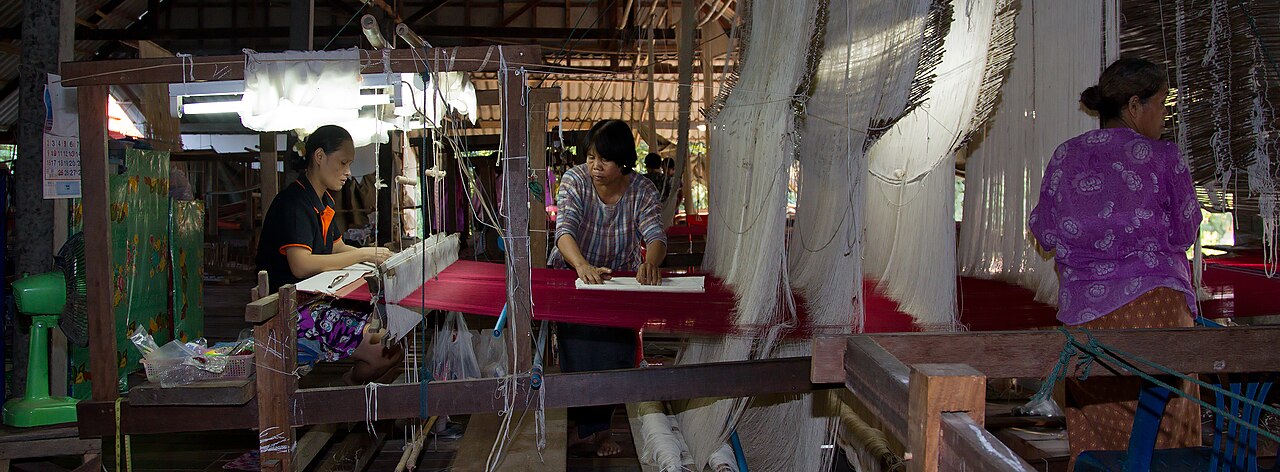
If you want to see a real weaving village, the Ban Du silk handicraft group in Pak Thong Chai district is the place to go. This is a Lao Wiang community that has woven silk for a long time, building it into a skill that brings in millions of baht for the village. Walk in and you'll see looms set up under the raised houses, with the older women weaving every day. You can chat with them and buy fabric straight from the weaver, with no middleman.
- See every step — from reeling and spinning the silk to natural dyeing and weaving on the treadle loom
- Prices straight from the weaver — buy from the person who made it, cheaper than the city shops
- Great for photos — an Isan village setting with old wooden looms makes for shots with a real story
- Call ahead — these are real homes, so if you're coming as a group or want a full demonstration, contacting the group leader in advance is easier
To be honest, the weaving village isn't a tourist attraction set up for visitors — it's the villagers' real daily life. So when you go, be respectful: ask before photographing people, and if a piece of fabric catches your eye, support a weaver by buying it. That's what keeps this handwoven craft alive.
How to get to Pak Thong Chai
Pak Thong Chai is about 30 kilometres south of Korat city, along Highway 304 (the Korat–Kabin Buri road). The road is easy, and driving yourself is the simplest option.
Self-drive / car rental
From Korat city, take Route 304 south for about 40–50 minutes, stopping at roadside shops whenever you like. The most flexible option if you want to compare several shops.
Minivan / songthaew
There are minivans and songthaews on the Korat–Pak Thong Chai route from the city bus terminal. Get off at the district centre and take a motorcycle taxi into the village.
Combine with a Wang Nam Khiao trip
Pak Thong Chai sits on the way from Korat to Wang Nam Khiao, so you can stop for silk before heading up to the cafés and vegetable farms in one trip.
Suggested routes — half day and full day
Short on time? Pick the half-day route, just shopping for silk along Route 304. With a full day, add a visit to the village to watch the weavers and continue up to Wang Nam Khiao.
Half day shopping for roadside silk
Full day — visit the village + continue to Wang Nam Khiao
Pak Thong Chai Silk & Korat Local Goods Festival
Pak Thong Chai is at its liveliest during the Pak Thong Chai Silk and Korat Local Goods Festival, held every year in early December (usually around 9–15 December) in front of the Pak Thong Chai district office. It has run for over twenty years now. The festival brings silk shops from across the district together, with wholesale prices, fabric contests, weaving demonstrations, parades, and Korat's local food and goods. If you want several pieces at good prices and a full picture of the district's craft, this is the best time to go.
Before you go to the festival
The exact dates shift slightly each year, so check them on the TAT Korat page or the Pak Thong Chai district page before you go. It gets crowded and traffic backs up in the district centre during the festival, so leave extra time to find parking.
Know before you go
- Bring cash — many small shops and village weavers mainly take cash, though some accept QR payment
- Prices are negotiable — especially if you buy several pieces or buy straight from a weaver in the village
- Ask if they weave it themselves — avoid resold stock by choosing shops with a loom behind them
- Respect the community — the weaving village is people's actual home, so always ask before photographing anyone
- Self-driving is the best value — shops are spread all along Route 304 and public transport takes several legs, so driving or renting a car is easier
Plan a full Korat trip — food, sights and where to stay
See the Korat travel guide →