🔄 Updated 21 Jun 2026
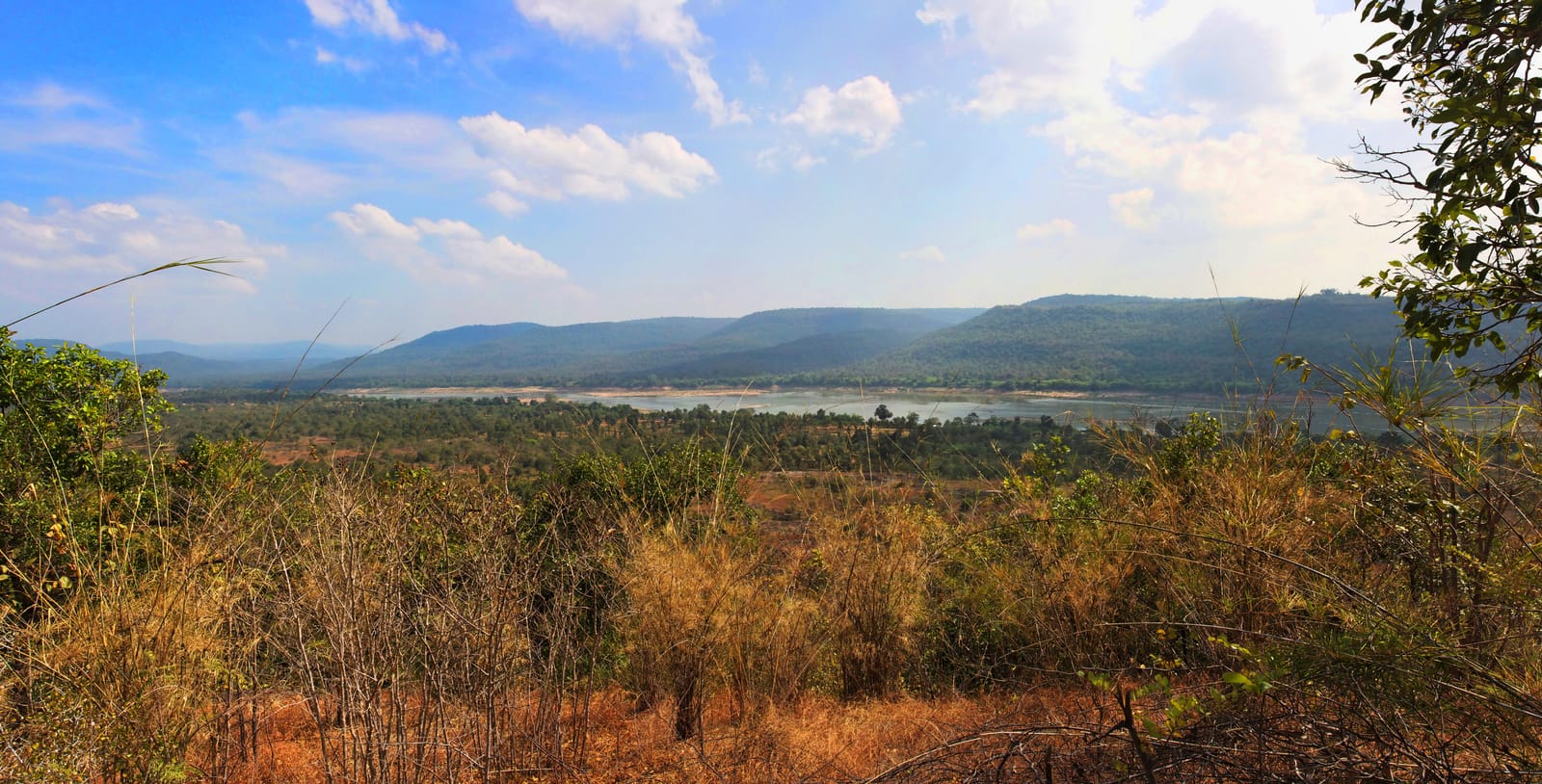
Pha Taem National Park is in Khong Chiam district, Ubon Ratchathani province, covering around 340 square kilometers along the Mekong from Khong Chiam up through Si Mueang Mai and Pho Sai. The headline sight is the Pha Taem cliff itself — a sandstone wall roughly 30 meters high facing straight out over the Mekong. Stand on the rock terrace at the top and you look down on the river running off into the distance, with the land of Laos on the far bank. It's a view you won't find easily anywhere else in Thailand.
What sets Pha Taem apart from your average scenic park is that the same cliff hides prehistoric rock paintings 3,000–4,000 years old on the lower rock face. It's a natural site and an archaeological site in one. Coming here, you get both the walk along the Mekong and a look back at traces of the early people who once lived along this river.
The Mekong Viewpoints — the Heart of Pha Taem
Around the park headquarters there's a wide rock terrace on top of the cliff. From the car park it's a short walk to the edge, with railings and photo spots at intervals. From here the Mekong stretches out in front of you with the Laos mountains filling the view. Early morning is when the crowds show up, because Pha Taem faces due east — the sun rises straight ahead, climbing over the horizon above Laos. Plenty of people call this the spot where you see the sun before anyone else in Thailand.
- Pha Taem cliff terrace — the main viewpoint by the headquarters, easy to reach, with the Mekong and Laos filling the view. Good for both sunrise and daytime photos.
- The trail below the cliff — a path running along the cliff face down to the rock paintings, with glimpses of the Mekong along the way. The full loop is around 3–4 kilometers and brings you back up.
- Sao Chaliang — a cluster of mushroom-shaped stone pillars carved by nature, sitting before you reach the headquarters. A quick photo stop before the main viewpoint.
- Pha Chana Dai — a sunrise and sea-of-fog viewpoint deeper in another zone of the park, a different direction from the main Pha Taem cliff. You'll need to keep driving to reach it.
If you want to catch the sunrise
If you're coming for sunrise, you need to be at the cliff before first light — around 5:30–6:00 a.m. — so factor in the drive from your accommodation. The cool season (November–February) brings clear skies and pleasant chill, and that's when the photos come out best. Pack a light jacket too, because the morning wind off the Mekong is colder than you'd expect.
Want more out of Ubon Ratchathani? Book tours & activities
Booking online ahead on Klook or GetYourGuide is usually cheaper than the gate and skips the queue. Pick only the experiences you actually want — prices and availability are shown live on each site.
Pha Taem's Prehistoric Rock Paintings
This is what put Pha Taem on the map internationally. The rock paintings sit on the lower cliff face — red images made from ochre and tree resin, running in a continuous band along roughly 180 meters of cliff. There are several hundred images in all, split into around 4–5 main groups. Archaeologists put their age at roughly 3,000–4,000 years — traces of the prehistoric people who once lived along this stretch of the Mekong.
- Human figures and handprints — figures of people and painted handprints, a direct echo of the people who lived here.
- Animals — cattle, buffalo, fish and other animals, pointing to the creatures they lived alongside and hunted for food.
- Fishing gear and rice farming — images resembling fish traps and a riverside way of life, showing how much these people relied on the Mekong.
- Geometric patterns — lines and designs still open to several interpretations, part of what draws people to come and see the real thing.
The park has built a nature trail along the cliff face so you can walk down and see the paintings group by group, with signs explaining each one. The route is a mix of steps and cliffside path, around 3–4 kilometers if you do the full loop, taking about 1–2 hours depending on how long you stop to take photos. Some sections are narrow and stepped, so comfortable walking shoes are a good idea.
Honest heads-up
The rock paintings are extremely old, the colors have faded over time, and some spots take a hard look to make out. If you're expecting the crisp, vivid images from the posters, they may look fainter than you imagined. But once you realize they're 3,000–4,000 years old and still here, standing in front of the real thing feels different. Don't touch the painted wall — it makes the colors deteriorate faster.
Waterfalls and Stone Pillars — More to See in the Park
Pha Taem isn't just the cliff and the rock art. The park also has waterfalls and oddly shaped stone formations worth a stop at several more spots. Each one is in a different location and needs more driving, so if you've got a full day, work your way through them one at a time.
Soi Sawan Waterfall
Two streams meeting as they fall, around 20 meters high. In late rainy season and early cool season, the surrounding area fills with wildflowers like Dusita and Soi Suwanna blooming together — a corner not many people reach yet. Park, then walk in about another 500 meters.
Saeng Chan Waterfall (the 'hole' waterfall)
A small waterfall where water flows through a hole in the rock ceiling and pours down in a column. When sunlight catches it, you get a lovely shaft of light. The draw is the unusual shape you rarely see anywhere else.
Sao Chaliang
A cluster of mushroom-shaped stone pillars eroded by wind and water over millions of years, sitting right by the road before the Pha Taem headquarters. An easy photo stop, and another icon of Ubon.
Pha Chana Dai
A sunrise and sea-of-fog viewpoint deeper in another zone of the park, still off most people's radar. Good for anyone who likes a quiet corner — check the route and road conditions first.
Rough distances to keep in mind: Soi Sawan Waterfall is about 15–18 kilometers from the Pha Taem headquarters — drive along Highway 2112 and turn off where the signs point. Pha Chana Dai is in a different zone and further out again. If you're set on Pha Chana Dai for sunrise, it's worth staying overnight around Khong Chiam or camping in the park the night before.
Entry Fees and Opening Hours
Pha Taem is a national park, so there's an entry fee at the standard Department of National Parks rate, collected at the checkpoint before the viewpoint. The prices below are approximate and may change, so bring cash to be safe.
- Thai visitors — around ฿40 for adults, ฿20 for children, per person.
- Foreign visitors — around ฿200 for adults, ฿100 for children, per person.
- Vehicle fee — around ฿30 per car (motorbikes are cheaper).
- Opening hours — open for visits around 6:00 a.m.–6:00 p.m. daily; the visitor center is open around 8:00 a.m.–4:30 p.m.
Check before you go
National park fees across the country are adjusted from time to time. To be sure, it's best to call the Pha Taem National Park office before your trip — especially if you're planning to come for sunrise — to confirm the checkpoint opens before dawn on the day you're visiting.
Getting There from Ubon City
Pha Taem is about 95 kilometers from Ubon Ratchathani city, out toward Khong Chiam district, around a 1.5–2 hour drive. The road is paved the whole way and easy to reach, though the last stretch is a slight climb. A regular sedan handles it fine.
- Private car / rental car — the most convenient option, since the sights inside the park are spread far apart. From the city, take the road toward Khong Chiam, then turn off following the Pha Taem National Park signs. There are several car rental outfits in Ubon city.
- Motorbike — good for solo travelers or pairs. It's 95 km, so allow extra time and take breaks; watch out for sun and wind.
- Private hire / taxi from the city — if you're not driving, you can hire a car round-trip with stops at various spots around Khong Chiam. Agree on the price before you set off.
- Day tour — some hotels and tour companies in Ubon run Khong Chiam–Pha Taem–Two-Color River packages in a single day, handy if you'd rather not plan it yourself.
If you've come all the way to Pha Taem, it's worth carrying on around Khong Chiam district to make the most of it. Nearby is the Two-Color River, the point where the chalky Mun River meets the reddish Mekong, plus a riverside market where you can stop for fresh river fish. It all adds up to a tidy day trip from the city.
Best Time to Visit
Pha Taem works year-round, but each season has a different feel — pick the one that matches what you want to see.
- November–February (cool season) — the best window: clear skies, cool air, ideal for the sunrise and the sea of fog around Pha Chana Dai. This is high season here.
- Late rainy to early cool season (October–December) — wildflowers around Soi Sawan Waterfall bloom together, a corner not many people reach yet.
- Rainy season (June–September) — the waterfalls run full and lush green, but the cliffside trail can get slippery, and the morning Mekong view is often hidden by cloud.
- Hot season (March–May) — strong sun and low water at the falls, but clear skies give you a sharp Mekong view. If you come now, skip the midday walk and go early or late instead.
Night skies
Pha Taem sits far from city lights, and the night sky here is dark enough that it's been declared a Dark Sky conservation area. If you camp overnight in the park on a clear night, there's a good chance you'll see a sky full of stars and the Milky Way — another reason a lot of people choose to stay over rather than go early and head back the same evening.
Plan a full Ubon trip — where to stay, eat, and explore
See the Ubon Ratchathani travel guide →