🔄 Updated 21 Jun 2026
Phan Thai Norasing Shrine sits in Phan Thai Norasing sub-district, Mueang Samut Sakhon, at the mouth of the Khok Kham Canal — not far from Samut Sakhon town or from Bangkok. A lot of people know the name from school textbooks, from films, and most recently from TV dramas shot around the Khok Kham area. But standing here in person, the story sharpens a great deal, because the winding canal in front of you is the very same one from the legend.
The Legend of Phan Thai Norasing, in Brief
The story unfolds in the Ayutthaya period, during the reign of King Sanphet VIII — better known to most people as Phra Chao Suea, the Tiger King. One day the king travelled by water aboard the royal barge Ekkachai, passing through the Khok Kham Canal, which twists and bends sharply. Phan Thai Norasing served as the helmsman steering the stern. At one hairpin turn, the prow lost its line and struck an overhanging branch, snapping the carved figurehead clean off.
Under the palace law of the day, a helmsman who let the figurehead of a royal barge break was to be executed. The Tiger King saw it for the accident it was and was ready to pardon him — but Phan Thai Norasing instead begged to be put to death as the law required, fearing that an exception in his case would erode royal tradition and set a precedent for those who came after. In the end the execution was carried out at his own request, and the king ordered a shrine built and the broken figurehead set there as a memorial, right at the spot where it happened.
Why this story still gets told
The heart of it isn't the dying — it's a man accepting the consequences of a rule he was sworn to uphold, even with a way out handed to him. For many Thais, the phrase 'loyalty to one's duty' traces in part back to this very story.
Want more out of Samut Sakhon? Book tours & activities
Booking online ahead on Klook or GetYourGuide is usually cheaper than the gate and skips the queue. Pick only the experiences you actually want — prices and availability are shown live on each site.
What You'll See Here
The grounds split broadly into two areas that sit close together: the old shrine by the canal, and the Phan Thai Norasing Historical Park, laid out as a space that tells the story. You can walk through both in a single loop — no need to rush.
Phan Thai Norasing Shrine (the main shrine)
The shrine at the mouth of the Khok Kham Canal, believed to be the first and oldest Phan Thai Norasing shrine. People come to pay respects and ask for integrity, success at work, and the keeping of promises.
Phan Thai Norasing Historical Park
The actual site of the incident, with a statue of Phan Thai Norasing, a commemorative base, and a replica of the royal barge Ekkachai to help you picture how it all played out.
Khok Kham Canal
The winding canal that set the scene for the legend. The leafy banks make a nice photo stop and a shady spot to sit and catch the breeze.
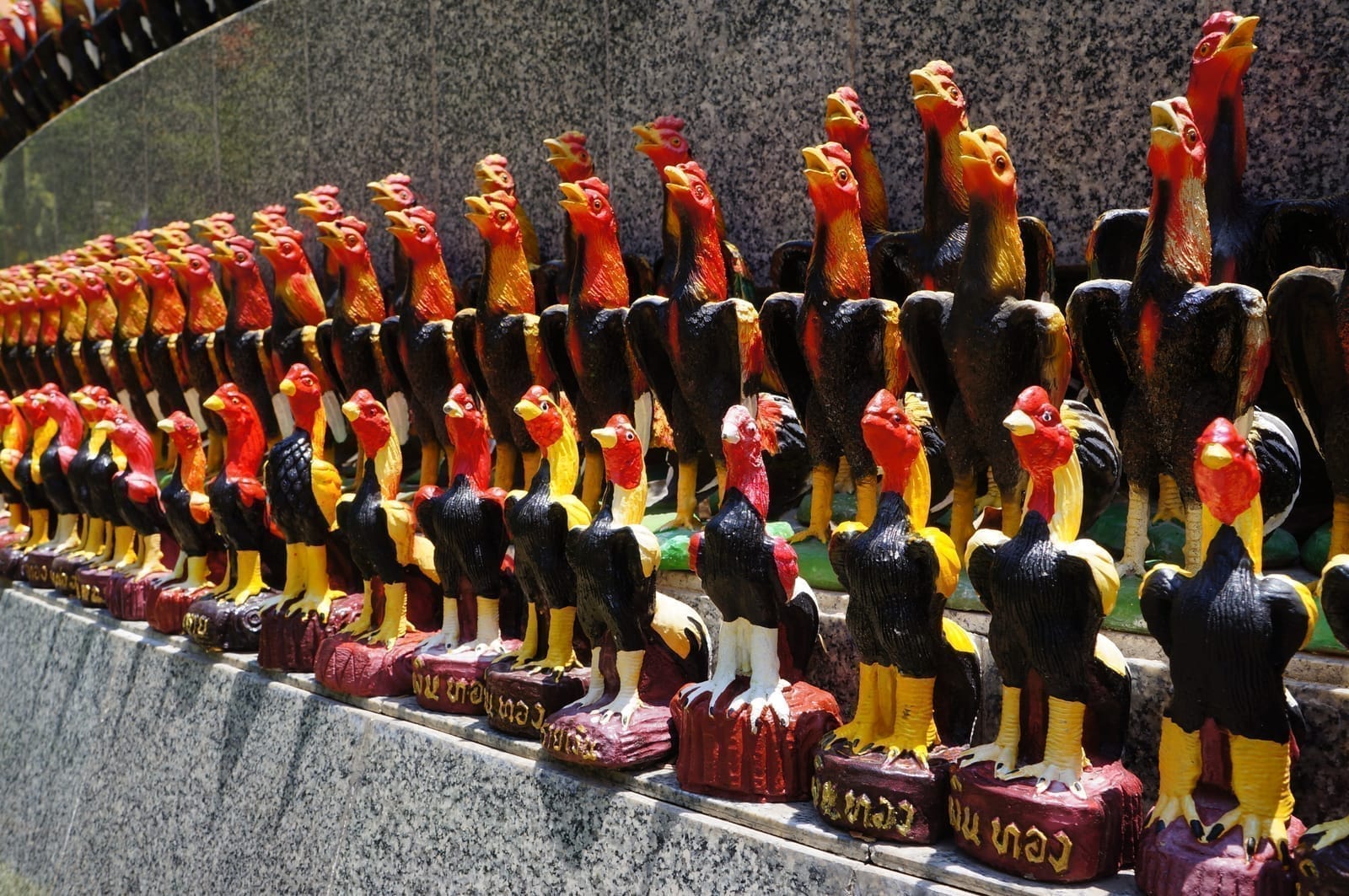
What many people really come to see is the figurehead and the old woodwork displayed around the shrine, along with the countless stucco fighting cocks that visitors leave as offerings. Because the Tiger King was fond of cockfighting, the fighting cock has quietly become the shrine's signature votive offering.
Getting There
- From Bangkok (by car) — Take Rama II Road toward Samut Sakhon, cross the Kanchanaphisek elevated expressway, then continue about 7 km. Watch for the entrance sign on your left, turn in, and follow the road another 9 km or so to the shrine.
- From Samut Sakhon town — Follow Ekkachai Road and Sahakorn Road heading toward Phan Thai Norasing Shrine, a distance of roughly 15 km.
- Public transport — Fairly limited. Most visitors come by private car or rental. If you don't have a vehicle, chartering a car or taxi from town is the easier bet.
- Parking — There's a lot on site; quiet on weekdays, busier on Saturdays and Sundays.
Opening hours
Open daily, usually around 08:00–18:00. On Saturdays and Sundays it sometimes stays open until about 19:00. Entry is free. Double-check the latest hours before you go, as they can shift around festival periods.
When to Go, and What to Know Going In
- Morning or late afternoon is best. The midday sun in Samut Sakhon is fierce, and most of the area is out in the open.
- Dress respectfully — this is a working shrine where people genuinely come to pay their respects.
- Easy to pair with other stops — the shrine takes about 45 minutes to an hour to walk through, which makes it a good match with another spot on the same day.
- Straight talk — this is a place of history and belief, not a theme park. If you're into stories and a quiet atmosphere, you'll get more out of it; small kids may not last long here.
More to See Around Here
Around Phan Thai Norasing sub-district and along Sahakorn Road there are several more places worth a stop. Pick and pair them based on the time you have.
Wat Khok Kham
An old temple near the Khok Kham Canal with a riverside community feel — a natural fit for the follow-the-legend theme.
Khok Kham Salt Fields & Mangroves
The salt fields and mangrove forest around Ban Laem–Khok Kham — a spot for birdwatching and late-afternoon photos.
Maha Chai Market
Head back into town for fresh seafood — short mackerel and the local catch that Samut Sakhon is known for.
Want to make the most of a single day in Samut Sakhon? See itineraries and places to stay across the province.
See the Samut Sakhon guide →