🔄 Updated 21 Jun 2026
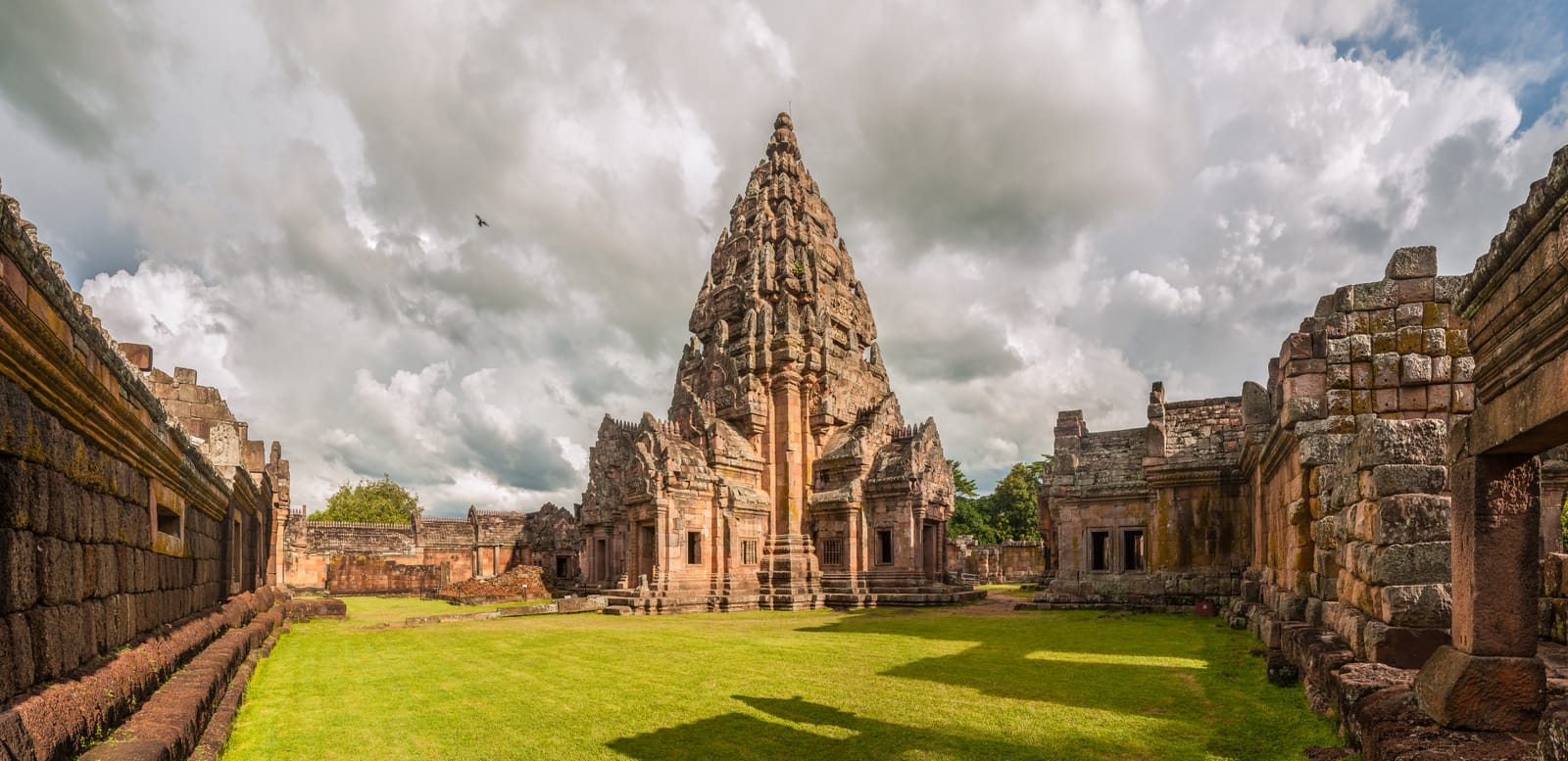
If you only have time for one place in Buriram, most people will tell you to make it Phanom Rung. The temple is built of sandstone and laterite in the Hindu tradition, a sanctuary dedicated to Shiva, dating to roughly the 10th–13th centuries. Its key builder was Narendraditya of the Mahidharapura dynasty, a relative of King Suryavarman II who built Angkor Wat. The name Phanom Rung comes from the Khmer vnam rung, meaning "broad mountain," and what sets it apart from other Khmer temples is its setting on the rim of an old volcano, with everything laid out to rise steadily higher until you reach the summit.
Entry fees and opening hours
The park is open daily from 07:00–18:00. Entry is 20 THB for Thai visitors and 100 THB for foreigners, and visitors aged 60 and over get in free. If you plan to carry on to Prasat Muang Tam the same day, you can buy a combined ticket for both sites that works out cheaper than buying them separately — just ask at the ticket booth.
- Opening hours — daily 07:00–18:00 (aim to be up at the temple before 17:00 so you have time to wander)
- Entry, Thai visitors — 20 THB
- Entry, foreign visitors — 100 THB
- Visitors aged 60+ — free entry
- Combined Phanom Rung + Muang Tam ticket — available, better value than buying separately if you visit both
Best time to go
Buriram gets fierce from mid-morning into the afternoon, and there's no shade up on the summit. Go early, before 10am, or in the late afternoon toward dusk — it's much easier to walk and the light is better too. Bring a hat, sunglasses and your own water, since the shops are mostly down at the base.
Want more out of Buriram? Book tours & activities
Booking online ahead on Klook or GetYourGuide is usually cheaper than the gate and skips the queue. Pick only the experiences you actually want — prices and availability are shown live on each site.
The Naga walkway, the heart of the climb
Before you reach the temple itself, you walk along a long causeway lined with stone pillars on both sides, ending at the Naga bridge — a raised, cross-shaped platform whose balustrades are carved as the bodies of five-headed serpents. In Hindu cosmology this bridge stands for the rainbow linking the human world to the world of the gods, so crossing it is like stepping from the ordinary world up toward Mount Meru. From the first Naga bridge there are another 52 steps climbing to the top terrace — the most tiring stretch, but also the one that gives you the best photos.
- Pillar-lined causeway — a long paved walkway with stone pillars on either side, the first spot where you see the temple standing at the far end
- First Naga bridge — the cross-shaped platform with five-headed serpent balustrades, one of the most popular photo spots
- The 52 steps — the climb up to the summit; take it slowly, there are landings along the way
- Upper Naga bridge — just before the gallery gateway, positioned to face straight into the central prang
The carving to hunt for: the Phra Narai lintel
The highlight of Phanom Rung's carvings is the Phra Narai lintel (the reclining Vishnu lintel) above the east doorway of the central prang. It shows Vishnu reclining on the serpent Ananta as it stretches across the back of a dragon; from his navel rises a lotus stem, and seated in the lotus is the four-faced Brahma — the Hindu image of the universe being born. This lintel has a long backstory: it was smuggled out of the country and displayed in the United States for nearly 30 years before it was finally returned to its original place in 1988, sparking a slogan that became famous at the time.
Beyond that signature lintel, there are plenty of other carvings worth looking up for — pediments depicting the Ramayana, scrolling foliage, Hindu deities, and dvarapala guardians flanking the gateways. These sandstone works are still crisp and readable even after nearly a thousand years. If you have time to walk slowly and study them one by one, you'll see that the temple was designed to tell a story all the way from the entrance to the garbhagriha (the inner sanctum) at the center.
Read the carvings with more context
The visitor center at the base has an exhibition and a scale model explaining the temple's layout and the story on the lintel. Spend 10–15 minutes there before you climb and the carvings up top will make a lot more sense — you'll know what each scene is telling you.
The sun aligning through all 15 doorways
What makes Phanom Rung special compared to other Khmer temples is that all 15 doorways are aligned on a single straight axis. Four times a year, the sun shines straight through all 15 doorways at once — a sign of just how precisely the ancient builders married the architecture to the path of the sun. The dates (based on the 2025 calendar) are:
- Sunrise through the doorways — around 3–5 April and 8–10 September (early morning, ~05:30–06:00)
- Sunset through the doorways — around 5–7 March and 5–7 October (late afternoon, just before sunset)
- It gets very crowded — there are festivals and the queues to go up fill fast; arrive well before dawn or several hours ahead of the actual time
The exact dates can shift slightly each year depending on the calculation. If you're going specifically for this, always check the announcements from Phanom Rung Historical Park or TAT Buriram before you travel, because the weather matters a lot — if the sky is overcast or cloudy, the alignment may not be clear.
Photo spots that actually deliver
Lower Naga bridge
Shoot so the serpent balustrades lead the eye toward the temple at the far end — the signature image of Phanom Rung. Works both in portrait and landscape.
In front of the gallery gateway
Stand on the doorway axis and look straight through several layered frames all the way to the central prang. Lots of depth, especially when the light is low.
Top terrace, panorama
From the summit you get a wide view over the Buriram plains; on a clear day you can faintly make out Khao Kradong and Prasat Muang Tam. Best in early morning or late afternoon.
Lintel + prang pediment
Zoom in on the detail of the reclining Vishnu carving and the pediment work — an image that tells a story without anyone in the frame.
Getting to Phanom Rung
The temple is in Ta Pek subdistrict, Chaloem Phra Kiat district, about 70 km from Buriram town — roughly a 1-hour drive. The easiest way is to drive yourself or rent a car, since public transport up to the temple itself is limited.
- Self-drive — from town take Highway 219 toward Prakhon Chai, join Highway 2075, then turn onto 2117 up the hill; there's parking at the base
- Songthaew / chartered car — ride to the foot of the hill and take onward transport up to the temple; good if you don't have a car, but agree a clear pickup time
- Pair it with Prasat Muang Tam — it's not far, about another 15–20 minutes' drive, and many people do both in one day
- From Buriram train station — if you come by train, it's smoother to charter or rent a car in town for the trip out to Phanom Rung than to wait for buses
The honest heads-up: Phanom Rung involves a fair bit of stair-climbing. If your knees aren't great, or you're bringing older relatives, allow extra time and build in rest stops. The sun is strong and there's no shade up top, so wear shoes you can walk in, carry your own water, and watch for slippery stone if you go in the rainy season. Overall, around 1.5–2 hours is about right to see it at a comfortable pace.
Plan a full Buriram trip — the temples, the football stadium and the food
See the Buriram travel guide →