🔄 Updated 21 Jun 2026
Phaya Sri Sattanakharat sits along Sunthon Wichit Road, running parallel to the Mekong inside Nakhon Phanom town. It's an easy walk from the riverside hotel area and the Vietnamese Clock Tower. The Naga is cast entirely in brass — seven heads coiled on an octagonal base 6 metres wide, with the whole thing standing around 15 metres tall including the base. It's said to be the largest brass Naga in the Isan region. The plaza is open for worship 24 hours a day, but the busiest times are early morning and the evening before sunset.
Why people come here
People in Nakhon Phanom believe Phaya Sri Sattanakharat drifted up the Mekong and chose to come ashore here to watch over the town and keep it peaceful. The Naga is treated as a sacred guardian of the city. Communities along the Mekong have revered the Naga for generations anyway, so this became a place both locals and visitors come specifically to pay respect. Most people ask for luck, money, and success at work. Beyond the faith side of things, the plaza is also an open riverside space where townsfolk come to stroll, exercise, and catch the evening breeze — it's not only tourists.
- 7-headed Naga, 9 tonnes of brass — cast in one piece, gleaming golden brass, visible from far along the river.
- Scheduled water spray — the Naga sprays a jet of water out toward the Laos side, lovely both by day and when it's lit up at night.
- Exhibition room under the base — there's a small room beneath the pedestal telling the story of how the Naga was built; worth a quick look.
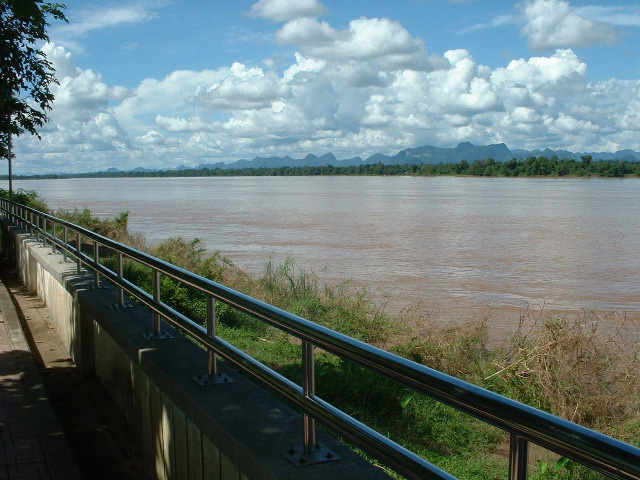
- Full Mekong views — you look straight across to Laos, a backdrop you'd struggle to find anywhere else.
Want more out of Nakhon Phanom? Book tours & activities
Booking online ahead on Klook or GetYourGuide is usually cheaper than the gate and skips the queue. Pick only the experiences you actually want — prices and availability are shown live on each site.
How to pray to Phaya Sri Sattanakharat
You don't need to bring anything from home — the plaza has stalls renting out flowers, incense, candles, and offerings, with prices starting in the tens of baht. The basic set is a flower garland, a pair of incense sticks and candles, plain water, and fruit. If you want to do it the proper way, people typically use 9 or 19 incense sticks specifically for the Naga.
- Light the incense and candles, settle your mind, and chant the Namo three times first.
- Then follow with the prayer to Phaya Sri Sattanakharat (there's a sign at the plaza with the chant).
- State your full name clearly, then make your wish.
- A tip locals pass around: ask for just the one thing you want most — it's believed to come true more easily than asking for many things.
- Place the incense and candles in the burner, and you're done.
Water-spray times
The Naga sprays water on a schedule — generally morning 6:00–11:00, afternoon 1:00–4:00 pm, and evening 6:00–9:00 pm. The evening session, when the lights are on and the water's spraying, is the prettiest. Times can shift depending on the day and the weather, so keep your expectations flexible.
Getting good sunset photos
Phaya Sri Sattanakharat looks its best before sunset, roughly 5:00–6:30 pm. The golden evening light hits the Naga and deepens its brass tone, with the Mekong and Laos as the backdrop. As the sky darkens, the plaza lights come on and the Naga takes on a different, more dramatic feel. If you want photos in both moods, get there before sunset and stay on until the lights come up.
- Full statue + river view — stand slightly off to the side so you catch all seven heads with the river behind.
- Low angle from the front — shoot upward to make the Naga look tall and imposing, with the orange evening sky as the base.
- Catch it mid-spray — wait for the water spray, then shoot; the mist with the night lights gives the shot depth.
- Walk up onto the river embankment — step back and shoot from the embankment path to fit the whole plaza and the river in one frame.
Straight talk
The plaza is an open space by the water, and by day the sun is fierce and it gets very hot. Midday light is so harsh the Naga reflects glare. If you can, come in the evening — it's far more comfortable and the photos come out much better. If you're sensitive to the sun, bring an umbrella and water.
Where to go next around the plaza
The good thing about this spot is that it's right in the middle of the riverside district, so you can walk to several places without driving — perfect for stringing together one long evening in a single area.
Vietnamese Memorial Clock Tower
An old riverside landmark that the Vietnamese community in Nakhon Phanom helped build. It's within walking distance of Phaya Sri Sattanakharat and marks the start of the walking street.
Mekong Riverside Walking Street
Stretches along the river from the clock tower toward the Naga plaza. Open Friday–Saturday–Sunday, around 4:30–8:30 pm, with plenty of Isan and Vietnamese street food to graze on.
Wat Okat (Wat Si Bua Ban)
An old riverside temple that's part of the town's history, not far from the plaza. Stop in to make merit right after praying to the Naga, all in one trip.
Riverside cafes
The Sunthon Wichit Road area has several cafes with river views — a good spot to rest with a coffee or wait for the evening light before shooting.
Getting there and when to go
- Location — along Sunthon Wichit Road, running by the Mekong in Nakhon Phanom town. Drop a pin on "Phaya Sri Sattanakharat" in Google Maps and it'll take you right there.
- From the town centre — if you're staying in the riverside area it's an easy walk; if you're further out, take a motorcycle taxi or a local songthaew. Fares around town aren't expensive.
- Parking — there's a lot by the river near the plaza. On weekend evenings it gets crowded and parking is harder to find, so arriving in the early evening is easier.
- Best times — early morning has nice weather and few people, good for a quiet visit; the evening is when photos are best and the place is liveliest.
- What to wear — this is a place of worship, so dress neatly and respectfully, and avoid being loud or behaving inappropriately around the Naga.
Make your time count
If you come on a weekend, aim to reach the plaza in the evening, pray and shoot photos in the golden light, then carry on to the Mekong walking street in the early evening. You'll wrap up the whole evening — temple, food, and photos — all in one place.
Plan a full trip to Nakhon Phanom
See the Nakhon Phanom guide →