🔄 Updated 21 Jun 2026
Phayao sits along Kwan Phayao, the large freshwater lake that's the heart of the town. The main things to do fall into three areas: the lakefront (cafes, temples, boat trips, sunsets), temples and food in town, and the winter mountains like Phu Langka further out. There are only a few things that decide whether the trip feels worth it or a bit of a letdown — let's go through them one by one.
When is the best time to visit Phayao?
The heart of a Phayao trip is picking the right month, because both the evening lake views and the sea of fog on Phu Langka come down entirely to the weather. Short version: November to January is best, and avoid March to April if you possibly can.
- Oct–early Nov — the tail of the rains into early cool season. Skies start to clear, the rice fields are still green, and Phu Langka begins getting fog before dawn. Crowds are still light. It's lovely, but some days still get rain, and the road up the mountain can be slippery.
- Nov–Jan — peak cool season. It genuinely gets cold, around 20–22°C before dawn in town, and down to 10–15°C at the top of Phu Langka, with the best odds of a full sea of fog. The catch: lodging on the mountain fills up fast and prices climb.
- Feb — still pleasantly cool early in the month, but toward the end the burning starts and the views begin to haze over.
- Mar–Apr — burning season. PM2.5 dust hangs thick, the mountain and lake views vanish into the haze, and it's hot. Not recommended if you're coming for the scenery.
- May–Sep — rainy season. Everything's lush and the lake is full, but it rains often, getting up Phu Langka is harder, and the sea of fog is hit or miss. Check the forecast first.
Check the dust levels before you book
If you really can't avoid the burning months, check Phayao's daily PM2.5 reading on an app like IQAir before locking in your dates. Some years the wildfires come early, from mid-February; some years they drag on into May. The evening lake views that are the whole highlight disappear the moment the smoke rolls in.
Taking the boat to Wat Tilok Aram — know before you go
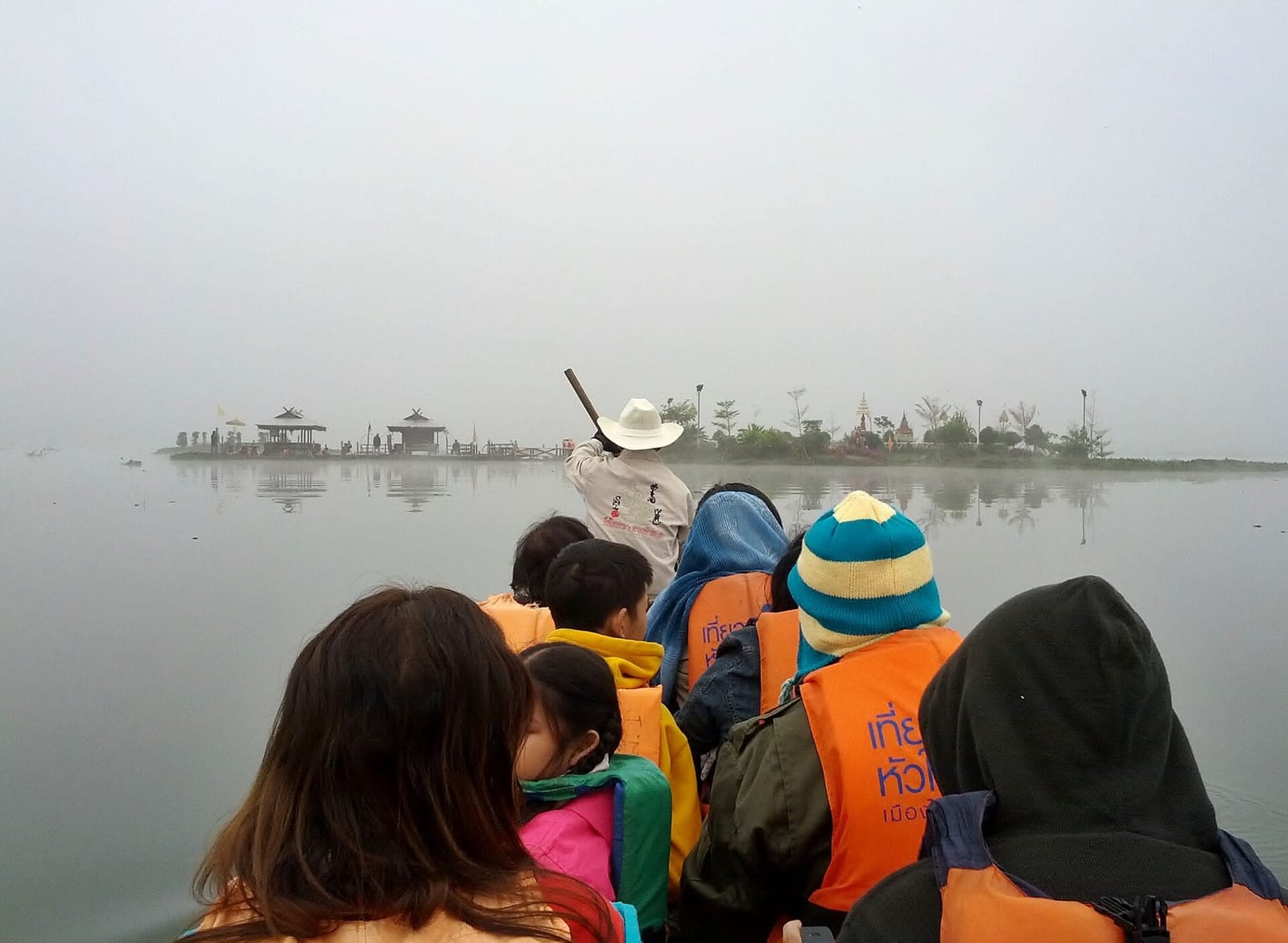
Wat Tilok Aram is the temple in the middle of Kwan Phayao, over 500 years old. It was submerged after a reservoir dam was built, and today only the top of the chedi rises above the water — it's been restored so you can go out and pay your respects. Getting there means taking a boat out into the middle of the lake, an experience not many visitors have done, but it helps to know the timing and the fare before you go.
- The pier — boats leave from the lakeside pier on the Wat Tilok Aram side, near the public park along the lake in town. It's an easy walk from many of the lakefront cafes.
- The fare — a rowboat starts around ฿30 per person (roughly 5 people per boat), or about ฿150 to charter the whole boat. These prices can change, so ask before you get in.
- Timetable — you can usually take the boat out to pay respects during the daytime. The official merit-making boat procession to honour Luang Pho Sila is held on the full-moon Buddhist holy day, roughly 5–7 PM. Check that month's holy day in advance if you want this session.
- Candlelit procession on the water — a Kwan Phayao specialty, held three times a year on Makha Bucha, Visakha Bucha, and Asalha Bucha days. If your trip lines up with a major Buddhist holiday, it's worth planning around.
Morning and evening feel completely different
Take the boat in the morning and you get clear skies and still water — good for photos and for offering alms along the lake. In the evening you get the sunset behind the chedi in the middle of the water, which is stunning, but it's windier and busier. On a windy day the water can get choppy, so anyone prone to seasickness should come prepared.
Heading up Phu Langka in winter — how to prepare
Phu Langka is in Pong district, a fair distance from Phayao town (around 2 hours' drive or more). It's a winter sea-of-fog spot that's hugely popular with northerners — the highlights are Pha Chang Noi cliff and the morning fog that fills the valley. But because it's far out and up on a mountain, you'll need to prepare differently from a trip around town.
- Stay on the mountain at least 1 night — the fog rolls in before dawn, so if you sleep in town and drive up in the morning you won't make it. There are plenty of guesthouses and homestays on Phu Langka, starting around ฿700 a night; fog-view rooms cost more and fill up fast in winter.
- Book ahead — Nov–Jan is peak, and the rooms with good views sell out weeks in advance. If you've got your eye on a clifftop room, book as soon as your dates are set.
- Serious cold-weather clothing — the top of Phu Langka can drop to 10–15°C before dawn, several degrees colder than in town. Bring a thick jacket, a scarf, and light gloves.
- A vehicle ready for the mountain — the final stretch of road is steep and narrow. A sedan can make it but you'll need to drive carefully. Some homestays offer a pick-up service for the last leg, so ask before you book.
- Cash on hand — many shops and homestays on the mountain take cash only, and the nearest ATM is far. Bring enough cash with you.
The sea of fog isn't guaranteed every day
The fog depends on the humidity and temperature that night — some mornings it's thin or doesn't show at all. If you're coming specifically to see it, allowing two nights raises your odds, and wake up before first light to get to the viewpoint, because the fog tends to burn off quickly once the sun is up.
How to get to Phayao
Phayao has no airport of its own. Most people fly into Chiang Rai and continue by road, or take a coach or drive in directly. The figures below are rough prices that vary with the season and promotions.
Fly into Chiang Rai, then drive to Phayao
The fastest option. Fly direct from Bangkok to Chiang Rai's Mae Fah Luang Airport (CEI), about 1 hr 20 min, then rent a car or catch a minivan to Phayao, another 1.5 hours or so. Good if your days are limited and you want a car for getting around.
Coach from Bangkok
The cheapest option if you're not in a rush. Depart from Mo Chit; air-conditioned coaches run Bangkok–Phayao (some routes to Chiang Rai–Chiang Khong pass through Phayao). It's a long overnight ride of roughly 9–11 hours — good if you're watching your budget and can sleep on a bus.
Drive yourself
The most freedom, and good value if there are several of you. It's about 690–720 km from Bangkok to Phayao, taking 8–9 hours with rest stops. The upside is you've got a car to head up Phu Langka and on to Chiang Kham–Phu Sang. Ideal if you're already planning to explore outside town.
You can get around town on foot, but you'll need a car beyond it
Around Kwan Phayao you can get around easily by bike or on foot — the cafes, temples, and viewpoints are all close together. But Phu Langka, Chiang Kham (the Tai Lue village), and Phu Sang are far out and need a car. If you've flown in, renting a car at Chiang Rai airport is the way to go, starting around ฿900–1,200 a day for a small car. Book ahead in winter.
Daily budget — how much to set aside
Phayao is still an inexpensive place to travel — lodging and food are far cheaper than the big tourist cities. These figures are per person per day (not counting the cost of getting to Phayao or car rental) and you can adjust them to your style.
- Budget ฿700–1,200/day — a guesthouse or hostel in town, eating at made-to-order spots and khanom jeen nam ngiao, free temple and lakefront visits, and just a few baht for the temple boat.
- Comfortable ฿1,200–2,200/day — a lakeside hotel or resort, time at a water-view cafe, a fresh freshwater-fish meal, and a few souvenirs. About right for a typical trip.
- Full-on relaxed ฿2,500+/day — including a fog-view homestay on Phu Langka, special meals, and good cafes, with extra for fuel up the mountain and tips.
Want a lakeside stay or a well-placed mountain view? We've picked them out for you.
See 10 Phayao hotels →What to wear and what clothes to pack
A lot of people slip up thinking the north means cold all day. In reality, in winter Phayao the daytime sun can be hot, but before dawn at the lake and at night on Phu Langka it genuinely is cold — a swing of more than ten degrees in a single day. So you'll want to dress in layers you can add and shed.
- One warm jacket — essential if you're staying on Phu Langka, where it's bitterly cold before dawn. If you're only in town, a thick long-sleeve top will do.
- Short-sleeve or light tops — the daytime sun is strong and these are more comfortable, working as a base layer once you take the jacket off.
- Sneakers / comfortable walking shoes — for walking around temples, the lakefront, and the uneven ground at the mountain viewpoints.
- Hat, sunglasses, sunscreen — the sun by the water and up on the mountain is stronger than you'd think, especially shooting photos outdoors for a while.
- Scarf / light gloves — if you're coming Nov–Jan and plan to wait for the dawn fog on Phu Langka, these genuinely help.
- A dust mask — in case you come toward the end of the cool season when the smoke starts.
Phayao souvenirs — what to buy and where
Phayao souvenirs are strong on local food and regional handicrafts — you can bring home both edibles and goods. The easiest place to shop is the OTOP centre across from Wat Sri Khom Kham, which gathers a lot of souvenirs in one spot.
- Kwan Phayao fermented fish (pla som) — the most famous souvenir, fermented from freshwater fish in the lake. Well-known makers like the long-established boneless Mae Thong Pon have been around for years. Fry, grill, or toss it into a salad. Buy the vacuum-packed version for an easy trip home.
- Tai Lue woven cloth — the signature patterns of the Tai Lue people of Chiang Kham, sold around Wat Phra That Sop Waen and the community markets. Beautiful handwoven work that's genuinely usable.
- Naem and sai ua — popular northern foods, found at the morning markets and souvenir shops in town. Eat them along the way or bring them home for the family.
- Old-style Chiang Kham kalamae — a chewy, sweet, fragrant local sweet, the classic souvenir of the Chiang Kham side.
- Water-hyacinth basketry — bags, baskets, and home decor woven from the lake's water hyacinth. It's community work that gives you something useful and supports locals.
Fresh items need a plan to get home
Fermented fish, naem, and sai ua are fresh products. If you're driving home a long way, buy them on your last day and ask for the vacuum-packed version; bringing a cooler bag along puts your mind at ease. Woven cloth and basketry can be bought any day — no need to worry about them spoiling.
Ready to go? Open the full Phayao travel plan next.
Open the Phayao travel guide →