🔄 Updated 21 Jun 2026
Phetchabun splits neatly into three areas. To the northwest is the Khao Kho–Phu Thap Boek zone, all misty mountains and pretty temples. There's the Phetchabun town zone, with the city's landmark temples and a few cafes. And to the south is the Si Thep zone, home to the World Heritage ancient city. The three sit in different directions and are a fair drive apart, so if you've got 2–3 days you can cover them all without rushing.
Nature — the Khao Kho & Phu Thap Boek sea of fog
This is the main reason people drive up to Phetchabun. It stays cool all year. The rainy season (June–October) is the green season, when fog rolls in often and the mountains are at their greenest, while late in the year (November–February) it turns properly cold with clear skies, great for photos. The sea of fog looks best in the early morning, around 5–6 a.m., so you'll need to set an alarm.
Phu Thap Boek
The highest point in Phetchabun at around 1,768 metres, and the most popular spot for watching the sea of fog and sunrise, with the Hmong people's terraced cabbage fields as a backdrop. The road up is fairly steep, so if you're not used to it, hiring a local driver to take you up is a good idea.
Khao Kho Wind Turbine Viewpoint
A field of power-generating wind turbines along the ridge, with flower fields that change colour with the seasons. You park outside and take a tram up. It's the signature photo landmark of Khao Kho.
Khao Kho (cafes & viewpoints)
The whole Khao Kho district is dotted with clifftop resorts and cafes. Many let you stop for free fog photos, or buy a single coffee and sit a while. Great for a morning drive collecting views.
Si Dit Waterfall
A large waterfall in the Khao Kho area with water year-round and a pool you can swim in. A good afternoon stop to cool off, and a short walk in from the parking lot.
Tip for catching the fog
Fog appears most often after rain the night before. Check the forecast — if there's a drizzle overnight, your odds of a sea of fog the next morning are very high. Leave your hotel before dawn to grab a spot at the viewpoint.
Want more out of Phetchabun? Book tours & activities
Booking online ahead on Klook or GetYourGuide is usually cheaper than the gate and skips the queue. Pick only the experiences you actually want — prices and availability are shown live on each site.
Culture — hilltop temples and a World Heritage ancient city
Phetchabun has cultural sites known across the country — a temple so striking it has become the face of Khao Kho, and an ancient city only recently inscribed as a World Heritage Site. Don't skip these two if it's your first time in Phetchabun.
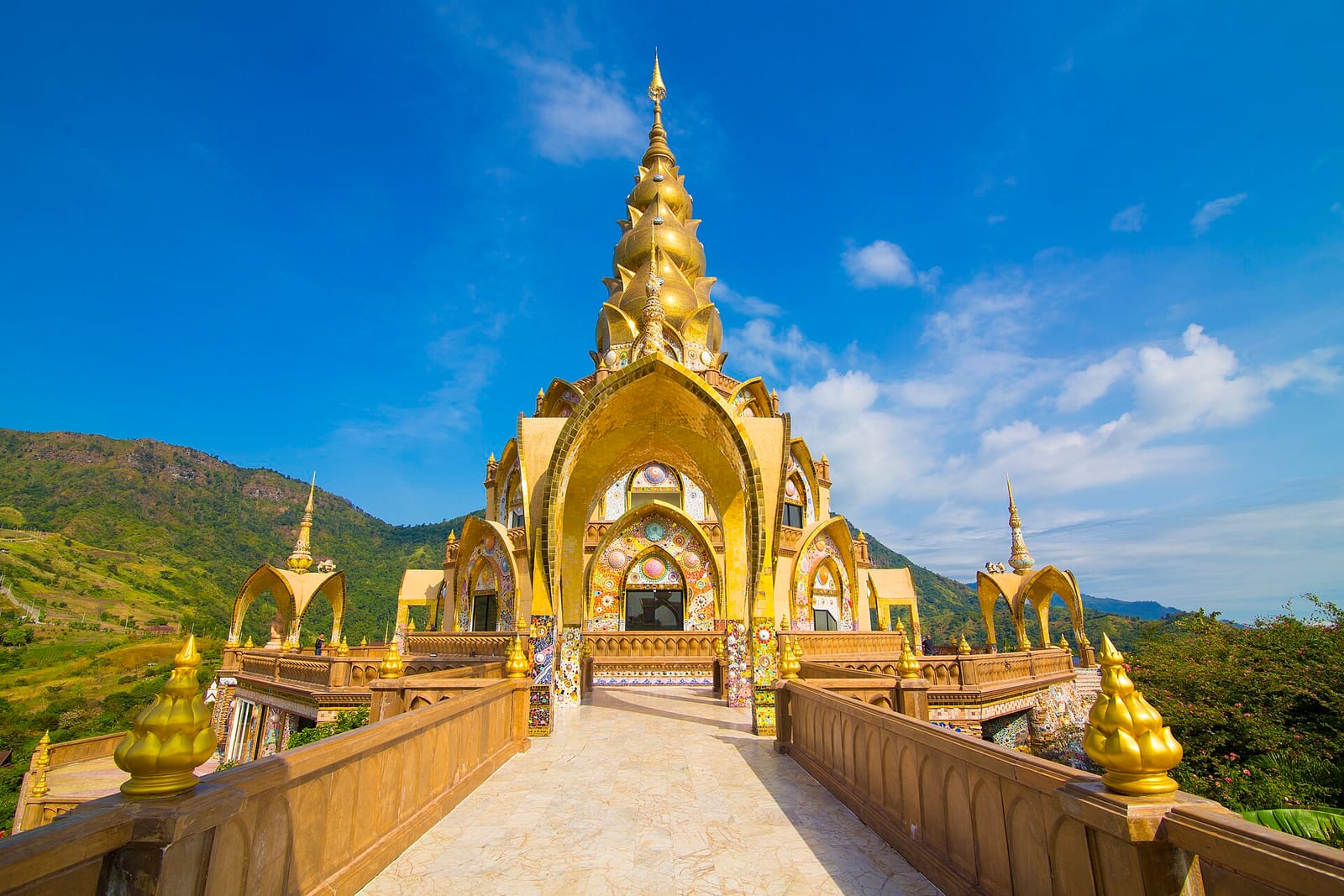
Wat Pha Sorn Kaew
A temple on a Khao Kho hillside that has become the image of the province. Its pagoda is covered in colourful tiles and broken ceramics, and there's an ordination hall with five white seated Buddhas stacked behind one another. The temple looks out over mountains, and on misty rainy mornings it's stunning. Free entry, dress modestly.
Si Thep Ancient City (World Heritage)
A historical park over 2,000 years old, inscribed as a UNESCO Cultural World Heritage Site in 2023. It includes Khao Klang Nok, Prang Si Thep, and the ancient city moat, with a tram to tour the grounds. Open 08:00–16:30. 20 THB for Thais, 100 THB for foreigners, 50 THB per car.
Phetcha Bura Buddha Park
Home to the large Phra Phuttha Maha Thammaracha statue in town, modelled on the city's revered Buddha at Wat Trai Phum and held in deep respect by locals. Free entry, and not far from the town centre.
Phetchabun Intharachai Archaeological Hall
Converted from the old provincial hall, it tells the history, culture, and archaeology of Phetchabun. A good stop before or after visiting Si Thep to understand the backstory.
Before you go to Si Thep
The Si Thep ancient city is hot and exposed, as it sits on open flat ground. Go in the morning or late afternoon, bring a hat and water, and use the park tram to cut down on walking.
Phu Hin Rong Kla — nature meets history
Phu Hin Rong Kla National Park sits where three provinces meet — Phetchabun, Phitsanulok, and Loei. It combines unusual natural rock formations with traces of past armed conflict in one place. It stays cool almost all year. Open 06:00–18:00.
- Lan Hin Pum — a natural rock field where stones poke up in knobs around 15–25 cm tall, lined up in rows, shaped by wind and rain erosion. A photo spot most people haven't covered yet.
- Pha Chu Thong — a clifftop viewpoint with the Thai flag planted on it, about 500 metres on from Lan Hin Pum, and a lovely place to watch the sunset.
- Lan Hin Taek — a rock floor cracked into deep natural grooves, which you can explore along the marked path.
- Rom Klao & Man Daeng Waterfalls — waterfalls within the park that look best in the rainy season.
A 3-day, 2-night Phetchabun trip
If it's your first time in Phetchabun and you want to cover all three zones, this route works best. Start at Khao Kho and loop down to Si Thep on the last day before heading home.
Khao Kho & Wat Pha Sorn Kaew
Phu Thap Boek & Phu Hin Rong Kla
Town & Si Thep World Heritage
When is the best time to visit Phetchabun?
- June–October (green season) — the mountains are at their greenest, fog appears often, and there's some rain but the sea of fog is gorgeous. Some stretches of road get slippery, so drive carefully.
- November–February (cool season) — properly cold with clear skies, great for photos. This is high season, so it's busy, hotels fill up fast, and you should book ahead.
- March–May (hot season) — still pleasantly cool up on the mountains, but Si Thep and the lowlands get hot. Better for the mountain nature than the town.
Plan a full Phetchabun trip — where to stay, eat, and explore
See the Phetchabun travel guide →